

Audience Activation: What It Is and How It Works
Customer data is only as valuable as your ability to put it to work. Yet 55% of marketers say their first-party data remains completely siloed or only partially connected across systems, making it harder to turn what you know about customers into meaningful engagement.
Audience activation helps close that gap by transforming customer and prospect data into addressable groups you can reach across marketing channels. With the right strategy, you can make better use of your customer insights, improve campaign performance, and get more value from your marketing investments.
In this guide, we’ll explore how audience activation works, the different ways you can use it, common challenges, and best practices for building an effective strategy.
Key takeaways
- Audience activation turns customer data into defined audience segments that can be reached across marketing and media channels.
- Identity resolution helps you connect fragmented customer signals so that you can build more accurate audiences and reach them across devices and platforms.
- Effective audience activation combines segmentation, governance, activation, measurement, and continuous optimization.
- Strong governance helps ensure audiences are activated according to applicable permissions, policies, and business rules.
- Connecting activation and measurement creates a feedback loop that helps you continually improve audience strategy and media performance.
What is audience activation?
Audience activation is the process of transforming customer and prospect data into actionable audience segments and making those audiences available across your advertising, marketing, and media destinations.
It focuses specifically on who you want to reach, where you can reach them, and how you can engage them effectively. That makes audience activation narrower than data activation, which can encompass making data actionable across a much broader range of business systems and workflows.
How does audience activation work?
Audience activation starts with connected, reliable customer data. Creating accurate, addressable audiences requires several steps that carry your data through activation and inform future campaign decisions.
Here’s how the audience activation process works:
- Gather data
- Connect identity and unify data
- Build segments
- Govern and activate audiences
- Measure performance
- Continuously optimize
1. Gather data
Start with the customer signals available across your organization, including customer relationship management (CRM) records, purchase history, website interactions, app activity, and other first-party sources. Depending on your strategy, you can also incorporate second- and third-party data to enrich your understanding of an audience.
2. Connect identity and unify data
The same person may appear differently across your CRM, website, mobile app, CTV environment, and media platforms. Identity resolution connects those fragmented identifiers so you can develop a more complete view of individuals or households and reduce duplication across audience records.
3. Build segments
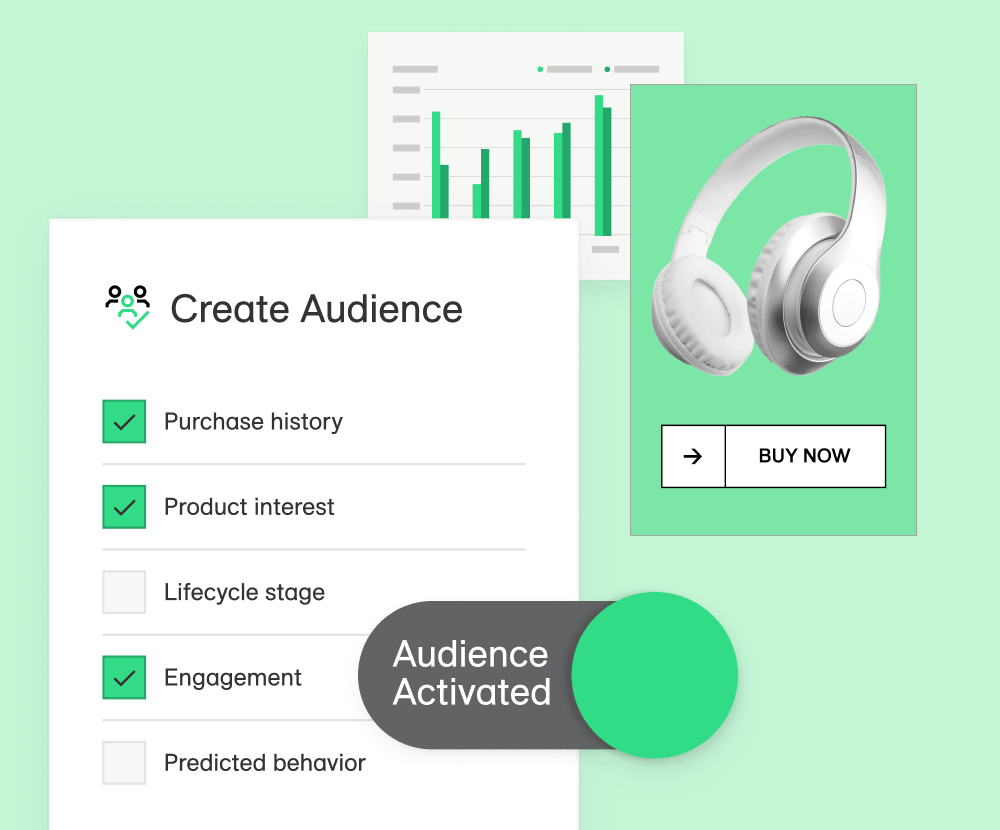
Next, use customer data segmentation to group people according to characteristics or behaviors relevant to your campaign goals. You might create audiences based on purchase history, product interest, lifecycle stage, engagement, predicted behavior, or combinations of several signals.
4. Govern and activate audiences
Before distributing an audience, apply the appropriate permissions, exclusions, suppression rules, and usage controls. Approved segments can then be activated to the destinations that support your strategy, such as social platforms, publishers, programmatic media, or CTV.
5. Measure performance
Track whether activated audiences are delivering the outcomes you intended. Depending on the campaign, useful indicators might include audience reach, match rates, conversions, engagement, customer acquisition costs, or return on ad spend.
6. Continuously optimize
Audience activation should respond to new customer signals and campaign results. Refresh segments, adjust inclusion and suppression criteria, refine targeting, and use performance insights to inform the next activation.
What are the types of audience activation?
Audience activation can take different forms depending on the data, channels, and goals behind your strategy. Understanding these approaches can help you determine how to put your audiences to work.
First-party activation
First-party activation puts the customer data you already own to work across marketing channels. For example, you can activate known customer audiences for retention, cross-sell, re-engagement, or suppression campaigns.
Programmatic and paid media activation
Programmatic and paid media activation helps you use audience segments to reach the right people across digital advertising channels. Extending those audiences across media destinations allows you to carry your targeting strategy from one channel to another.
Lookalike and modeled activation
Modeled and lookalike audiences help you expand beyond existing customers by identifying people who share characteristics with high-value segments. These models can support acquisition strategies when you want greater reach without sacrificing audience relevance.
Rules-based and journey activation
Audiences can also be created around defined customer behaviors or lifecycle events. For example, you might activate a segment of recent purchasers differently from cart abandoners, lapsed customers, or highly engaged loyalty members.
AI-powered and agentic audience activation
AI-powered audience targeting can help you uncover new opportunities, create segments, and adjust campaigns based on changing signals. As you collaborate with AI agents on more campaign tasks, connected identity and strong governance give you greater control over how audience data is used.
Data collaboration and partner activation
Data collaboration allows you to combine your customer insights with data from trusted partners to build richer audiences. Working with retailers, publishers, or other partners can deepen your customer insights and improve targeting while maintaining appropriate controls over data use.
CTV audience activation
CTV activation helps you reach your audience across streaming and connected television environments. Connecting authenticated customer signals across CTV and other channels gives you a clearer view of who you’re reaching and how those campaigns perform.
What are the benefits of audience activation?
Audience activation creates a stronger connection between your customer data and marketing execution. When your audiences are accurate and addressable, that connection can translate into several benefits across your campaigns.
Improve targeting precision
Better connected customer signals allow you to define audiences around meaningful behaviors and attributes rather than broad assumptions. That can help you focus campaigns on the people most relevant to your objectives.
Increase campaign efficiency
Connected activation can simplify how audiences move from your data environment to marketing destinations. That reduces manual processes and makes it easier to apply a consistent audience strategy across campaigns.
Deliver personalized customer experiences
Audience activation lets you tailor experiences according to what you already know about customer interests, behaviors, or relationships with your brand. More relevant segmentation can help ensure different audiences receive messaging suited to their needs.
Reduce wasted media spend
Accurate targeting and suppression can help prevent you from spending money reaching the wrong people. For example, you can exclude existing customers from an acquisition campaign or prevent the same individual from being treated as multiple audience members.
Improve measurement and attribution
When audience identity remains connected from activation through audience measurement, you can better understand how particular segments respond. Those insights can inform future targeting, channel selection, and budget allocation.
What are the common audience activation challenges?
Building addressable audiences can be challenging when your customer data, identities, and technology are disconnected. Recognizing the barriers that can get in the way can help you create more accurate audiences and improve activation.
Siloed customer data across systems
Your customer information may be scattered across CRMs, data warehouses, ecommerce platforms, apps, and other systems. When those sources remain siloed, you risk working with an incomplete picture of your customers when defining who belongs in each audience.
Identity fragmentation across channels and devices
A single customer can generate different identifiers as they interact with your brand across devices and channels. If you can’t connect those identifiers, you may count the same person multiple times or struggle to recognize them as they move between environments.
Inconsistent audience data quality
Outdated, incomplete, or duplicate records can undermine the audiences you build. Maintaining reliable data helps you avoid inaccurate segmentation, poor match rates, and campaigns based on information that no longer reflects your customers.
Limited interoperability across marketing platforms
Different platforms often rely on their own identifiers, integrations, and technical requirements. Managing those differences through individual point-to-point connections can add complexity and make it harder to move your audiences where you need them.
Maintaining governance across AI-powered workflows
Greater automation can introduce new questions about how your audience data is accessed and used. As you incorporate AI into activation workflows, you need clear controls around which data those systems can use, what they can do with it, and where it can be activated.
Why governance matters
Audience activation governance gives you control over who is included in your campaigns and how customer data is used across channels.
Effective governance must include:
- Honoring customer choices and permissions
- Maintaining suppression and exclusion lists
- Applying destination-specific restrictions
- Establishing clear rules for how audience data can be used
These controls are particularly important when the same customer qualifies for multiple segments. Connecting permissions and business rules with audience identity allows you to account for different communication preferences and eligibility requirements throughout your campaigns.
Clear governance also makes it easier to scale your audience strategy. Establishing repeatable rules allows you to maintain appropriate controls as activation expands across more channels, platforms, and partners.
Best practices for successful audience activation
A strong audience activation strategy keeps your data, audiences, and campaign goals aligned. Consider the following practices to help you build accurate segments and get more value from every activation.
Prioritize first-party data
Your direct customer relationships provide a strong foundation for building relevant audiences. Start by making your first-party signals usable across channels, then determine where additional partner or third-party data can strengthen particular segments.
Connect activation with measurement
Build measurement into your audience activation strategy from the start. Connecting exposure and outcome signals helps you identify which audiences perform well and use those insights to refine future segmentation and targeting.
Keep audience segments up to date
Customer behavior changes constantly, and yesterday’s high-intent prospect may be today’s customer. Refresh segments frequently enough to reflect new signals, remove outdated records, and update eligibility and suppression rules.
How to choose an audience activation approach
Activation solutions generally fall into a few categories, connecting directly to individual ad platforms, activating from your warehouse or CDP, or working through a data collaboration platform. Each makes different tradeoffs around how identity is handled, how many destinations you can reach, how integrations are managed and updated, and how data is governed along the way.
The right fit depends on your channel mix, data maturity, IT expertise, and risk profile.
Ready to evaluate platforms?
The Data Activation Buyer's Guide, from former IDC analyst, Lynne Schneider, is built for teams like yours actively comparing vendors. In the guide, she covers the three architectural approaches and their tradeoffs, a tiered requirements framework, and the questions to ask before you sign.
LiveRamp brings identity, segmentation, connectivity, governance, and measurement together to help you build and activate high-value audiences across media destinations. RampID, LiveRamp’s tokenized, person-based identifier, connects fragmented customer signals across platforms to support addressable activation and measurement. Brands have used this identity foundation to expand their audiences and improve campaign performance. For example, Whirlpool achieved 5x greater reach to addressable audiences while removing more than 200,000 duplicate records. Similarly, Indeed grew its retargeting audience by 54% and increased response rates by 20%, while Sky Zone doubled its audience reach and improved ROAS by more than 100%.
Audience activation FAQs
How is audience activation different from data activation?
Data activation is the broader process of making organizational data actionable in business systems and workflows. Audience activation applies that concept specifically to customer and prospect segments, making defined audiences addressable across marketing and media channels.
Because most platforms handle both, evaluating an audience activation solution usually means evaluating its broader data activation architecture.
What is an audience activation platform?
An audience activation platform helps marketers turn customer data into segments and distribute those audiences to marketing destinations. Depending on the platform, it may also support capabilities such as identity resolution, data enrichment, audience governance, connectivity, and measurement.
How is audience activation different from audience segmentation?
Audience segmentation determines who belongs in a particular group based on selected attributes or behaviors. Audience activation takes the next step by making that group available for targeting, suppression, personalization, or measurement across relevant channels.
Why is identity resolution important for audience activation?
Identity resolution connects customer signals that might otherwise appear to represent different people. That gives you a more accurate foundation for segmentation and can improve your ability to reach the intended audience across platforms and devices.
What data is used for audience activation?
Audience activation can use first-party data such as CRM information, purchase history, website activity, app interactions, and loyalty data. Marketers can also incorporate second- or third-party data when it adds relevant information or expands audience opportunities.
How do you measure audience activation success?
Start with metrics tied to the objective of the audience. Reach and match rates can show whether you successfully made the audience addressable, while engagement, conversions, customer acquisition costs, incremental reach, and ROAS can help you evaluate business performance.