

The Four Trust Boundaries of Data Collaboration
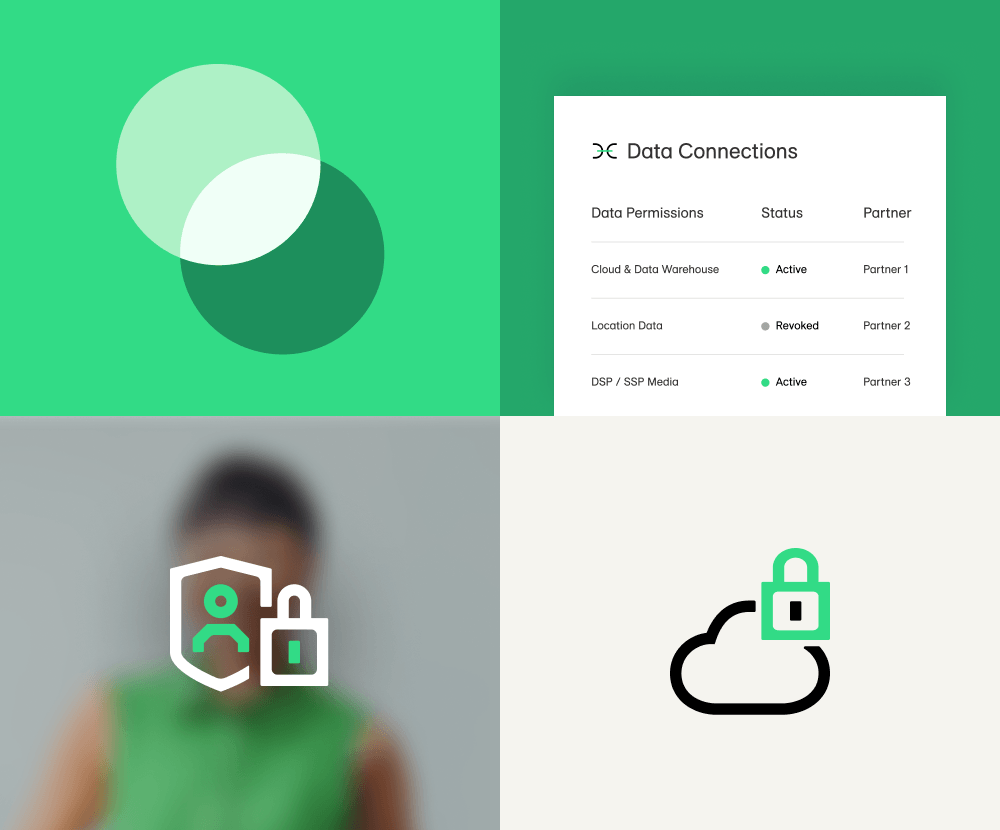
At its core, data collaboration is about making trust possible at scale. The technology is critical because it gives every participant assurance, control, and clarity over how data is used.
That matters because collaboration only works when each party understands the rules, trusts that those rules will hold, and can see how data is being protected throughout the process.
There are four distinct trust boundaries at play in the use cases our industry runs every day. Each boundary has a specific mechanism that protects it, and together, they create an environment that enables us to partner safely and securely.
Boundary 1: Between a company and its customers
The first boundary is the one most people think of when they hear the word "privacy": the trust between a company and the consumers it serves.
When you shop at a retailer, that retailer holds data about you. That relationship carries both a legal obligation and a moral one – to handle your data exactly as the retailer said it would, and to provide notice and choice about how it's used. This obligation belongs to the retailer. It's theirs to honor with their customers, and no platform can take it on for them.
What a platform like ours can do is make it possible for that retailer to honor the promise even while collaborating with other companies – to extend the relationship without breaking the commitment.
Boundary 2: Between collaborating companies
The second boundary is the trust between businesses working together.
When a brand sells its products at a retailer, both companies have data and stand to gain if they can put that data to work together – better assortment, smarter promotions, less wasted spend, and ultimately better consumer experiences. But because the retailer's data belongs to the retailer, and the brand's data belongs to the brand, neither is willing to hand the other unrestricted use and insights.
Solving for these trust boundaries with the protections of clean rooms is what was a true unlock for data collaboration within our industry. The retailer should be able to decide if the brand can build segments using the retailer's data, whether the brand can activate those segments or only analyze them, which channels they're permitted to activate to, and under what pricing terms.
Those are controls that the retailer sets and the platform enforces. The retailer defines what's allowed and the system makes anything outside that boundary technically impossible, not merely prohibited. This is what a purpose-built collaboration platform actually is – the machinery that lets one company set rules over its data and have those rules hold even when the data is being used alongside someone else's.
For these first two boundaries, the protection is the platform itself. The rules are expressed as configuration, and the configuration is what runs.
Boundaries 3 and 4: Between everyone and the platform, and between everyone and the cloud
The third boundary is between the collaborating companies and LiveRamp.
If a retailer and a brand are running their collaboration on our platform, they're trusting us not to do anything with their data beyond what they've approved and to show them exactly how it was used.
The fourth boundary is the cloud infrastructure all of this runs on.
The retailer, the brand, and LiveRamp all share an interest in knowing that the cloud provider itself can't peek inside a workload and use what's there in any unapproved way.
Across both of these boundaries, three safeguards of protection prevent parties from looking where they shouldn't.
The first safeguard is contractual. Our agreements state plainly what we can and cannot do with customer data, and "cannot" is the operative word – the permitted uses are enumerated, and everything else is off the table. The same holds down the stack to the cloud providers we run on. As a company that champions responsible data collaboration, we undergo third-party audits and hold certifications that validate our practices and operations.
The second and third safeguards are technical, and they address both boundaries at once. In these arrangements, a company can pseudonymize its data in its own environment, before it is ever connected to our platform. They can encrypt it. They can use our trusted execution environments, which can cryptographically attest – prove, before any decryption key is released – that the data will only ever be processed inside confidential compute environments, under the agreed-upon rules. Only then are keys released into that protected environment.
The practical result is that the same mechanism closes both boundary 3 and boundary 4 in a single stroke: In these configurations, LiveRamp never holds the underlying data, and neither does the cloud. There is nothing for LiveRamp or the cloud provider to misuse, because neither party ever has access to the underlying data.
How trust is made durable
The first two boundaries are governed by platform controls. A company defines what is allowed, and those rules are enforced in the system. It is this clear authority over how a company’s own data is used that makes collaboration possible.
The third and fourth boundaries are protected through multiple layers working together. Contracts define permitted use. Audits and certifications provide independent verification. And for customers who require additional assurance, technical protections such as pseudonymization, encryption, and confidential computing ensure data is processed only in approved ways and environments.
What matters is not any single safeguard on its own, but how they reinforce one another. Policy sets the rules. Operational controls govern access. Independent verification tests that those controls are working. Technical protections add another layer of assurance for sensitive use cases.
That is what it means to build trust into data collaboration. The goal is not to ask participants to rely on promises alone, but to create a system in which responsibilities are clear, controls are enforceable, and protections are designed to hold over time.
When those conditions are in place, trust becomes more than a statement of intent. It becomes part of how collaboration actually works.