
What Is First-Party Data? Examples, Benefits & Uses

First-party data is information businesses collect directly from customers through interactions with their website, email channels, and other owned touchpoints. This data provides valuable insights into customer behaviors, preferences, and interests, helping companies understand their audiences in greater detail.
Below, we’ll uncover everything you need to know about the most valuable type of customer data there is—first-party data—and, more importantly, how it can be used as a powerful tool to personalize customer experiences, unlock new revenue streams, and stand out among the competition.
Key takeaways
- First-party data is information businesses collect directly from customers through interactions with their websites, mobile apps, purchases, and other owned channels.
- Common examples of first-party data include website activity, purchase history, customer account information, and customer feedback.
- First-party data helps businesses better understand customer behaviors and preferences, deliver personalized experiences, and improve audience targeting.
- By connecting and activating first-party data across different systems, businesses can create more complete customer profiles, improve marketing performance, and support more effective advertising strategies.
{{first-party-data-ai-era}}
What is first-party data?
You’ve probably seen the term “first-party data” before, but if you’re new to marketing or the advertising industry (or if you just need a refresher), you may be unfamiliar with what “first-party” means exactly.
First-party data is information you collect from customers with their explicit permission. You can use this data from interactions with their websites, apps, and other channels to develop strategies, experiences, and campaigns catering to their ideal customer’s wants and needs.
As first-party data comes directly from customer interactions, it can provide valuable insights into customer preferences. It is considered one of the most reliable forms of data because it comes from users who have already engaged with your company.
However, first-party data is less useful if you can’t tie the data in all your siloed systems – such as your marketing platforms, customer relationship management tools (CRMs), point of sale (POS) systems, enterprise resource planning tools (ERPs), contact center databases, etc. – back to single customer records.
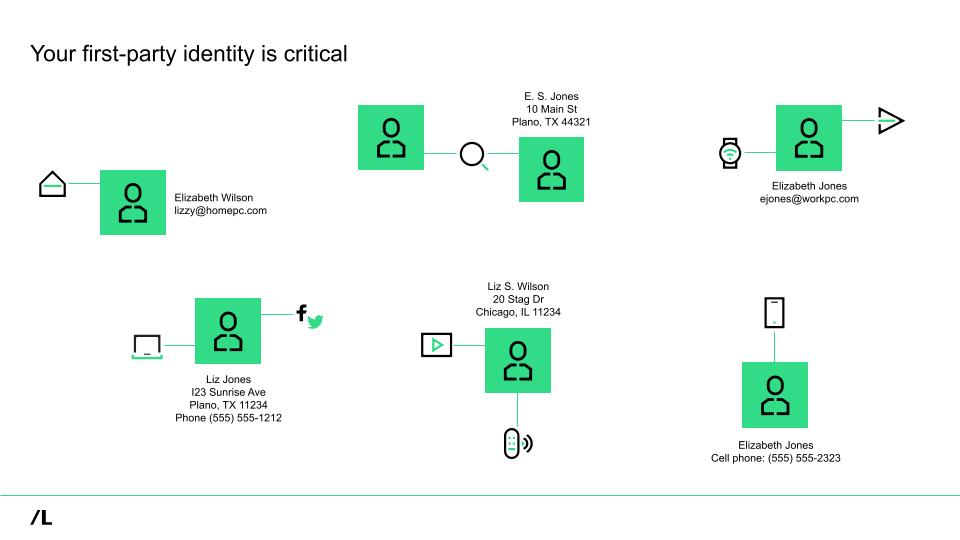
For example, consider the customer depicted below who has moved, uses multiple email addresses, and changed her name. All of this first-party data about Elizabeth/Liz may be somewhere in your system, but without the ability to bring it all together safely, securely, and accurately, you may be inadvertently offering her a disjointed customer experience.
By correctly connecting first-party data across customer touchpoints, businesses can develop a more unified understanding of their customers.
Why is first-party data important?
While there are millions of different ways to go about marketing, we can all agree on one thing—it is always cheaper to retain customers than it is to acquire new customers. First-party data acts as the baseline for getting to know your customers because it comes from genuine engagement with your company across a wide variety of consumer touchpoints. When you connect the constellation of touchpoints per customer and multiply that by millions, you can easily see how powerful first-party data can become for your business as a whole.
What are examples of first-party data?
Businesses collect first-party data through direct customer interactions across websites, mobile apps, email campaigns, purchases, and other touchpoints. Each of these data types can provide valuable insights into customer behaviors and preferences. Common examples and collection methods include:
Email marketing
Nurture campaigns and email subscription newsletters provide a direct way to engage customers and collect first-party data. Through email campaigns, businesses can gather data such as open rates, bounce rates, and click-through rates to inform campaigns.
Websites
Your website is often the most widely used method to collect first-party data. Where it makes sense, you can request information from folks who visit your site (like names and email addresses) on your checkout page and gain key insights into customer transactions and behavior, such as how long they spend on a particular page.
Mobile apps
Mobile app downloads can help discern how interested a customer is in your brand. Depending on the app's functionality, businesses can gather information about account activity, feature usage, in-app purchases, and customer preferences.
Purchase history
Purchase history data can include previous purchases, transaction dates, and purchase frequency. Businesses can use purchase history to identify high-value customers, explore purchasing patterns, and recommend relevant products. This data is also very useful for measurement and analysis: Brands can see what’s selling, what’s not, and where.
CRM and customer account data
Customer relationship management (CRM) systems and customer accounts store first-party data collected through direct interactions with customers. This information can include names, email addresses, contact preferences, account details, and loyalty program activity.
Surveys and customer feedback
Surveys, feedback forms, and customer reviews allow businesses to gather information directly from their audiences about their needs, preferences, and experiences. This data can include customer satisfaction ratings, product feedback, and responses to questions about purchasing preferences.
How can you start trusted first-party data relationships?
For marketers, there is nothing more meaningful than providing the personalized experiences consumers expect and welcome. However, companies can be so eager to deliver those unique experiences that they sometimes forget the goal is not just to simply extract information from their customers, but to do so in the context of an established value exchange.
Simply put, people need to know what’s in it for them. If you’ve done it right, a downstream result is robust first-party data and a deeper understanding of a customer—which can build your competitive advantage because this information is exclusive to you.
How to establish a value exchange with customers
The idea of “value exchanges over time” is not unlike the marketing funnel. Say you are a retailer. A consumer might click on one of your ads. They might visit your website. They like what they see and decide to follow you on social media. They might even like, comment, or retweet your content. If you have brick-and-mortar locations, they might stop in, peruse the aisles, and ask your salespeople questions. These would all be considered upper-funnel engagements that mark the beginning of your relationship. Every touch point matters. Marketing is not the only team that builds that relationship or trust.
If you want to deepen a first-party data relationship, you need to continue delivering valuable experiences across all interactions. Provide opportunities to move customers down the relationship funnel, such as allowing them to create wish lists for favorite items they enjoy. Perhaps it’s a newsletter, alerts when a favorite writer or topic is posted, or a text message when a coveted item is back in stock. Consider this mid-funnel—the point at which you can obtain an increased level of authentication or “hand-raising.” Continue to nurture the relationship by always creating value.
This is the question to ask: “How can I help this person with what they need?” It is not “How can I get this person to convert?”
Over time, the consumer will move into the bottom funnel and willingly provide a greater level of first-party data. At that point, they’re converting into a longer-term customer. For some companies, that might be the end game. For the leaders, it’s just the beginning in what you hope is an enduring, loyal relationship.
Prioritize privacy and transparency
Trust is the foundation of all relationships. To build trust with customers, all companies should be committed to ensuring personal data use is ethical and appropriate—not only within the confines of the law, but also with foresight that goes beyond compliance with legal or regulatory guidelines.
In fact, regulators acted on behalf of consumers and the GDPR in the EU was one of the first significant privacy regulations to take effect, which forced companies to change how they were handling consumer data. Since then, more regulatory bodies have followed suit—notable entrants include California’s CCPA and CPRA, Brazil’s LGPD, Japan’s amendments to APPI, and more. Additionally, tech leaders have taken a stand to show solidarity with consumers in order to instill loyalty and trust in their brand and experiences.
What is the difference between first-, second-, third-, and zero-party data?
While first-party data is collected directly from a business's customers and audiences, other types of customer data differ in how they're obtained and shared. Understanding the differences between first-party, second-party, third-party, and zero-party data can help businesses determine how to use each type effectively.
Second-party data
This is data that consumers provide to another company that—with the consumer’s notification and consent—you may access through a partnership agreement. Put another way, second-party data is someone else’s first-party data. For instance, you could enter into a collaborative data partnership with an airline to share loyalty card data to improve your targeting.
Third-party data
This is data that was collected on other sites, platforms, or offline by—you guessed it—a third party. Third-party data is used extensively by companies to better understand their audiences and to better target prospective customers. It’s great for demographic, contextual, and behavioral targeting if your core audience for a particular message or product is 24- to 36-year-old males who love wine but not cheese, for example.
{{maximizing-third-party-data-strategy}}
Zero-party data
Forrester Research created this term to describe data that a customer proactively or voluntarily shares with a brand through social media, interactive quizzes, messages with customers through chatbots, etc. Zero-party data is valuable because it doesn’t require analysis and offers insights directly from customers.
{{first-party-data-ai-era}}
What are the benefits of first-party data?
First-party data provides businesses with profound insights into their customers. As consumer privacy expectations evolve and marketers look for ways to reduce their reliance on third-party data, first-party data is an important resource for building stronger customer relationships and delivering relevant experiences. Some of the key benefits of first-party data include:
Improved customer insights
First-party data helps businesses better understand their customers by providing insights into purchasing behaviors, interests, and engagement patterns. When customer information is connected across channels, marketers can develop a more complete view of their audiences, identify important trends, and better understand customer needs.
More personalized customer experiences
Businesses can use first-party data to tailor marketing messages, product recommendations, and customer interactions based on individual preferences and behaviors. By delivering more relevant experiences across channels, brands can strengthen their customer engagement and build stronger relationships.
Stronger audience targeting
First-party data allows marketers to create audience segments based on direct customer interactions and behaviors. This can help businesses reach more relevant audiences, improve their advertising strategies, and reduce wasted ad spend by focusing their efforts on interested customers.
Greater control over customer data
First-party data is collected directly from customers and audiences, which means companies typically have greater control over how the information is obtained, stored, and used. This visibility can help companies establish stronger data governance practices and support compliance with regulations while reducing reliance on third-party data providers.
How to activate first-party data
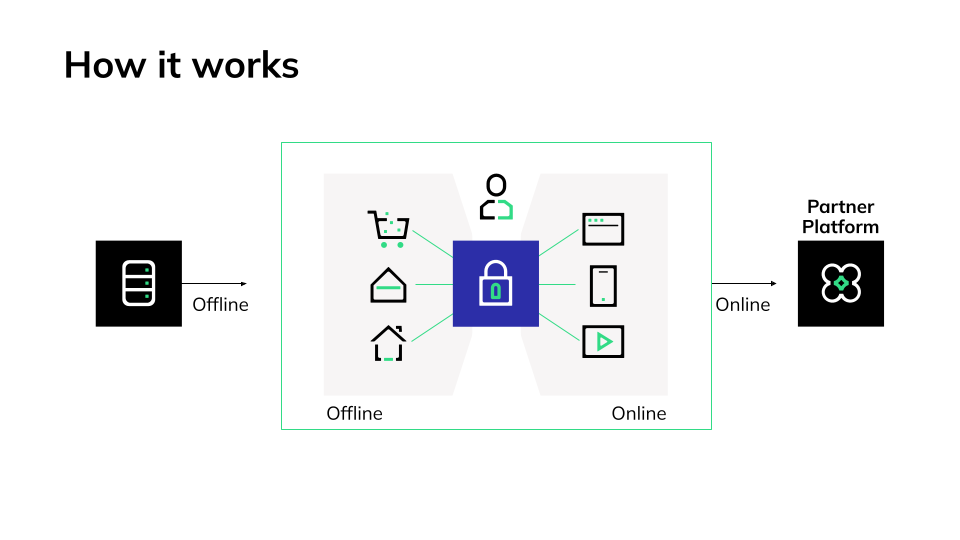
Activating first-party data allows you to use customer information across marketing channels to deliver more relevant experiences. An effective first-party data strategy requires company alignment, a clear understanding of existing data, and the right technology to connect customer information. This process includes 3 broad steps:
Align on your identity strategy
The first step is company buy-in. Your organization’s leadership should be aligned and fully support a digital transformation journey inclusive of connecting your disparate first-party data.
Conduct a first-party data audit
Next, conduct a data audit. Determine what data you already have and, more importantly, why you are collecting it. Earning useful data is a continuous process that has the ongoing goal of discovering what the customer wants from you.
Connect and organize customer data
Finally, invest in an identity solution to help you clean, resolve, enrich, and organize your first-party data so you can activate it across the customer journey.
This enables you to unify and consolidate your customer view, an ongoing challenge all industries face that is well worth continued investment for many use cases. Leading identity solutions even do the hard work of integration for you to ensure your media strategy matches consumers’ ever-changing preferences, so you can respect privacy guidelines and stay ahead of competitors.
How can businesses use first-party data for marketing?
Businesses can use first-party data to understand their audiences, improve marketing performance, and deliver more relevant customer experiences. Once customer information is activated across different channels, companies can use it to support a variety of marketing and customer engagement strategies.
Ad targeting
Targeting is one of the most powerful use cases for first-party data activation. It enables you to precisely engage your customers with the right message at the right time across their journey. You can accomplish things like activating offline customer records to target them via digital channels, or reach the same customer across multiple devices and channels at the right frequency with personalized ad messaging and creative.
Audience suppression
Through suppression, you are able to remove specific audience-based segments from online and offline marketing campaigns. Suppression enables tactics like removing customers who made a recent in-store purchase from online or offline campaigns or blocking high-risk prospects from viewing an insurance display advertising campaign.
Lookalike modeling
New modeling techniques like predictive modeling are being adopted to better analyze customers. Lookalike models help you reach new customers that look and behave like your high-value customers, increasing prospects in the pipeline and growing your business.
Retail media networks
First-party data can help retailers develop retail media networks, which help retailers and their suppliers better understand customers and deliver personalized experiences. By using insights from customer purchases, browsing behaviors, and other interactions, retailers can help advertisers reach relevant audiences across their owned channels.
{{whirlpool-customer-story}}
Unlock the full potential of your first-party data
While using first-party data to market to known customers is not a new concept, the approach to doing so is constantly evolving. Marketers can now integrate all of a brand’s offline and online first-party data to reach and engage customers wherever they are in their journeys. As marketers increasingly adopt customer intelligence as a strategic discipline, brands are expecting more from their first-party data and are planning on increasing their use of first-party data in the years ahead.
Having a clear and executable first-party identity strategy is crucial for opening up more opportunities in the post-cookie, post-mobile ad ID world of evolving regulatory compliance. Brands need to get their efforts set up with an eye on managing their approach, today as well as into the future.
LiveRamp has the essential data collaboration network for the AI era, trusted by 650+ brands and platforms.
LiveRamp helps businesses build a more complete view of their audiences across channels. Explore LiveRamp's first-party identity solutions to learn how your business can make the most of its customer data, or talk to an expert to get started.
{{beyond-the-signal}}
FAQs about first-party data
Is first-party data more accurate than third-party data?
First-party data can be more accurate and relevant than third-party data because businesses collect it directly through customer interactions. This provides greater visibility into where the information comes from and how it was collected. However, accuracy still depends on data quality, how frequently information is updated, and how effectively customer records are managed. Reliable data marketplaces can be a good source to find trustworthy third-party data.
Does first-party data require compliance?
Yes. Businesses should clearly communicate their data collection practices, obtain consent when required, and provide notice and choice.
How can businesses improve first-party data quality?
Businesses can improve first-party data quality by auditing customer information, removing duplicate records, and correcting inaccuracies. Identity resolution solutions can also help companies unify customer records and maintain a more consistent view of their audiences across channels.
Can businesses share first-party data with other companies?
Businesses remain responsible for complying with applicable privacy laws and respecting customers' rights and preferences regarding how they use and share personal data. Data clean rooms can be a reliable option for secure data collaboration.
What tools are used to activate first-party data?
Businesses can use several types of tools to activate first-party data, including customer data platforms (CDPs), identity resolution solutions, customer relationship management (CRM) systems, and marketing automation platforms. These technologies help companies connect customer information, build audience segments, and make first-party data available across channels.
How do advertisers use first-party data for audience expansion?
Advertisers can use first-party data to identify existing customers and build lookalike audiences with similar characteristics and behaviors. By combining customer insights with identity resolution and audience modeling, advertisers can reach new potential customers across channels.
How can businesses use first-party data to improve paid media efficiency?
Businesses can use first-party data to create more relevant audience segments and personalize ad messaging. First-party data can also support campaign measurement and optimization, helping advertisers reduce wasted ad spend and allocate budgets toward higher-performing audiences and channels.

Maximizing Your Third-Party Data Strategy
The First-Party Data Playbook for the AI Era

Whirlpool Reaches 5x More Shoppers with Personalized Experiences Everywhere

Subscribe to Beyond the Signal