

Take Control of Your Marketing Strategy: What is Audience Planning and Customer Data Segmentation?
A recent McKinsey & Company report found that 71% of consumers expected companies to deliver personalized interactions, and 76% got frustrated when it didn’t happen.
Yet delivering personalization remains a challenge. Many organizations still struggle to unify and activate customer data across the full customer journey, making it difficult to build accurate customer profiles or apply insights consistently across channels.
Leading brands, agencies, and publishers have found a better way. Rather than managing audience strategies for each platform, these teams are moving upstream to take control of their strategies with audience planning.
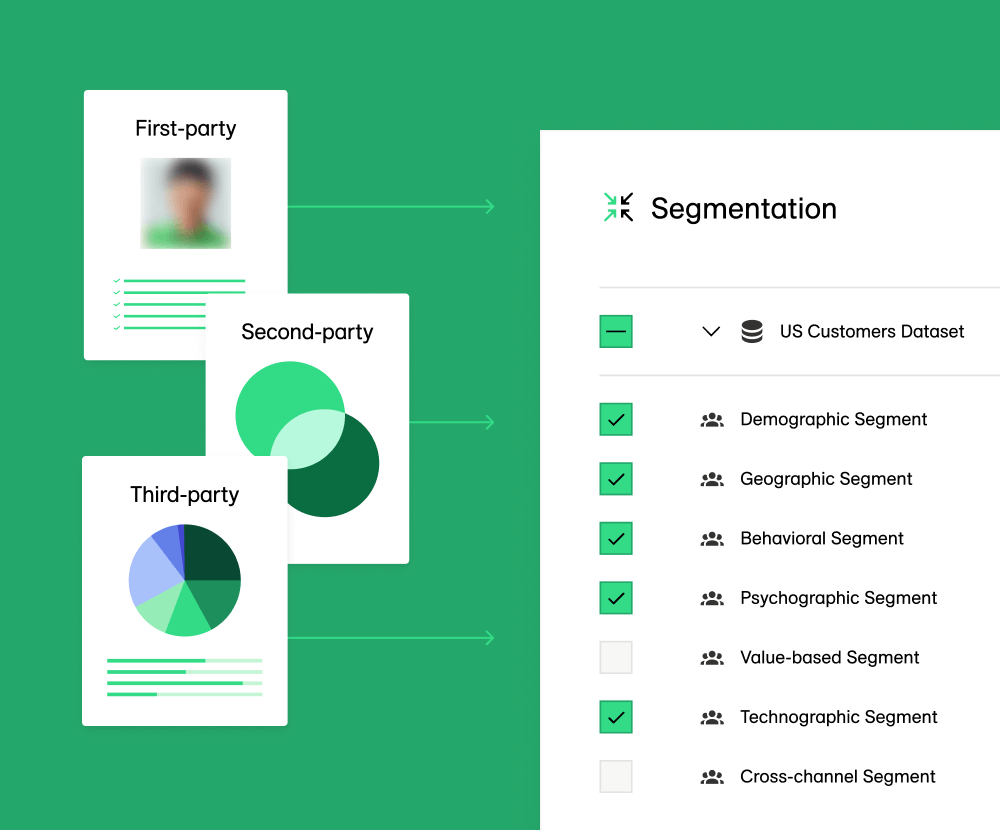
Audience planning includes robust customer data segmentation and allows you to bring disparate datasets together to better understand your customers and deliver a consistent message everywhere it matters. By identifying the relationships between signals and building precise segments, you can move beyond fragmented targeting to build a unified, scalable strategy.
Key takeaways
- Take control upstream by unifying all your data – from CRM to website to third-party providers – to overcome traditional CDP limitations.
- Use natural language with AI to make audience planning faster and smarter – no data science degree required.
- Enrich segments with second- and third-party data to build overlaps and uncover new growth opportunities.
- Scale with lookalike modeling to find new prospects who share traits with your best customers.
- Activate everywhere – from walled gardens, CTV, social, emerging AI channels, and more – to deliver a unified brand experience, not a fragmented channel strategy.
{{five-ways-to-create-better-experiences}}
What is audience planning?
Audience planning is the strategic process of taking control of your audience strategy upstream from your media channels. A critical part of this process is customer data segmentation.
What is customer data segmentation?
Customer data segmentation is the practice of grouping customers based on shared characteristics such as behaviors, preferences, demographics, or value. This makes it easier to activate your data and deliver experiences tailored to specific audiences.
Rather than treating all customers the same, segmentation helps you understand who your customers are, how they behave, and what they need so you can engage them more effectively at every stage of the journey.
Common types of customer data segmentation
There are many ways to segment your audience, but the most effective strategies combine multiple approaches. Each type of segmentation offers a different lens into customer behavior and value, helping you build more precise and actionable segments.
Demographic and geographic segmentation
Demographic and geographic segmentation use attributes such as age, income, household status, and location to provide foundational insights that help shape targeting strategies and regional campaign execution.
Behavioral segmentation
Behavioral segmentation analyzes purchase history, engagement patterns, product usage, and frequency to reveal how customers interact with your brand, making it one of the most actionable segmentation methods.
Psychographic and attitudinal segmentation
Psychographic and attitudinal segmentation examine interests, values, and lifestyle indicators to help you understand why customers make decisions and to inform messaging and creative strategy.
Value-based segmentation
Value-based segmentation focuses on metrics such as customer lifetime value, average order value, churn risk, or propensity to convert. These segments help you prioritize investment, guide media spend allocation, and concentrate on the audiences most likely to drive revenue and long-term growth.
Technographic segmentation
Technographic segmentation groups customers based on the technologies, platforms, devices, or software they use, enabling more precise channel selection, messaging alignment, and product positioning.
Identity-based and cross-channel segmentation
Identity-based and cross-channel segmentation rely on unified customer identities that persist across devices, platforms, and partners, enabling consistent activation and measurement across the ecosystem.
Account-based or B2B segmentation
Account-based or B2B segmentation uses firmographic, buying-group, and role-based data to align marketing and sales efforts within account-based marketing strategies.
Lookalike and expansion segmentation
Lookalike and expansion segmentation use high-value or high-performing customer segments to identify similar audiences across media platforms, helping you scale acquisition efficiently.
Why customer data segmentation matters
Customer data segmentation plays a central role in helping companies make more informed decisions across marketing, product development, and customer experience. When your data is organized into meaningful segments, it becomes easier to identify patterns, prioritize actions, and deliver more effective outcomes. Benefits of improving segmentation include:
Better personalization and relevance
Segmentation enables you to deliver targeted experiences that align with the needs and preferences of specific customer groups, resulting in more relevant messaging and stronger engagement.
Increased marketing efficiency and ROI
By focusing spend on high-value audiences, you can help improve conversion rates and allocate marketing budgets more efficiently.
Enhanced customer retention and loyalty
A deeper understanding of how different customer groups behave allows you to tailor retention strategies and build stronger, longer-lasting relationships.
Stronger product and experience optimization
Insights derived from well-defined customer segments help inform product development, pricing strategies, and user experience improvements.
See how audience planning and customer segmentation workflows come to life with LiveRamp demos.
Common challenges in customer data segmentation and how to overcome them with AI
Segmentation often breaks down because data is fragmented and because traditional approaches to building and maintaining audiences are slow and manual.
Common friction points include:
- Disconnected data and limited signal depth – It’s hard to assemble enough high-quality signals from first-, second-, and third-party data to power precise models and high-fidelity segments.
- Data science bottlenecks – Custom models can take weeks or months to build and refresh, making it difficult to keep pace with campaign needs and evolving customer behavior.
- Static, hard-to-refresh segments – Once segments are built, they’re often used for a single campaign or quickly become stale, limiting their long-term value.
- Limited audience expansion – Many teams stay confined to known CRM or loyalty audiences because net-new prospecting requires complex modeling and specialized tools.
LiveRamp’s AI segmentation and lookalike modeling remove this friction. AI-assisted segment building lets marketers explore, test, and refresh segments directly in the platform, while lookalike modeling uses your best-performing audiences as seeds to find new, high-propensity prospects at scale. Together, these capabilities help you turn unified data into continuously improving segments that drive growth with far less operational overhead.
How LiveRamp strengthens customer data segmentation
Scaling segmentation effectively requires a connected data foundation that supports identity resolution, secure data collaboration, and activation across channels. These capabilities work together to help ensure your segments remain accurate, consistent, and actionable across the ecosystem.
Secure identity resolution
LiveRamp connects fragmented data into tokenized profiles with privacy and security controls. This allows you to maintain reliable segmentation across systems, channels, and partners.
Data enrichment and expanded signals
Additional attributes and signals from LiveRamp’s broad partner ecosystem enhance your first-party data. This includes data collaboration with partners and access to third-party data, helping you build more meaningful, high-fidelity segments that reflect customer behavior and intent.
AI-powered segmentation and lookalike modeling
Simplify audience planning with natural language and a few clicks. LiveRamp’s segmentation capabilities allow you to build segments with all of your data – no data science degree required – and use AI to surface insights from first-party, second-party, and third-party data.
In the same audience planning experience, lookalike modeling takes your highest-performing or highest-value customer segments and finds new prospects who share similar attributes. By using seed audiences from your connected first-party data and enriching them with collaborative and marketplace data, LiveRamp helps you scale customer acquisition efficiently while maintaining strong performance and ROAS.
Activation and cross-media measurement
LiveRamp’s segmentation and activation capabilities bring together first-, second-, and third-party data with AI-assisted segment building and direct activation across walled gardens, CTV, social, and retail media environments. This enables more consistent audience measurement across channels and helps you optimize performance with a unified view of results.
Enhance your data strategy with LiveRamp
Customer data segmentation helps you organize and understand your audiences, making it easier to identify patterns and act across marketing, product, and customer experience. The impact of those segments depends on how effectively your data can be used across systems, partners, and channels.
LiveRamp provides the foundation to unify identity, expand data signals, and enable activation across the ecosystem. Through LiveRamp’s Segmentation + Activation capabilities, you can build high-fidelity segments, reach audiences across walled gardens, CTV, social, and retail media, and measure performance consistently across channels.
Learn more about how LiveRamp can help you activate and scale your data strategy.
{{interactive-clean-room-guide}}
Customer Data Segmentation FAQs
What data is used for customer segmentation?
Customer segmentation can use any permissioned data set, including first-party data from your CRM, websites, apps, and offline transactions, as well as second-party and third-party data from trusted partners and marketplaces. By unifying these sources, you can create richer, more complete customer profiles and build segments that reflect real behaviors, preferences, and value.
What is an example of customer segmentation?
An ecommerce brand might segment customers into frequent buyers, occasional shoppers, and inactive users, then tailor messaging, offers, and timing to each group.
What is an example of segmentation data?
Segmentation data includes inputs such as purchase history, website behavior, general location, device type, and customer lifetime value.
How do audience planning and customer segmentation improve marketing ROI?
Audience planning and customer segmentation improve ROI by directing spend toward high-value audiences and reducing wasted impressions. Furthermore, by building precise combinations of segments, brands can be more relevant with their messaging and offers, which significantly increases conversion rates and long-term customer loyalty.
How does customer data segmentation support a consumer data strategy?
Customer data segmentation helps organizations identify high-value audiences and deliver more relevant experiences across channels. A strong consumer data strategy connects customer insights, audience planning, activation, and measurement to help teams make better marketing decisions.
What is the difference between customer segmentation and audience segmentation?
Customer segmentation focuses on your existing customers, while audience segmentation includes both current customers and prospective audiences for acquisition efforts.
How often should customer segments be updated?
Customer segments should be updated regularly – ideally in real time or at frequent intervals – to reflect changes in behavior and maintain accuracy. AI-powered segmentation helps automate this process by continuously ingesting new signals and refreshing segment definitions, so your audiences stay aligned with how customers actually engage over time.
What’s the difference between customer segmentation and broader market segmentation?
Customer segmentation focuses on your existing customer base, while market segmentation analyzes the broader population of potential buyers to identify new opportunities.
Learn 5 ways to create better customer experiences with data collaboration.
Learn more about the power of data collaboration. Download the eBook, 5 Ways to Create Better Customer Experiences Using Data Collaboration
Clean Room Explainer
Strengthen marketing performance, insights, and impact