AI Advertising Explained: From Targeting to Measurement
AI is becoming part of nearly every stage of advertising, from identifying audiences and buying media to personalizing creative and measuring campaign results. With the right data and guardrails behind it, AI can help marketers make sense of growing volumes of information, streamline time-consuming processes, and surface insights that inform faster decisions.
But getting that data in shape remains a challenge. According to IAB, nearly two-thirds of advertising industry professionals cite data quality, data protection, and fragmentation across disparate tools as top barriers to AI adoption. As more tools, models, and agents enter marketing workflows, addressing these issues will play an important role in using AI effectively and responsibly.
Trusted data collaboration helps bring the pieces together. By connecting high-quality data across platforms and partners while maintaining privacy, governance, and human oversight, marketers can use AI with greater confidence throughout the advertising lifecycle.
Key takeaways
- Marketers can use on AI across many of their daily activities including audience targeting, media buying, personalization, optimization, and measurement.
- First-party data provides an important foundation, while collaboration with second- and third-party data can help marketers fill gaps in customer understanding.
- AI can streamline advertising workflows and help teams respond to insights faster, but marketers remain responsible for strategy, oversight, and decision-making.
- Privacy, security, transparency, and governance should be built into AI advertising workflows from the beginning.
{{AI-ready-advertiser-action-plan}}
What is AI advertising?
AI advertising is the use of artificial intelligence technologies, including machine learning and generative AI, to support the planning, execution, optimization, and measurement of advertising campaigns.
These technologies can analyze large volumes of data, recognize patterns, and surface recommendations that would be difficult or time-consuming for humans to identify manually. Marketers like you can use those capabilities to understand audiences, identify opportunities, personalize experiences, and make informed campaign decisions.
How is AI changing digital marketing?
Digital advertising generates signals across search, social, connected TV (CTV), commerce media, websites, and other channels. AI gives marketers new ways to connect and analyze those signals, turning them into useful insights.
That can change how teams work. Instead of spending as much time manually assembling performance dashboards, navigating platforms, or analyzing reports, marketers can use AI-assisted workflows to simplify these processes and support campaign execution.
Marketers still call the shots. AI can help teams explore possibilities and act on information more efficiently, while people provide the strategy, context, and judgment needed to determine which actions make sense for the business and its customers.
How does AI work in advertising?
AI advertising can take many forms depending on the technology, data, and advertising channel involved. Across use cases, however, AI needs accurate, connected data to support relevant insights and recommendations.
AI-ready data and identity
AI needs reliable information about your customers, interactions, and campaign outcomes to identify meaningful patterns. Identity resolution helps make that data more useful by connecting fragmented customer signals across systems and channels, giving you a more consistent view for analysis while respecting applicable permissions and data-use requirements.
AI-powered audience targeting
With AI, you can analyze audience characteristics, identify patterns, and develop audience segments at scale based on relevant signals. You can then review and refine those audiences based on your campaign goals, brand considerations, and other business context.
AI-powered media buying and campaign optimization
AI can analyze campaign signals such as audience engagement, placement performance, and spending patterns to help you identify opportunities for optimization. These capabilities can reduce some of the manual analysis involved in media buying while giving you information you can use to determine where and how to adjust campaigns.
Dynamic creative optimization (DCO)
Dynamic creative optimization uses data and technology to assemble or serve creative variations based on audience and contextual signals. AI can enhance this process by helping you analyze which combinations of messaging, imagery, or other creative elements may be relevant for different audiences. You still set the strategy and parameters that guide how those capabilities are used.
AI agents and agentic marketing workflows
AI agents assist you with multi-step marketing workflows, taking specific action on your behalf within parameters you define. They can support tasks such as exploring audiences, analyzing campaign results, or coordinating activities across connected tools, while governance, approvals, and human oversight remain part of the process.
As these capabilities evolve, you'll need clear parameters around what agents can access, which actions they can support, and when human review is required. Keeping humans in the loop helps ensure agentic workflows remain aligned with your business objectives, data policies, and brand standards.
The role of data in AI advertising
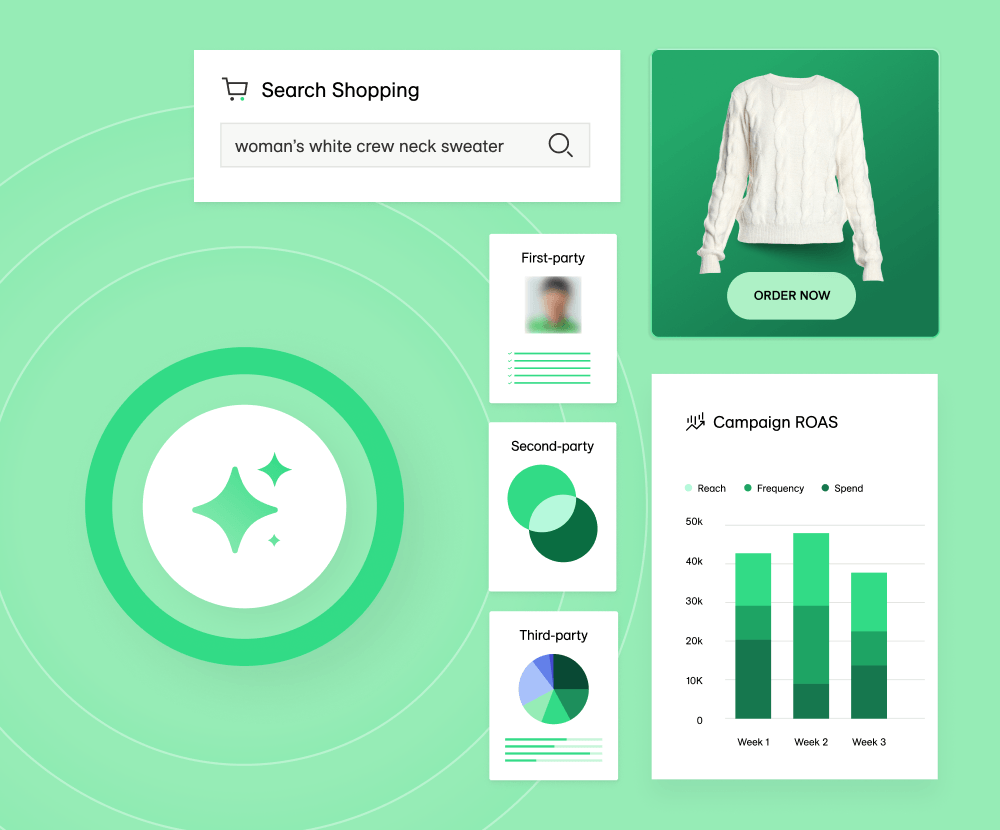
Your data strategy shapes how effectively you can use AI across advertising. First-party data, identity resolution, and collaboration with second- and third-party data each play a role in giving AI the context it needs to support your decisions.
Why first-party data matters
First-party data comes directly from your interactions with customers, including transactions, website activity, and loyalty programs. Because it reflects your own customer relationships, it can provide AI systems with valuable context for audience analysis, personalization, and measurement.
{{AI-ready-advertiser-action-plan}}
Connecting customer signals for a clearer view
Your customer signals often live across disconnected systems and use different identifiers. Identity resolution helps connect those signals to create a more consistent understanding of customer interactions, giving AI tools more complete information for analysis.
Collaborating across first-, second-, and third-party data
Your first-party data rarely tells the entire story. Collaborating with second- and third-party data can help you fill information gaps, discover additional audience insights, and provide AI models with relevant signals beyond your own datasets subject to applicable data use terms and permissions.
The opportunity doesn’t stop at your first party data. With the right partners and a secure data clean room, you can bring powerful insights from second-party data, as well.
LiveRamp's Data Marketplace provides access to third-party data that you can use to enhance audience targeting and customer understanding. As AI use cases evolve, governed data collaboration can also help you access the permissioned inputs needed to support AI while maintaining greater control over how data is used.
How AI advertising is used across different marketing channels
AI advertising can support your strategy across a growing range of marketing channels, with applications that vary based on the audiences, signals, and capabilities available in each environment.
Paid search
AI can analyze search behavior, keywords, campaign performance, and other signals to assist with bidding, audience selection, and ad delivery. You can use these insights to refine your search strategy based on your objectives while retaining oversight over campaign decisions.
Social media advertising
Social platforms generate extensive behavioral and engagement signals. AI can help you analyze those signals to inform audience targeting, creative selection, and campaign optimization while you establish campaign goals, creative direction, and brand parameters.
Connected TV (CTV)
AI can support your CTV advertising by analyzing the audience and viewing signals that inform campaign planning and evaluation. Combined with identity and cross-channel data, these insights can contribute to a more connected view of advertising performance across screens.
Retail media networks
Retail media combines advertising with valuable commerce and transaction signals. AI can help you analyze these datasets to inform audience selection, campaign optimization, and measurement, including how advertising exposure relates to purchasing behavior.
Display and programmatic advertising
Programmatic environments already rely heavily on algorithms to facilitate media transactions. AI can further assist you with analyzing audience, inventory, and performance signals, helping you evaluate opportunities and determine potential adjustments to campaign strategies.
AI platforms as destinations
LLMs themselves are also becoming an opportunity for marketers to connect with their target audiences. With the introduction of ads on ChatGPT this year, marketers are beginning to experiment with meeting their audiences on these emerging platforms.
What are the intended benefits of AI advertising?
As AI becomes integrated across advertising workflows, it can help you get more from your data, campaigns, and existing resources. These capabilities can create benefits across targeting, efficiency, personalization, optimization, and measurement.
Improved targeting accuracy
AI can help you analyze larger and more diverse datasets to identify patterns that inform audience segmentation. When those datasets are accurate and powered by a strong identity backbone, you can develop audience strategies informed by a broader set of relevant signals.
Greater campaign efficiency
AI-assisted workflows can reduce the time you spend on repetitive tasks such as analyzing reports, exploring audience combinations, or reviewing campaign signals. That can give you more time to focus on strategy, creative thinking, and higher-value decisions.
Better personalization at scale
AI can help you understand customer signals and identify opportunities to tailor experiences across larger audiences. Human guidance remains important for determining what personalization is appropriate, relevant, and aligned with customer expectations.
Faster optimization and decision-making
Instead of relying solely on manual analysis, you can use AI to surface campaign trends and optimization opportunities quickly. You can then review those insights, apply your business context, and decide whether and how to adjust campaigns.
More accurate measurement and attribution
AI can help analyze complex datasets and identify relationships among exposures, interactions, and outcomes. Identity and connected data can provide additional context, helping you build a more complete picture of which marketing activities contribute to results.
What are the challenges of AI advertising?
Using AI effectively requires careful consideration of the data, processes, and safeguards behind it. Understanding the following challenges can help you manage risk and maintain greater control as you incorporate AI into your strategy.
Data quality and availability
Incomplete, outdated, or disconnected data can limit the usefulness of AI-generated insights. Regularly assess data for accuracy, completeness, and relevance so AI tools have the right context to work with.
Privacy, security, and brand safety
AI introduces additional ways data can potentially be accessed and used. Clear controls around permissions, data access, and approved use cases can help you protect customer information, reduce risk, and maintain brand trust.
AI transparency and bias
AI outputs reflect the systems and data behind them, which can introduce bias or make recommendations difficult to interpret. You should understand where data comes from and whether it can be trusted, critically evaluate AI-generated recommendations, and require human review before those recommendations inform action.
Balancing automation with human oversight
AI can assist with increasingly complex advertising workflows, but you still provide the judgment, context, and accountability that guide how those capabilities are used. Define which tasks AI can support, what data it can access, and where human approval is required.
This principle should extend across your AI strategy. Whether you're using AI to build audiences, analyze campaign performance, or support multi-step agentic workflows, human oversight helps keep AI aligned with your goals, policies, and responsibilities.
How do AI-assisted workflows help marketers measure advertising performance?
Measuring AI advertising starts with connecting your advertising investments to meaningful business outcomes. Your measurement strategy should reflect your campaign objectives and help you understand what's driving results.
Track more of the right performance metrics
Relevant metrics will vary by campaign, from reach and engagement to conversions, customer acquisition, and revenue. Rather than measuring AI as an isolated technology, evaluate how AI-assisted workflows are supporting your campaign objectives.
Measure incrementality and attribution
Attribution can help you understand how different touchpoints contribute to outcomes, while incrementality can help determine whether an outcome would have occurred without the advertising exposure. Together, these approaches can give you a more nuanced understanding of campaign impact and help inform future investment decisions.
Evaluate performance across more channels
Your customers move between search, social, CTV, commerce media, and other environments. A strong identity framework can help you evaluate these interactions across channels rather than treating each platform as an isolated source of performance data.
Use AI insights to improve future campaigns
AI can help you identify trends within measurement data and surface opportunities worth investigating. You can combine those insights with your own expertise to inform future audience, channel, creative, and investment decisions.
{{ai-reshaping-webinar}}
Best practices for successful AI advertising
How you manage your data, technology, and workflows can shape how effectively you use AI in advertising. The following best practices can help strengthen your approach while maintaining strong governance and human accountability.
Build a strong first-party data strategy
Start your first-party data strategy by understanding what data you have, how it's collected, and where it can appropriately be used. Well-organized, reliable data gives AI tools stronger inputs and helps you set clear parameters for responsible data use.
Govern AI with privacy, transparency, and compliance
Build governance into your AI workflows by defining what data AI systems and agents can access, what they can use it for, and where approvals are required. Maintaining visibility into those interactions can help you move quickly while retaining control of your data and upholding your responsibilities to customers and partners.
Connect data across platforms
Data silos can prevent you and your AI tools from seeing the full picture of audience behavior. Identity and data collaboration can help you connect signals across platforms, partners, and channels while maintaining appropriate controls over data access and use.
Continuously test and optimize
AI can help you evaluate more signals and identify new opportunities to test. Use those capabilities to support an iterative process in which you establish hypotheses, evaluate results, and determine what to adjust or scale.
Why trusted data is the foundation of AI advertising
As you embed AI across more advertising workflows, you're connecting more signals, systems, and partners. Trusted data collaboration can help you:
- Connect high-quality data across platforms, partners, and channels.
- Maintain control over how your data is accessed and used.
- Build in governance around privacy, security, and approved AI use cases.
LiveRamp brings together consumer insights, planning and activation, and measurement and optimization capabilities to help you connect data and support AI use cases across the marketing lifecycle. With privacy and governance incorporated into your workflows, you can explore new AI capabilities while maintaining control over your data and supporting responsible use.
Putting AI advertising into practice
AI advertising can help you understand audiences, streamline campaign workflows, and turn insights into action everywhere it matters. Making these capabilities useful requires connected, high-quality data, durable identity, and human oversight to guide how AI supports your strategy.
As AI continues to evolve, the same principles apply: give AI reliable information, maintain clear governance, and keep marketers at the center of decision-making. Together, these practices can help you incorporate AI across targeting, activation, optimization, and measurement while continuing to meet your responsibilities to customers and partners.
Explore LiveRamp’s agentic AI orchestration capabilities to see how the platform can help you connect AI agents to identity, segmentation, activation, and measurement with governed access.
AI advertising FAQs
How is AI used in advertising?
You can use AI to assist with audience analysis, targeting, media planning, personalization, campaign optimization, and measurement. AI can analyze large datasets and identify patterns that help you make informed decisions throughout the advertising lifecycle.
What are the benefits of AI advertising?
AI can help you analyze more information, streamline repetitive workflows, personalize experiences, and surface campaign insights faster. The specific benefits depend on factors including data quality, technology, governance, and how you incorporate AI into your workflows.
What data does AI advertising use?
AI advertising can use first-party data from your own customer relationships as well as permissioned second- and third-party data. Identity resolution and data collaboration can help connect these signals, giving AI systems more complete information for analysis.
How do you measure AI advertising performance?
Start with the business outcomes and campaign objectives you want to achieve. Depending on your campaign, you can track metrics such as reach, engagement, conversions, and revenue, along with approaches such as attribution, incrementality, and cross-channel measurement to understand whether AI-assisted strategies are supporting your objectives.