

How to Leverage Agentic AI Without Sacrificing Governance
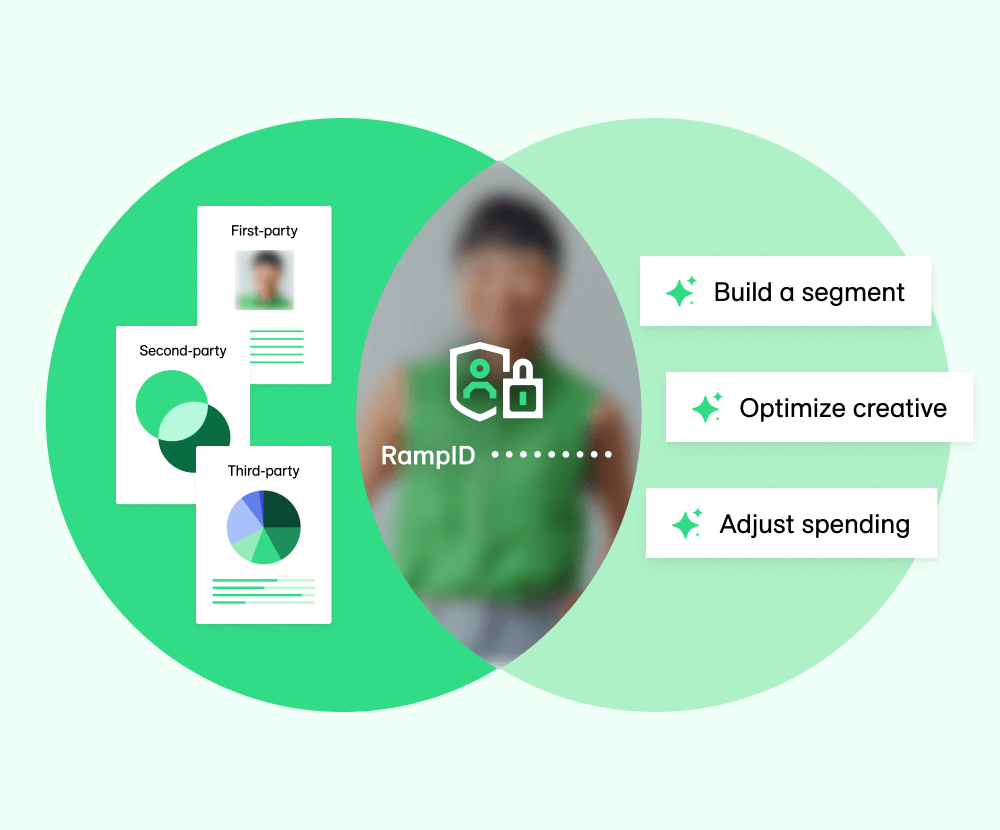
Agentic AI is moving fast. AI agents are already helping teams plan media, build audiences, and surface insights, and marketers are under pressure to adopt them to keep up with the competition.
But speed without governance is a liability: an AI agent that acts on ungoverned data can violate consumer privacy, breach compliance rules, and erode the customer trust your brand spent years building.
The good news is that governance and agentic AI aren't opposing forces. When you build agentic AI on a foundation of governed data collaboration and durable identity, you get intelligent workflows and the controls to keep them safe, and defensible.
This blog breaks down what agentic AI means for marketers, why governance has to be part of the equation, and how to put governed data collaboration to work so you can move fast without losing control.
Key takeaways
- Agentic AI needs guardrails. AI agents that plan, execute, and optimize marketing tasks are only as trustworthy as the data, permissions, and human expertise behind them.
- Governed data collaboration is the foundation. Securely connecting first-, second-, and third-party data gives AI agents accurate inputs to work from.
- Identity keeps AI accountable. A durable, interoperable identity layer lets you track what an AI agent knows, does, and touches across the customer journey.
- Governance accelerates adoption, not slows it. Clear policies, permissions, and monitoring let marketing teams confidently scale AI agents.
- The biggest risks are fragmentation and opacity. Disconnected systems and black-box decisions make agentic AI harder to trust and regulate.
Before you dive in, it's worth grounding your approach in first-party data strategy. LiveRamp's First-Party Data Playbook for the AI Era walks through how to prepare your data foundation for the AI era.
{{first-party-data-ai-era}}
What is agentic AI?
Agentic AI refers to AI systems, or AI agents, that can plan and take action toward a goal with minimal human input, rather than simply answering a prompt or generating content on request. In marketing, that might mean an agent that builds an audience, launches a campaign, adjusts bids, and reports on performance in a continuous loop, adapting as it learns.
That autonomy is exactly what makes agentic AI so valuable, and so risky. An agent that can act on its own can also act on bad data, outdated permissions, or an incomplete picture of the customer, faster than a human ever could. Simply put: the more autonomy you hand an AI agent, the more governance you need behind it.
Why marketers need a trusted approach to agentic AI
Governance isn't a compliance checkbox bolted onto agentic AI after the fact. It's what makes agentic AI safe to deploy at scale in the first place. Here's why it matters across four key areas.
Protecting sensitive customer data
AI agents often need broad access to customer data to do their jobs well, which means a single ungoverned agent can become a single point of failure for sensitive information. Governance helps ensure agents only access the data they need, when they need it, protected by encryption and secure access controls rather than open pipes into your customer data.
Maintaining privacy, compliance, and trust
Privacy regulations weren't written with AI agents in mind, but they still apply to every action an agent takes on consumer data. Marketers need governance frameworks that support agentic AI’s compliance with regulations like GDPR and CCPA by design, not as an afterthought, so trust with consumers and regulators stays intact as automation scales.
Governing AI agents and workflows
An AI agent that plans and executes without oversight can drift from its intended purpose, especially as it chains multiple actions together across systems. Clear governance defines what an agent is authorized to do, where those boundaries sit, and how to intervene when an agent's behavior needs a course correction.
Enabling responsible AI adoption
Marketing leaders don't want to choose between innovation and responsibility, and governance is what lets them have both. When governance is built into the AI foundation from the start, teams can adopt agentic AI faster because they're not stuck relitigating privacy and security concerns with every new use case.
The role of governed data collaboration in agentic AI
Trustworthy agentic AI starts with trustworthy data. Governed data collaboration is the connective tissue that gives AI agents accurate, compliant, and permissioned data to act on.
Connecting first-, second-, and third-party data securely
AI agents are only as smart as the signals they can access, and most marketers' data is scattered across first-party systems, partner relationships, and third-party sources. Governed data collaboration connects all three securely, so agents work from a more complete, accurate view of the customer instead of a fragmented one.
Identity as the foundation for trustworthy AI
Without a consistent, durable identifier, an AI agent can't reliably tell whether it's looking at one customer or ten fragmented profiles. A people-based identity layer like RampID gives agents a stable foundation to reason over, so their decisions are grounded in an accurate customer view rather than guesswork.
Governed data access for AI agents
Not every AI agent should see every piece of data, and governed access controls help make sure that's true in practice. Permissions, encryption, and secure access frameworks define exactly what an agent can query, use, and act on, helping keep sensitive data protected even as automation scales.
Data collaboration across partners and platforms
Marketing doesn't happen in a single walled garden, and neither should agentic AI. Secure data collaboration lets AI agents work across partners, platforms, clouds, and identifiers without forcing you to centralize everything in one place or compromise on privacy to get a complete picture.
How trusted agentic AI improves marketing outcomes
Governance isn't just a safeguard, it's what unlocks agentic AI's full value for marketing performance. Here's how it shows up across the workflow.
Governed campaign execution
When an AI agent operates within clear governance boundaries, it can help marketers plan and execute campaigns without introducing compliance risk or targeting errors. That means faster campaign turnaround for marketing teams, without trading away the oversight needed to catch problems before they reach the customer.
Smarter audience targeting and activation
Governed data collaboration gives AI agents richer, more accurate signals to build and refine audiences from, resulting in more precise targeting and less wasted spend. Agents can model lookalikes, suppress low-value segments, and activate across channels, all grounded in permissioned, high-quality data under the supervision of a marketer.
AI-powered planning through measurement and continuous optimization
Agentic AI doesn't stop at execution. It can continuously monitor campaign performance, identify what's working, and adjust media plans in near real time, closing the loop between planning and measurement faster than manual processes allow. Governance helps ensure those optimizations are made on permissioned data rather than a fragmented, and potentially misleading, dataset. It also helps ensure that a human is in the loop as needed.
Natural language insights
One of agentic AI's most practical benefits is turning complex measurement data into plain-language answers marketers can act on immediately. Instead of waiting on an analyst to build a report, a marketer can ask an AI agent a direct question about campaign performance and get a governed, accurate answer in return.
Best practices for implementing governed agentic AI
Rolling out agentic AI responsibly comes down to a handful of foundational moves. Get these right and everything downstream, from campaign execution to measurement, gets easier.
Build an AI-ready data foundation
Agentic AI is only as good as the data it's built on, so start by connecting your first-, second-, and third-party data sources. A fragmented data foundation will produce fragmented, unreliable agent behavior no matter how sophisticated the AI itself is.
Establish an identity foundation
Before you deploy AI agents at scale, make sure you have a durable, interoperable identity layer in place to unify customer data across touchpoints. Identity is what lets an agent recognize the same customer across channels and partners, rather than treating every interaction as a fresh, disconnected data point.
Govern AI with clear policies and permissions
Define upfront what each AI agent is allowed to access, what actions it can take autonomously, and where human approval is required. Written policies and enforced permissions turn governance from an aspiration into an operational reality that scales alongside your agents.
Continuously monitor and optimize AI-ready marketing workflows
Governance doesn't end at deployment. Ongoing monitoring lets you catch drift, flag anomalies, and refine agent behavior as your data, regulations, and business needs evolve, so trust in the system holds up over time.
Common governance challenges with agentic AI
Even with the best intentions, marketers run into a familiar set of obstacles when governing agentic AI. Knowing them in advance makes them easier to plan around.
Fragmented data and disconnected systems
When customer data lives in disconnected silos, AI agents can't form a complete or accurate picture of the customer, which undermines both performance and governance. Connecting systems through secure data collaboration is the prerequisite for governing what agents can see and do in the first place.
Privacy and regulatory compliance
Privacy regulations vary by region and continue to evolve, and an AI agent operating across markets needs to respect all of them simultaneously. This requires governance frameworks that are built to flex as rules change, rather than static policies that quickly fall out of date.
Transparency and explainability
If an AI agent takes an action, marketers and compliance teams need to be able to explain why, both to internal stakeholders and to regulators. Opaque, black-box decision-making makes agentic AI harder to trust and much harder to audit when something goes wrong.
Balancing automation with human oversight
Full autonomy sounds efficient until an agent makes a decision that needed a human’s expertise first. The best governance frameworks define clear checkpoints for human review, so automation speeds up the work without removing accountability from the process.
The future of AI-powered marketing starts with trusted data collaboration
Agentic AI is set to reshape how marketing teams plan, execute, and measure campaigns, but only teams that pair it with strong governance will be able to scale it with confidence. Governed data collaboration and a durable identity foundation give AI agents the accurate, permissioned data they need to act responsibly, while clear policies and continuous monitoring keep that autonomy accountable. Marketers who get this right won't have to choose between speed and trust: they'll have both.
LiveRamp's agentic AI capabilities are built on this exact foundation, connecting identity, governed data collaboration, and AI orchestration in one interoperable platform. See how a durable identity foundation grounds trustworthy AI with a LiveRamp Identity demo.
{{live-identity-demo}}
Frequently asked questions about agentic AI and governance
Why is governance important for agentic AI?
Governance helps ensure AI agents only access data they're authorized to use, act within clearly defined boundaries, and remain compliant with privacy regulations. Without it, autonomous decision-making can expose sensitive data, violate compliance rules, and erode consumer trust.
How does governed data collaboration support agentic AI?
Governed data collaboration securely connects first-, second-, and third-party data so agents work from accurate, permissioned information instead of fragmented or unauthorized data. It gives agents a more complete customer view while keeping access controlled and auditable.
What role does identity play in agentic AI?
Identity gives AI agents a consistent, durable way to recognize the same customer across touchpoints, partners, and platforms. Without a unified identity foundation, agents risk acting on fragmented or duplicate profiles, which undermines both accuracy and governance.
How can organizations implement agentic AI without sacrificing governance?
Start with an AI-ready data foundation, establish durable identity, and define clear policies and permissions for what agents can access and do. Pair that with continuous monitoring so governance evolves alongside your AI agents rather than falling behind them.
The First-Party Data Playbook for the AI Era

Consumer Insights Demo
Take a deep dive into our interactive demo to discover how you can accurately identify and connect with customers across channels, partners, platforms, and cloud ecosystems.