

How Marketers Can Use AI-Driven Ad Optimization to Improve Campaign Performance

Every campaign generates more data than you can realistically analyze on your own. Powered by machine learning, predictive analytics, and automation, AI-driven ad optimization helps you turn that data into efficient decision-making across audience building , bidding, creative delivery, and measurement.
But AI is only as effective as the data behind it. If your data is fragmented across channels, so are your insights. In fact, only 38% of global marketers measure traditional and digital media together, highlighting the challenge of creating a unified view of campaign performance.
With the right data foundation in place, as well as appropriate human instruction and oversight, agentic workflows can help you move faster and work at greater scale — but it's equally important to do so while supporting compliance and the trust of your customers and partners.
This guide explores how AI-driven ad optimization works, its benefits and use cases, common challenges, and how LiveRamp helps you improve outcomes through connected data, interoperable identity, trusted collaboration, and an AI-ready infrastructure.
Key takeaways
- AI-driven ad optimization uses machine learning and automation to help improve campaign performance across targeting, bidding, creative delivery, measurement, and budget allocation.
- AI systems continuously assist marketers in analyzing campaign data and optimizing toward business goals such as ROAS, CPA, conversions, and engagement.
- Connected customer data improves optimization accuracy by providing more complete audience and performance signals.
- AI can help you improve targeting precision, reduce wasted spend, accelerate optimization cycles, and personalize experiences at scale, with appropriate human instructions.
- Successful AI-driven ad optimization depends on marketers decision-making, identity resolution, interoperable measurement, governance, and trusted data collaboration.
What is AI-driven ad optimization?
AI-driven ad optimization refers to the use of machine learning, predictive analytics, automation, and real-time data analysis to improve advertising performance across digital channels.
Rather than relying solely on manual campaign adjustments, AI systems continuously help marketers analyze performance data and assist in making optimization decisions – within workflows you define.
These systems can help marketers optimize:
- Bidding
- Targeting
- Audience selection
- Creative delivery
- Budget allocation
- Campaign pacing
- Measurement and attribution
Today, much of this optimization happens directly within advertising platforms such as Google Ads, Meta, demand-side platforms (DSPs), and retail media networks. As these systems ingest more data, they become well equipped to identify patterns and improve campaign outcomes.
{{AI-ready-advertiser-action-plan}}
How does AI-driven ad optimization work?
AI-driven ad optimization is a continuous cycle of analyzing performance, making adjustments, and learning from outcomes. Rather than relying on strict manual reviews, optimization systems help marketers evaluate campaign performance in near real time and respond to changing conditions with marketer-defined parameters. This is an incredible asset for you to leverage as you build campaigns to win in the AI era.
You can begin this process by establishing a business objective, such as maximizing return on ad spend (ROAS), increasing conversions, reducing cost per acquisition (CPA), or improving customer engagement. AI systems then monitor campaign performance against those goals.
As campaigns run, optimization engines evaluate signals such as audience engagement, conversion activity, channel performance, creative effectiveness, and budget utilization. Based on those insights, they help marketers make adjustments designed to improve results.
For example, with marketers’ instructions, AI may help:
- Increase investment in high-performing audience segments
- Shift budget toward more effective channels or placements
- Prioritize creative assets that generate stronger engagement
- Identify lookalike audiences with a higher likelihood to convert
- Adjust campaign pacing to improve efficiency
Over time, optimization systems refine their insights as they process additional data and performance signals. The more complete and connected those signals are, the more effectively AI can support marketers identify opportunities, improve decision-making, and drive stronger campaign outcomes.
Why does AI-driven ad optimization matter?
AI-driven ad optimization enables marketers to make smarter campaign decisions at scale. By analyzing large volumes of campaign and customer data in real time, AI can help marketers improve efficiency, increase relevance, and focus your budget and resources where they can have the greatest impact.
Improves targeting precision
AI can assist marketers in processing far more behavioral and contextual signals than traditional manual approaches. By analyzing customer interactions, engagement patterns, purchase history, and intent signals, AI helps you identify high-value audiences with greater accuracy, combined with appropriate human review.
AI can also help marketers identify lookalike audiences, high-intent prospects, and predictive audience segments. Audience precision improves when you connect first-party, second-party, and third-party data within a unified workflow.
Reduces wasted ad spend
Advertising budgets often suffer from inefficient spending on low-performing placements, audiences, or creative assets. AI continuously provides support in evaluating campaign performance and reallocating resources to opportunities more likely to deliver results.
This allows you to maximize efficiency while reducing unnecessary spend.
Accelerates campaign optimization
Manual campaign optimization requires ongoing monitoring and frequent adjustments. AI automates many of these repetitive tasks, allowing you to optimize campaigns continuously with appropriate human review rather than waiting for scheduled reviews.
The result is that marketers can achieve faster decision-making and quicker performance improvements through creative updates, automated bidding, and predictive retargeting based on intent signals, engagement history, and conversion likelihood.
Supports personalization at scale
Consumers expect relevant experiences across channels. AI can help you personalize messaging, creative assets, offers, and audience delivery based on individual behaviors and preferences.
By adapting experiences dynamically, you can improve engagement and conversion rates while maintaining consistency across touchpoints.
Improves cross-channel performance visibility
Modern customer journeys span search, social media, connected TV (CTV), retail media networks, programmatic advertising, and emerging AI-powered discovery environments.
AI-driven optimization performs best when measurement spans these channels, helping you understand which investments are driving business outcomes and where to allocate future budget. That broader view also enables AI to optimize media investments holistically across these environments rather than evaluating each channel independently.
What are the challenges and limitations of AI-driven ad optimization?
While AI can automate and accelerate many aspects of campaign optimization, it can also introduce new challenges. Understanding these limitations allows you to evaluate results more effectively and build a stronger foundation for long-term success.
AI is only as effective as the underlying data.
AI models rely on data to assist marketers in decision making. When your customer data is fragmented, incomplete, or inaccurate, optimization systems may produce inconsistent results and overlook valuable opportunities.
High-quality, unified data helps marketers use AI models to make more accurate optimization decisions and uncover stronger performance opportunities.
Limited transparency in automated systems
Many AI-driven advertising tools are opaque, making it difficult to understand why certain optimization insights are generated.
Without visibility into the insights-generation processes, you may struggle to evaluate performance, identify issues, or build confidence in AI-generated insights.
Signal loss and fragmented identity
Your customers interact across multiple devices, platforms, and channels. Disconnected identifiers make it difficult for optimization systems to maintain a complete view of customer behavior.
As signal loss increases, audience accuracy, measurement, and optimization effectiveness can suffer.
Measurement gaps across channels
AI systems can only optimize against the metrics they can see.
When measurement remains siloed across platforms, optimization engines may prioritize incomplete performance indicators instead of true business outcomes. Unified measurement helps ensure optimization decisions reflect reality.
Optimizing for data governance
As AI becomes more deeply embedded in advertising workflows, you need confidence that customer data is being used responsibly and in accordance with your governance requirements.
This challenge becomes even more important as agentic AI workflows emerge. As AI agents take on a larger role in campaign planning, activation, optimization, and measurement, you need visibility into how data is being accessed, shared, and used.
Without clear governance controls, AI agents may operate on incomplete information, access data beyond its intended purpose, or assist in decision making that doesn’t align with your privacy, compliance, or business requirements.
How does LiveRamp support AI-driven ad optimization?
You need confidence that your data is connected, governed, and used responsibly as you scale AI-powered marketing. As the trusted data collaboration network for AI-powered marketing, LiveRamp helps you connect fragmented signals across channels while maintaining security, transparency, and control.
Connected identity resolution across channels
LiveRamp unifies fragmented customer signals into durable, interoperable identities through RampID. This durable, permissioned identifier connects customer interactions across channels, platforms, and devices to create a more consistent and addressable view of your audiences.
With a stronger identity foundation, you can improve reach, campaign optimization, and measurement accuracy.
Data collaboration for richer optimization signals
AI models benefit from broader, more complete datasets.
LiveRamp enables secure data collaboration that helps you connect first-party, second-party, and third-party data and supports your ability to maintain governance controls. By bringing together richer data, you can activate audiences more quickly, improve audience insights, strengthen audience precision, and optimize campaigns toward meaningful business outcomes.
Cross-channel activation and measurement
Today's media landscape includes social platforms, media networks, CTV environments, programmatic ecosystems, and emerging AI-powered discovery platforms.
LiveRamp helps you activate and measure audiences as they move across these environments, creating a more connected foundation for optimization and performance analysis. RampID helps you treat these destinations as addressable and measurable.
AI-ready data infrastructure
AI-powered marketing requires trusted infrastructure that connects data, identity, measurement, and governance.
With LiveRamp, you can build an AI-ready foundation that supports scalable optimization, trusted collaboration, and emerging agentic workflows. Rather than simply passing data to AI systems, LiveRamp provides a secure governance layer that enables your ability to control how AI agents access and use your data.
Through built-in permissioning, approvals, and governance controls, LiveRamp support you in applying your governance requirements so that specialized AI agents only interact with approved data for approved use cases. This allows you to move faster, experiment more confidently, and scale AI-powered marketing while maintaining transparency and trust.
How can marketers build a stronger foundation for AI-driven advertising with LiveRamp?
AI-driven ad optimization can improve performance, help marketers increase decision-making efficiency, and scale campaigns more efficiently. But achieving strong results depends on having a clear understanding of your customers and the ability to evaluate performance accurately across channels.
LiveRamp brings these capabilities together through connected identity, data collaboration, cross-channel measurement, and AI-ready infrastructure designed to support modern marketing workflows.
Connect customer data, improve measurement, and power more effective AI-driven campaign optimization with LiveRamp's agentic AI capabilities.
{{how-AI-helps-marketers-work-smarter}}
AI-driven ad optimization FAQs
How can I improve ad performance with AI?
You can use AI to help improve ad performance by using machine learning to optimize bidding,reach , budget allocation, creative delivery, and audience selection based on real-time performance data.
Can AI optimize advertising campaigns in real time?
Yes. Modern advertising platforms use AI to continuously analyze campaign performance and make optimization adjustments in real time, helping you improve efficiency and outcomes.
What types of data power AI-driven advertising?
AI-driven advertising typically relies on campaign performance data, audience data, behavioral signals, conversion data, contextual information, and customer interaction data. More connected and complete datasets generally improve optimization accuracy.
How does AI improve audience building ?
AI analyzes large volumes of behavioral and engagement data to identify high-value audiences, predict conversion likelihood, create lookalike segments, and improve precision across channels.
How does connected customer data improve AI optimization?
Connected customer data provides AI systems with a more complete understanding of customer behavior across channels and touchpoints. This improves audience accuracy, measurement quality, personalization, and overall optimization performance.

The AI-Ready Advertiser Action Plan
How to show up everywhere your customers (and their agents) do
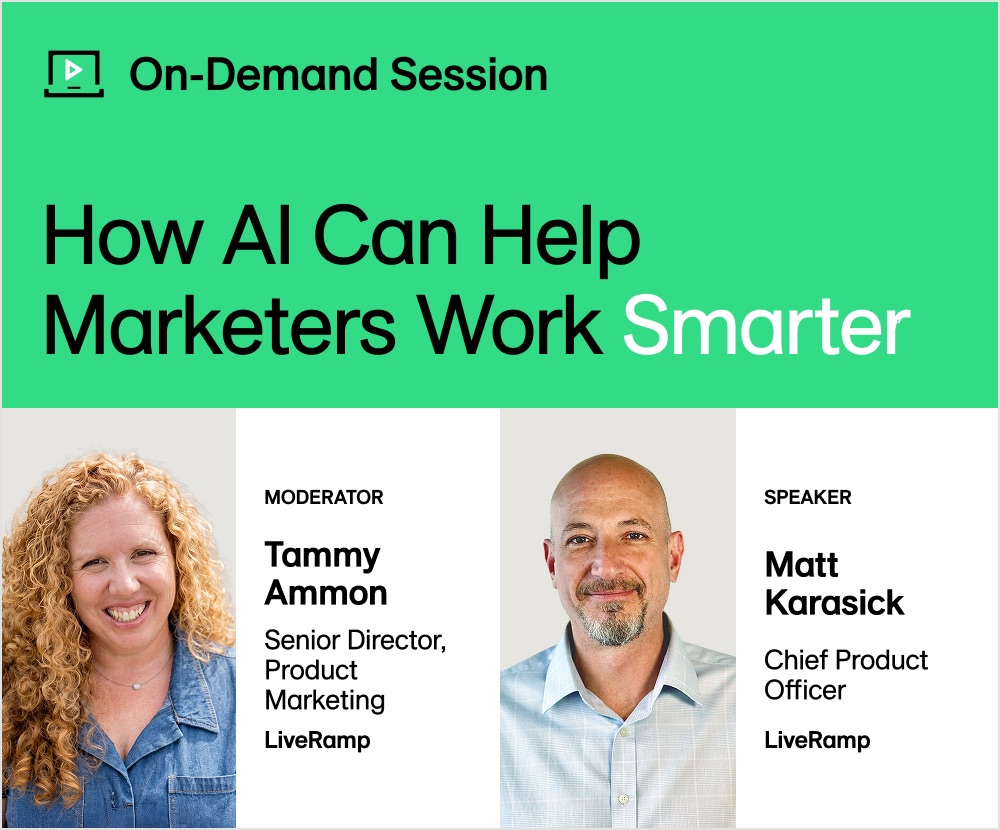
How AI Can Help Marketers Work Smarter
Get the insights you need to make AI work for you.