Is Your Cross-Media Measurement Foundation Ready for AI?
A marketer’s guide to cross-media measurement and agentic workflows
As agentic AI begins to run parts of the marketing workflow itself – from discovering audiences and preparing data to interpreting performance and optimizing media – it’s become clear that AI-powered measurement is only as good as the data behind it.
To move from an interesting experiment to a reliable decision driver, AI needs high-quality signals, connected identity, and a trusted environment where insights can turn into action.
That’s the gap LiveRamp is built to close. As the trusted network for AI-powered marketing, LiveRamp is bringing identity resolution, data collaboration, and measurement together so marketers can build a trusted foundation for AI-powered measurement.
Here’s why traditional measurement is struggling to keep pace and what an AI-ready cross-media measurement strategy looks like.
Key takeaways
- AI-powered marketing depends on trusted, connected data to generate reliable insights and recommendations.
- Cross-media measurement helps marketers understand performance across channels while reducing fragmented reporting.
- AI can accelerate data preparation and measurement workflows, but it cannot solve underlying data quality or measurement challenges.
- Building a trusted measurement foundation today prepares organizations to adopt agentic AI and make smarter marketing decisions.
Why traditional measurement can’t keep up
Marketing has become continuous, cross-channel, and signal-rich. Measurement, for most organizations, is still episodic, fragmented, and hard to operationalize.
Marketers now run campaigns across streaming, social, retail media, search, commerce, and owned channels – each with its own signals, methodologies, and measurement constraints. At the same time, the market is demanding continuous optimization, stronger governance controls, and AI-driven planning and recommendations delivered in real time.
Explaining results after a campaign ends is no longer enough. Cross-media measurement has to help teams make faster decisions and connect media investment to business outcomes across an increasingly fragmented landscape. We believe the brands and agencies that will get the most ROI from their ad spend will bring a modern approach to leveraging de-duped, cross-channel reach, frequency, incrementality, and attribution.
Is your measurement foundation ready for AI?
AI is poised to transform measurement, but it can’t fix a fragmented measurement strategy. It depends on trusted, connected data to deliver relevant recommendations, support workflow automation, and help marketers optimize performance faster.
As AI becomes embedded across the measurement lifecycle, it can add value in three key areas:
- Prepare trusted data. AI can help automate data preparation, quality checks, and signal unification so measurement starts with a more complete, accurate foundation.
- Orchestrate measurement. AI can continuously align reporting across channels, platforms, and partners as campaigns evolve, reducing manual work and keeping measurement current.
- Turn insights into action. AI can identify trends, answer questions in natural language, surface potential optimizations, and help marketers move from reporting to continuous optimization.
Before adopting AI-powered measurement, ask whether your foundation is ready. Warning signs include:
- You’re trying to join outputs reported by individual platforms
- You’re over-attributing some channels while having no telemetry on others
- Every new data source requires weeks of manual onboarding
- Your team spends more time reconciling reports than acting on insights
If these sound familiar, it’s time to strengthen your measurement foundation.
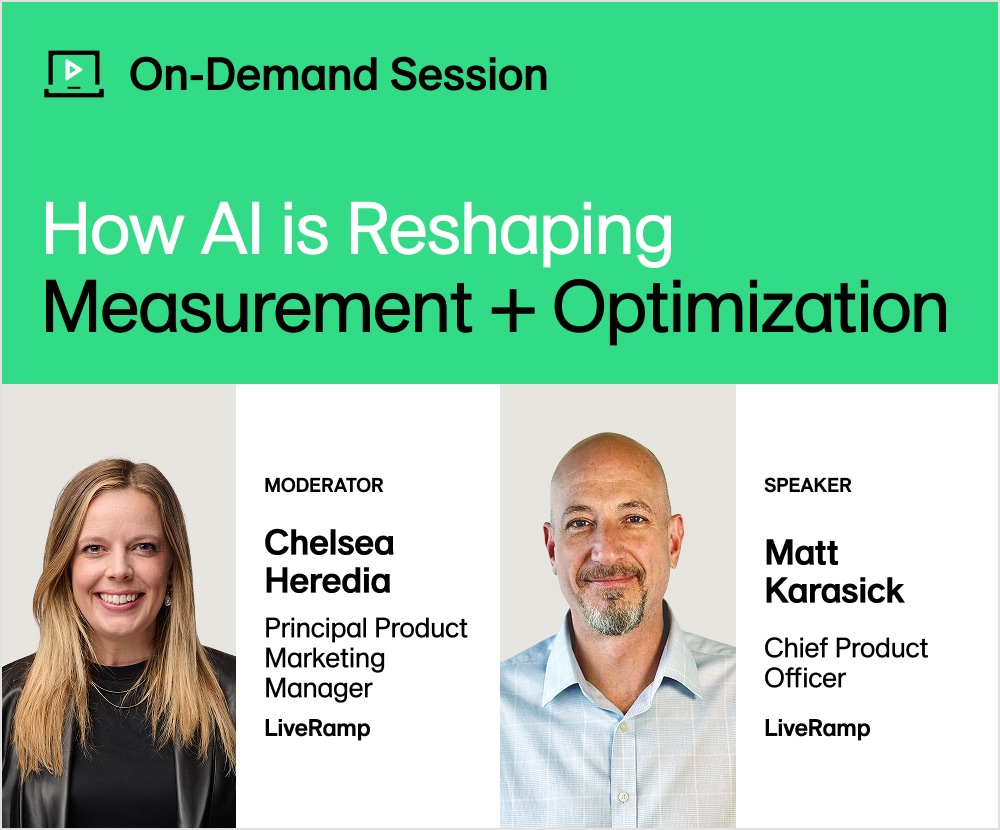
Ready to measure smarter and optimize faster? Join LiveRamp’s Chief Product Officer Matt Karasick on August 5 for a live conversation and Q&A on how agentic workflows are reshaping measurement and optimization. Save your spot.
AI needs a better measurement foundation
Preparing trusted data, orchestrating measurement across channels, and turning insights into action depend on connected, governed data. Without it, AI simply automates fragmented workflows and scales inconsistent measurement.
That’s why building an AI-ready measurement strategy isn’t just about adopting new tools. It starts with a connected measurement foundation. This is where LiveRamp takes a fundamentally different approach.
Build an AI-ready measurement foundation
The biggest barrier to AI-powered measurement is a fragmented infrastructure: Data is scattered across platforms and clouds. Methodologies vary by channel. Walled gardens create blind spots. Sound familiar?
AI-powered measurement works best when it understands two key elements: product context and customer context. Product context covers methodologies, inputs, outputs, and common use cases. Customer context combines publicly available information – such as seasonality and product launches – with insights specific to your customer relationship, including media strategy, key initiatives, and optimization opportunities. Without this context, reporting remains disconnected, making it difficult to build a consistent, trusted view of performance.
Connect fragmented data
A stronger measurement foundation starts by connecting those fragmented signals. LiveRamp brings first-, second-, and third-party data together with exposure data from across the ecosystem to unify measurement in a single environment. Built on RampID – the industry’s most durable, interoperable identifier for connecting the ecosystem – marketers can connect identity solutions, platforms, and partners without constraining data into a single system or rebuilding existing workflows.
Measure with transparency
Additionally, the LiveRamp Clean Room helps build trust and prevent data misuse by providing a secure environment for trusted data collaboration while ensuring each party’s privacy and governance controls are enforced. Because it interoperates across clouds and platforms, advertisers can securely connect siloed data spanning CTV, linear, digital, and social to unify measurement across reach and frequency, incrementality, and attribution – without the friction of moving data. And because the methodology is transparent, clients and publisher partners can review and approve the logic and underlying code behind every analysis, building confidence in the results and the flexibility to tailor measurement to their business needs.
Give AI trusted context
Together, identity, trusted data collaboration, and transparent measurement create the connected foundation AI needs to deliver better media optimization recommendations – not just faster reports. Instead of scaling fragmented workflows, AI can operate on a more complete view of customer interactions, helping advertisers optimize performance with greater speed and confidence.
How LiveRamp is putting agents to work
With a trusted measurement foundation in place, AI can automate more than reporting. It can improve how measurement is built, maintained, and optimized. That’s why LiveRamp is deploying agents across three layers of its ecosystem:
- Partner agents: Through our LiveRamp Agent Builder Program, partners like Newton Research, Datalinx, Akkio, and SemantIQ bring specialized agentic capabilities directly into the ecosystem.
- Customer-built agents: Leading marketers are already customizing attribution logic, synthetic control inputs, and LiveRamp-built measurement templates to fit their own workflows and business objectives.
- Embedded product agents: These agents improve how workflows get configured, refreshed, interpreted, and acted on – putting measurement in the hands of media planners, optimization leads, and brand buyers without requiring a data science team.
Agents are quickly becoming part of how the platform operates and how customers extract value from it.
{{ai-reshaping-webinar}}
From raw data to real-time recommendations
A typical cross-media intelligence clean room integrates 15 to 20 data connections, each requiring its own QA, transformation, and analysis. Here’s how agents move that process forward at every stage:
- Standardize inputs. An agent streamlines and standardizes data across sources, reducing the manual work required to prepare data for measurement.
- Orchestrate workflows. Agents interpret QA data across exposures, conversions, and audiences, update reporting parameters, and support troubleshooting from end to end – keeping measurement workflows running efficiently.
- Interpret results. Agents turn complex measurement outputs into actionable recommendations in near real time. Instead of waiting weeks to understand campaign performance, marketers can identify optimization opportunities while they’re still actionable.
- Action on insights. We’re piloting ways to pass de-duplicated reach, frequency, lift, and attribution signals directly to downstream partners, enabling more intelligent media buying decisions. Instead of relying on manual campaign adjustments, those signals can help optimize performance within marketer-defined parameters.
Here’s what this looks like in practice:
Datalinx AI ingests raw inputs from ad server reports and direct publisher connections, then trains customer-specific models based on each client’s taxonomy and hierarchy – reducing the manual work of naming, grouping, and mapping raw data for cross-media measurement. Consider a back-to-school campaign running across Meta, TikTok, Amazon, and five other platforms: the creative and placement IDs coming out of those platforms are long strings of numbers, not human-readable labels. An agent that categorizes them into recognizable names is a major time saver and keeps reporting accurate as new data rolls in.
Behind the scenes, by using LiveRamp embedded agents, the same approach accelerates refresh cycles, quality assurance, configuration updates, and output validation – tasks that once took days now happen in seconds.
In a pilot with Newton Research, LiveRamp is helping turn measurement outputs into actionable media optimization recommendations – identifying which publishers, creatives, audiences, and channels are driving the strongest performance over time. Instead of waiting weeks after a report is delivered to identify next steps, marketers can interpret months of measurement data in seconds and move quickly from insight to optimization.
Next, we are working in conjunction with top social and programmatic partners to allow cross-channel metrics around de-duped reach, frequency and attribution to be passed in a feed to platforms for use in bidder optimization. This would supplement the work a marketer does to manually optimize campaigns and make downstream bidding engines more intelligent.
The industry has spent too long confusing outputs with answers. A chart alone doesn’t improve performance. A recommendation, grounded in the right signals and delivered at the right time, does. That’s where AI becomes valuable in measurement: helping teams move faster from insight to action, and turning measurement into a driver of better decisions rather than just a record of what already happened.
Preparing for what’s next in AI-driven measurement
AI is changing what measurement can do, but it isn’t replacing the fundamentals. Success still depends on trusted identity, connected data, transparent measurement, and responsible collaboration.
Organizations don’t need to wait for fully autonomous marketing to begin preparing. Three steps can help you build a stronger foundation today:
- Audit where reporting breaks down. Identify two or three channels or partners where reconciliation takes the longest. That’s where AI will help least until the underlying data problem is fixed.
- Push for transparency from every AI tool. If a vendor can’t explain how a recommendation was generated, that’s a limitation worth factoring into the decision.
- Start with low-risk, agent-assisted workflows. Refresh cycles and data mapping are lower-risk places to let agents take on repetitive work before handing over interpretation or optimization decisions.
The marketers who get the most from AI will focus on building a trusted measurement foundation that enables faster decisions, stronger performance, and more confident optimization.
Ready to build a measurement foundation that’s ready for AI? Learn how LiveRamp’s cross-media intelligence and agent ecosystem help marketers move from fragmented reporting to action and optimization faster. Schedule a meeting.
FAQs about AI-powered measurement
Can AI replace traditional marketing measurement?
AI enhances traditional marketing measurement by automating data preparation, surfacing insights, and identifying optimization opportunities. However, AI still depends on trusted data, consistent methodologies, and human oversight to produce reliable results.
What data challenges can limit AI-powered marketing?
Fragmented data sources, inconsistent measurement methodologies and disconnected identities can reduce the effectiveness of AI-powered marketing by creating incomplete or conflicting views of performance.
How can marketers prepare for agentic AI?
Organizations can prepare for agentic AI by strengthening data governance, unifying measurement across channels, improving identity resolution, and establishing interoperable workflows.
Why is interoperability important for AI-powered marketing?
Interoperability is important for AI-powered marketing as it enables platforms to work together without manual intervention. This provides AI with broader context while supporting consistent analysis and optimization.
How can organizations evaluate whether their marketing data is AI-ready?
Organizations should assess whether their data is accurate, connected across channels, well-governed, and accessible. AI is best performed when it can rely on trusted, interoperable data rather than fragmented or incomplete datasets.