Identity Resolution vs. CDP: Where CDPs Miss the Mark
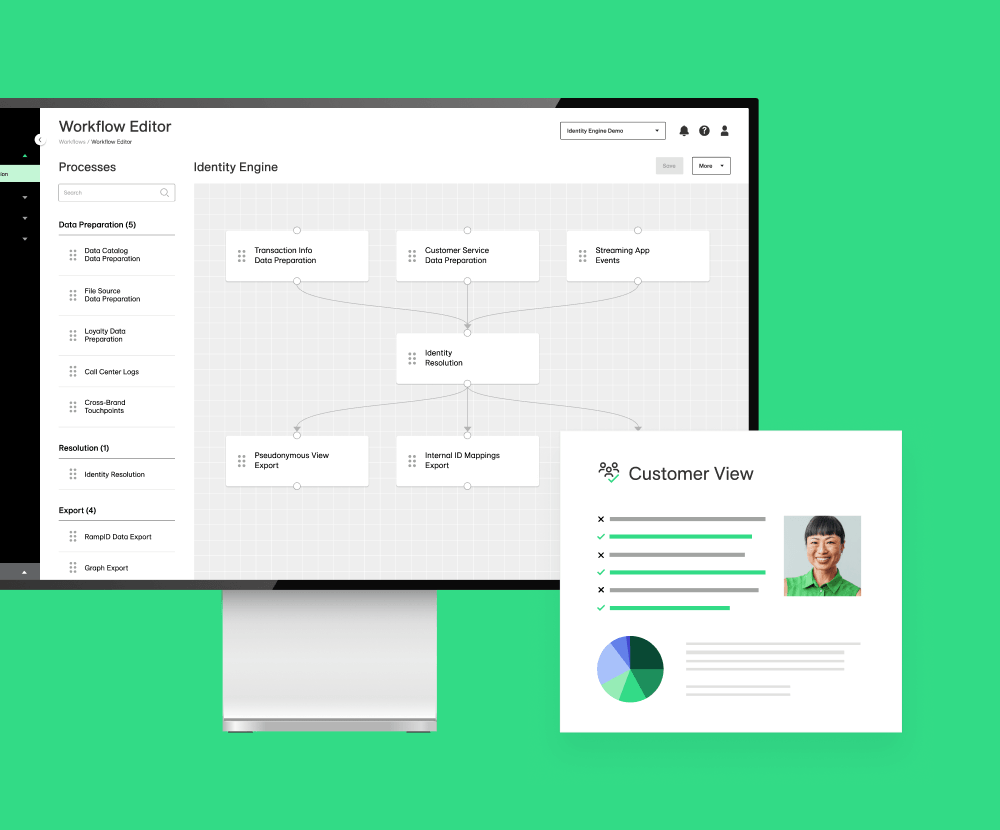
When it comes to customer data platforms (CDPs) and identity resolution, many marketers aren’t sure where one ends and the other begins. This confusion is understandable. While both assist in managing customer data, they play different roles. A CDP allows marketers to activate audiences to channels based on data you already own. Identity resolution is the infrastructure that allows you to recognize and connect those customers across your ecosystem – beyond the walls of your data.
A CDP unifies and activates first-party data within your organization. Identity resolution connects identifiers across devices, platforms, partners, and channels to create a complete, consistent customer view.
Some marketers assume identity resolution is baked into their CDP. In reality, most CDPs rely on basic matching rules to stitch profiles together internally. To reach customers across walled gardens, CTV platforms, and platform environments, you may benefit from a more durable, interoperable identity layer.
Marketers today know unified data drives growth. More than half say first-party and zero-party data (information intentionally shared by customers) will become even more important to advertising strategies in the next few years, according to EMARKETER.
So how do you stitch your data ecosystem together? Do you need a CDP, identity resolution, or both?
The answer is that for most enterprise brands, these are complementary tools in the same toolbox. While a CDP serves as the central hub for organizing the data you already own, identity resolution acts as the connective tissue that allows that data to travel – and remain accurate – across the broader advertising ecosystem.
This guide breaks down the differences, explains where CDPs fall short, and shows how to build a durable identity strategy that scales with today’s marketing landscape.
Key takeaways
- CDPs unify and activate first-party data within your organization, while identity resolution connects identity across platforms, partners, and channels.
- CDP-based identity resolution is typically limited to owned systems, making ecosystem-wide activation and measurement more difficult.
- Interoperable identity is essential for consistent cross-channel activation, deduplicated measurement, and privacy-enhanced data collaboration with robust security controls.
- For many enterprises, combining a CDP with scalable identity resolution creates the foundation for AI-driven personalization and measurable performance everywhere it matters.
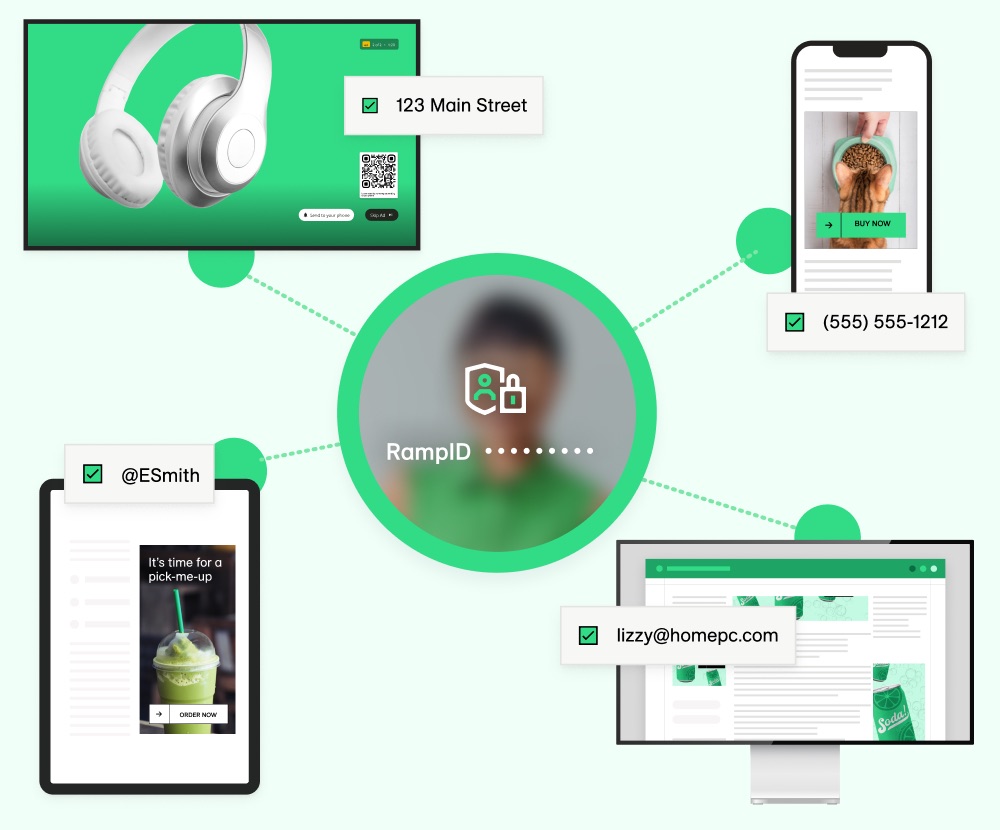
{{identity-explainer}}
Identity resolution vs. CDP: What are the differences?
It’s a common misconception that identity resolution and CDPs provide the same solution.
While both can unite customer data, identity resolution – and LiveRamp's RampID specifically – spans across devices, channels, and touchpoints to deliver a complete, actionable picture of a consumer's digital behavior. These unified insights can then be leveraged for data collaboration with platforms and partners to deliver cohesive omnichannel experiences.
A CDP collects, unifies, and activates first-party customer data across departments within your organization. While many CDPs can ingest external data, they are primarily designed to organize and activate data within owned systems rather than maintain a consistent identity across independent platforms and partners.
Most CDPs aren’t built to resolve identity at scale across all the devices and channels where customers spend time. Here are the core differences between identity resolution and CDPs:
The limitations of identity resolution within a CDP
In one Deloitte study, 92% of retailers believed they delivered effective personalization, yet more than half of consumers disagreed. This gap revealed a growing disconnect between internal data confidence and real-world customer experiences.
CDPs sometimes use built-in identity resolution to stitch together emails, device IDs, and CRM records into unified customer profiles. For internal marketing workflows, that’s valuable. But customer data platform identity resolution is designed to support internal CDP use cases – not ecosystem-wide connectivity. As customer journeys expand across CTV, retail media networks, social platforms, and publisher environments, those limitations become a competitive disadvantage.
- Owned data only goes so far
- Limited interoperability across platforms and partners
- Measurement and collaboration challenges
- Scaling identity beyond internal workflows
Owned data only goes so far
CDP identity resolution typically focuses on first-party data that lives within the platform: CRM records, website interactions, app usage, and email engagement. This supports internal segmentation and personalization, helping teams understand their customers within owned environments.
But today’s marketing doesn’t happen in just one environment. Brands increasingly need to connect identity across publishers, retail media networks, CTV platforms, social platforms, and data partners. When identity resolution is confined to owned systems, it becomes harder to maintain consistency and activate cross-channel campaigns as audiences move across the broader ecosystem.
US Bank faced this challenge. The organization wanted to activate its first-party data seamlessly across Facebook, Google, LinkedIn, and Pinterest without managing separate integrations for each platform. They needed a secure identity infrastructure that extended beyond their CDP and continued to protect customer privacy.
“US Bank had invested considerable resources into building up our customer data, but more importantly, we needed to find a way to activate this data on every platform where our audiences were spending time,” explained David Barnes of US Bank. “We needed a solution that integrated with all of the premier destinations we needed.”
Limited interoperability across platforms and partners
Most CDPs are optimized to connect, activate, and analyze data within the platforms they’re directly integrated with. However, identity frameworks vary across walled gardens, CTV, retail media networks, and measurement partners.
Without interoperability across identifiers, clouds, and platforms, marketers can face:
- Audience fragmentation
- Inconsistent match rates
- Duplicated reach
- Gaps in cross-channel measurement
To generate new consumer insights, deepen measurement, and pursue unique activation opportunities, marketers need more than CDP identity resolution.
“It’s critical to work with a partner that can accurately and consistently map and match all of those different identifiers back together,” explained Daniella Harkins, LiveRamp’s SVP of Product Go-to-Market. As the advertising ecosystem grows more complex, a durable, flexible identifier is essential to building meaningful customer experiences that deliver real results.
Measurement and collaboration challenges
Successful omnichannel marketing doesn’t happen in a silo. Companies like KitchenAid, Microsoft, and LinkedIn depend on collaboration with retailers, publishers, platforms, and agencies to drive performance across customer touchpoints.
When identity resolution is confined to a CDP, supporting secure data collaboration and accurate measurement is difficult. Matching data with external partners often requires additional workflows, custom integrations, or complex, manual processes – increasing risk and reducing accuracy.
This limits your ability to:
- Connect exposure data to real-world outcomes
- Achieve closed-loop measurement across channels
- Collaborate in secure environments like clean rooms
“There is nothing more important right now in the B2B landscape than being able to measure your campaigns accurately,” said Lauren Atiehm, business development manager at LinkedIn Marketing Solutions. “If you have multiple campaigns live on all these different channels, you have to be able to measure everywhere so you can understand the value of your advertising.”
In an outcomes-focused world, consistent identity across the ecosystem is a proven way to unlock closed-loop measurement, real-time optimization, and marketing innovation.
Scaling identity beyond internal workflows
As data volumes increase, journeys fragment, and signals fade, identifiers must do more than stitch profiles together. Identity solutions should be equipped to scale across devices, clouds, and partners while maintaining durability and governance.
CDP identity resolution is typically not designed to support:
- Enterprise-scale data processing
- Cross-cloud collaboration
- Consistent identity across emerging platforms
- Complex privacy regulations and requirements
When Indeed needed to connect millions of job seekers to their next best role – without relying on cookies – the company turned to LiveRamp’s RampID. By resolving first-party data directly within its cloud environment, Indeed replaced cookies, strengthened data governance protections, and achieved a 20% increase in response rate and 54% growth in re-targeted audiences.
“From a data collaboration perspective, it’s definitely impactful for us to be able to transact on publisher-specific ID,” said Paul Bloom, Indeed’s director of product management. As marketing ecosystems evolve, identity resolution must too.
When do you need a CDP, identity resolution, or both?
Real-time personalization runs on data – and AI has become the engine. Over a third (38%) of marketers plan to use AI to enhance their predictive analytics and insights, a 2025 survey found.
But AI-driven activation depends on more than collecting signals. It requires an identity foundation that can connect signals across platforms and turn them into measurable outcomes. Understanding where a CDP fits in your customer data strategy and where identity resolution can enhance it will help determine your path forward.
When you need a CDP
A CDP is powerful when the priority is internal personalization only, such as special offers on your app or customized email campaigns. It helps unify first-party data from CRM systems, websites, apps, and email platforms to build customer profiles that support segmentation, analytics, and automation across touchpoints.
If your primary goal is activating and optimizing experiences within your owned channels only, a CDP can provide the structure and workflows to make that happen.
When you need identity resolution
Identity resolution becomes critical when activation or measurement across platforms is a blocker. If your data infrastructure is already in place but audiences fragment across CTV, retail media networks, publishers, and social platforms, consistent identity becomes the missing link.
Without an interoperable identifier, your organization – and any AI models you’re using – lacks the complete signals and insights needed to optimize performance. Identity resolution connects the dots – enabling deduplicated measurement and stronger AI-driven optimization.
When you need both a CDP and identity resolution
Many organizations operate across complex ecosystems that include multiple clouds, partners, media channels, and data providers. In this case, CDP identity resolution isn’t enough.
A CDP can organize first-party data and orchestrate customer journeys within your owned channels. With identity resolution, data connections expand securely and consistently beyond your walls – across platforms, partners, and measurement environments. Together, CDPs and identity resolution create the foundation for scalable personalization, responsible collaboration, and measurable performance across the ecosystem.
Enhance your identity strategy with LiveRamp
CDPs help unite and activate first-party data within your organization. LiveRamp helps you connect it everywhere it matters.
Designed for neutrality, the LiveRamp Data Collaboration Platform extends the value of your CDP with durable identity resolution and translation, powering advertising across 500+ of the most important media and martech platforms.
Don’t neglect your existing investments – strengthen them. Discover what’s possible with LiveRamp’s on-demand demo.
The proof is in the numbers. LiveRamp achieved over 99% match rate score, validated by Comscore in an independent, third-party analysis — so you can trust you're reaching the same customer across every data touchpoint. Combined with 90% destination reach, that translates to nearly 3x the revenue compared to single-identifier solutions.
{{personalization-playbook}}
Identity resolution vs. CDP FAQs
What is identity resolution?
Identity resolution is the process of linking identifiers – such as emails, device IDs, phone numbers, and in-store transaction data – across both online and offline touchpoints, devices, channels, platforms, and partners to create a more complete, consistent customer view. It enables unified activation and deduplicated measurement across the broader marketing ecosystem, not just within owned systems.
What is a customer data platform (CDP)?
A customer data platform (CDP) collects, unifies, and activates first-party customer data from across an organization. It helps teams build customer profiles that support segmentation, analytics, and personalization within owned channels only.
What is identity resolution in a CDP?
Identity resolution in a CDP stitches together first-party identifiers like email addresses, CRM records, and device IDs to unify internal customer profiles. While valuable for internal workflows, it is often limited to owned data and environments.
Do all CDPs include identity resolution?
Most CDPs include basic identity resolution to merge customer records within the organization. However, these capabilities are usually designed for internal profile management rather than ecosystem-wide interoperability.
Is identity resolution a feature or a standalone solution?
Identity resolution can exist within a CDP, but at scale it often functions as a standalone infrastructure that connects data across the broader ecosystem.
Can you achieve identity resolution without a CDP?
Yes. Organizations can resolve identities across channels, enable cross-platform activation, and unify measurement – even without a CDP in place.
Can a CDP resolve identities on its own?
A CDP can resolve identity within its own environment, but it may not translate identity consistently across walled gardens, CTV platforms, retail media networks, and external partners. Ecosystem-wide connectivity often requires more durable, interoperable identity infrastructure.
Do brands need both a CDP and identity resolution?
Many brands benefit from both. A CDP manages first-party data and supports internal personalization, while identity resolution enables secure collaboration, cross-platform activation, and unified measurement across the broader ecosystem.

Identity Explainer
How to fuel unified customer experiences with connected data
The AI-Powered Personalization Playbook
Reach, resonate, and drive revenue across the modern consumer journey