

What Is a CDP? Customer Data Platforms Explained
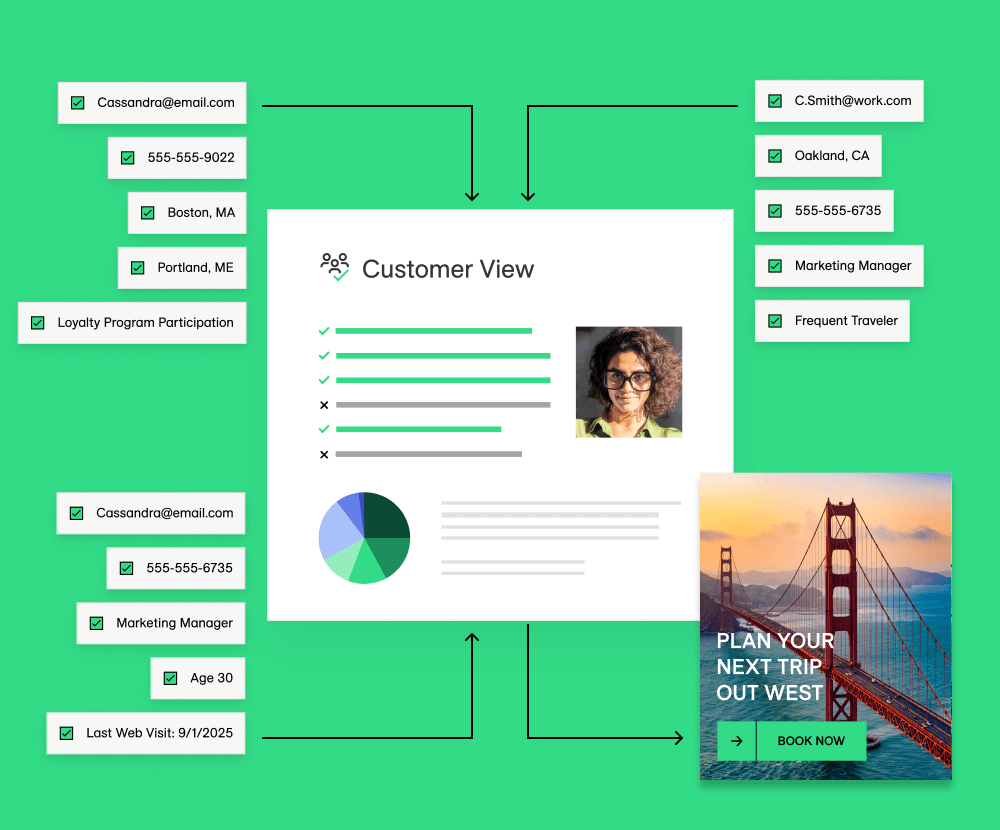
Customer data platforms (CDPs) address one of marketing's most persistent challenges – unifying customer data scattered across systems into a single, actionable view. For today’s marketers, this can include anywhere from 20 to 500 customer interactions throughout the buying journey, according to one 2023 study.
CDPs can give advertisers like you a start on pulling together what you know about your customers. They can serve as a single place for personalization and journey-mapping use cases through martech and digital channels. Many CDPs are great at what they do, but even the best ones have limitations in resolving identity, measurement, and connecting data of all types across every channel needed to truly power omni-channel personalization.
This guide walks through how CDPs work, what makes them valuable, where they typically face limitations, and how data collaboration platforms can help fill the gaps.
Key takeaways
- CDPs unify first-party customer data from multiple sources to create profiles that power personalized marketing across owned and paid media channels (e.g. email, web).
- While CDPs can give you a start on unifying your first-party data and journey orchestration, because most lack an identity graph they face limitations in identity resolution, data enrichment with second- and third-party sources, and measurement.
- Most CDPs can activate to martech and some digital channels, but are limited in reach and scale across all the channels marketers need.
- Advanced use cases like retail media collaboration, cross-screen measurement, and large-scale data partnerships require capabilities beyond what most traditional CDPs offer.
- CDPs need to be paired with a platform with complementary capabilities like LiveRamp to strengthen identity of first-party, connect data to second and third-party sources to enrich it for better personalization, and activate it to every possible marketing channel.
What is a customer data platform (CDP)?
A customer data platform is software designed to collect, unify, and activate first-party customer data from across different departments within your organization.
CDPs pull data from sources you own and control – your website, mobile apps, ecommerce platform, point-of-sale systems, email service providers, and customer support tools – then resolve that information into unified profiles tied to individual customers. This creates a foundation for segmentation, personalization, and cross-channel orchestration.
Unlike tools built for a single function – like CRMs for sales or analytics platforms for reporting – a CDP bridges a critical gap for brands by serving as a central repository where multiple first-party datasets can be brought together to create customer profiles for marketing activations. Still, many of these technologies remain untapped: while 72% of marketers now have a CDP, many use less than half of its total capabilities.
With their focus on known customers, CDPs can manage personally identifiable information, track offline or web interactions over time, and recognize the same person across devices and touchpoints – capabilities that are especially valuable for lifecycle marketing, retention strategies, and building long-term customer relationships.
How does a CDP work?
CDPs transform fragmented data into actionable customer insights. While different platforms vary in their features and sophistication, the core workflow typically includes four stages:
- Access data
- Unify and cleanse data
- Analyze data to build audience segments
- Activate data across marketing channels
1. Access data
A CDP connects to the systems where customer data lives, typically owned platforms like CRMs, email tools, or loyalty programs. Composable CDPs allow data to stay in their native environments, which allows advertisers to avoid having to move data.
CDPs can also access website behavioral data (what someone clicked, purchased, or viewed), demographic information available to the brand either through first or third-party data, and transactional records (order history, lifetime value). Most CDPs also offer pre-built integrations for data warehouses or cloud environments.
2. Unify and cleanse data
Once data is collected, the CDP works to resolve it into unified customer profiles. This means identifying which names, mailing addresses, phone numbers, email addresses, device IDs, or account logins belong to the same person, then attempting to merge those signals into a single record.
This step also involves data cleansing: removing duplicates and standardizing formats.
3. Analyze data and create audiences
With unified profiles in place, the CDP enables segmentation and analysis. Marketing teams can build audiences based on behavior (recent site visitors, repeat buyers), lifecycle stage (new customer, at-risk, loyal), or custom attributes (product preferences, engagement frequency).
Many CDPs also include predictive capabilities, using historical data to surface insights like churn risk, propensity to purchase, or next-best actions.
However, the depth of these insights is only as strong as the data available to the CDP. Because most rely primarily on first-party, owned data, they typically can’t incorporate external signals such as media exposure or partner-level performance data. That limits a marketer’s ability to analyze full-funnel impact or connect campaign outcomes across channels.
4. Activate data
Another crucial step is data activation – using customer profiles to deliver personalized experiences. CDPs typically integrate with owned-channel tools such as email, SMS, and on-site personalization engines, allowing marketers to trigger messages or automate workflows based on real-time behavior or predefined rules. This is often referred to as journey orchestration, where marketers can design conditional sequences like sending a follow-up offer if a customer doesn’t respond to an initial email.
While these automated journeys can streamline engagement, they tend to assume a linear customer path. In reality, most consumers interact across a mix of channels like email, mobile, connected TV, social, and more. This often happens simultaneously. As a result, orchestration that’s limited to a handful of owned or paid channels rarely captures the full customer journey.
CDPs also face constraints when it comes to activating audiences across the broader ecosystem. Their native integrations are typically limited to 20-50 destinations – mostly walled gardens like Meta, Google, or Amazon – and rely heavily on hashed email matching (HEM) to reach those partners. HEM-based matching can be fragile: even small variations in email formatting (capitalization, typos, or syntax) generate different hashes, reducing match rates and excluding valid customers.
Because these workflows depend largely on email identifiers, they miss opportunities to leverage other durable signals, like phone numbers or postal addresses, that could improve accuracy and scale.
To activate audiences wherever customers spend their time – and to unify measurement across all those channels – brands often supplement their CDPs with identity and data activation partners that provide deterministic matching across hundreds of destinations. This allows marketers to orchestrate connected experiences rather than channel-specific ones, ensuring consistent reach and message integrity from owned media to retail media, CTV, and beyond.
What are the benefits of using a CDP?
A CDP provides the foundation for understanding customers more completely and engaging them more effectively, leading to improved marketing performance and customer experience.
Creating a single customer view
When customer information is scattered across platforms – CRM, ecommerce, support, mobile – it's nearly impossible to see the full picture. A CDP brings those signals together, creating unified profiles that reflect each customer's interactions, preferences, and history with your brand. This connected view helps teams avoid redundant messaging, identify high-value segments, and make decisions based on complete context rather than partial data.
Personalization across channels
Roughly 2 in 3 consumers say they will leave brands with poor personalization, according to BCG. Instead of sending the same message to everyone, CDPs help you tailor content based on what someone recently viewed, purchased, or engaged with. This applies across email, SMS, push notifications, and on-site experiences.
However, this personalization is often limited to some paid media channels and owned channels. Extending that same level of precision across paid media, retail partnerships, or publisher networks typically requires additional infrastructure and identity resolution beyond what CDPs provide on their own.
Improved marketing performance
By centralizing data and enabling precise segmentation, CDPs help marketing teams work more efficiently. Campaigns become more targeted, reducing wasted spend on irrelevant audiences. Automated workflows save time and facilitate timely engagement. Since customer profiles are updated continuously, strategies can adapt to changing market behavior.
CDPs also support better reporting by tying actions back to individual profiles. That said, cross-channel measurement – especially across paid media – often requires integration with platforms built for attribution and analytics at scale.
Looking beyond traditional customer data management? Explore how the LiveRamp platform connects identity, collaboration, activation, and measurement.
Building a connected customer data strategy often requires capabilities beyond a traditional CDP. Learn why organizations choose LiveRamp to connect data, activate audiences, and measure outcomes across channels.
A look at CDPs vs. other data management tools
CDPs are often confused with other platforms that manage or activate customer data. Understanding how CDPs differ from CRMs, DMPs, and data collaboration platforms helps clarify where each tool fits and how they can work together to support a full-funnel strategy.
CRMs
A CRM (customer relationship management) platform is built for sales and service teams. It tracks leads, manages pipelines, and stores interaction history to help close deals and support customers. While CRMs contain valuable first-party data, they're not designed for marketing orchestration, real-time segmentation, or activation across channels.
Data management platforms
A DMP (data management platform) focuses on audiences for paid media campaigns. It collects third-party data – typically cookies and mobile ad IDs – and organizes it into segments that can be activated programmatically. DMPs excel at prospecting and short-term targeting but don't retain data long-term or manage PII.
As third-party cookies phase out and privacy regulations tighten, DMPs face shrinking utility. Many brands now look to CDPs and data collaboration platforms like LiveRamp to build audience strategies rooted in first-party data and durable identity frameworks.
For a deeper comparison, see our guide on CDP vs. DMP differences
Data collaboration platforms
Data collaboration platforms enhance what CDPs – and other marketing tools – can do. Where CDPs unify data and support personalization across owned channels, a collaboration partner like LiveRamp extends that value by:
- Resolving identity at scale using a deterministic graph that connects online and offline data with far greater accuracy than hashed email matching
- Activating audiences across unlimited destinations, including walled gardens, retail media networks, connected TV platforms, publishers, and DSPs
- Enabling data collaboration with second-party partners, allowing brands to unlock new insights, expand reach, and build high-performing media networks
- Powering cross-media measurement with secure identity that supports accurate attribution and optimization across paid and owned channels
The table below outlines the key differences:
The future of customer data platforms and LiveRamp
CDPs have become an essential infrastructure for data-driven marketers. But, as the commerce ecosystem grows more complex, their limitations also become harder to ignore. Nine in 10 business leaders now say data collaboration is critical to revenue growth, according to a 2024 survey, highlighting the importance of leaning on business partners to fill key data gaps.
For example, without a consistent, durable identifier, brands can lose 10-50% of their audience during onboarding, another 10-30% during measurement, and another 10-30% during optimization, creating a broken loop that makes accurate attribution nearly impossible.

A data collaboration platform like LiveRamp solves this data loss problem and extends the value of CDPs by providing:
- Enterprise-grade identity resolution that connects online and offline data with deterministic accuracy, increasing match rates by an average of 52% over hashed email matching
- Activation across 500+ destinations reaching 92% of where consumers spend their time – including walled gardens, retail media networks, connected TV, audio platforms, and premium publishers
- Data collaboration infrastructure that enables second-party partnerships, media network monetization, and secure insights generation through advanced clean room technology
- Cross-media measurement that unifies paid and owned channel performance on a consistent identity framework, powering smarter optimization and attribution

Case studies: How CDPs and LiveRamp win together
Many of the world's most innovative brands use CDPs to manage customer profiles and orchestrate engagement, while relying on LiveRamp to activate those profiles at scale, resolve identity across fragmented ecosystems, and unlock use cases their CDP wasn't designed to support.
US Bank Supercharged Data-Driven Marketing with LiveRamp and Adobe Real-Time CDP
U.S. Bank, a leader in financial-services innovation, recognized that customer touchpoints were multiplying across platforms. It needed a smarter way to harness its rich first-party data for personalized marketing at scale.
By partnering with LiveRamp and Adobe Real‑Time CDP, U.S. Bank unified its identity strategy and seamlessly activated audiences across the paid-media ecosystem. It boosted match rates by 2×-3×, eliminated the complexity of point-by-point integrations, and strengthening privacy and governance controls. With this approach, U.S. Bank is now able to deliver more meaningful experiences and continues to build on its reputation for data-driven growth and consumer-first engagement.
“Our investments in Adobe Real-Time CDP were amplified by its powerful audience delivery integration with LiveRamp. With Adobe and LiveRamp, we were able to efficiently activate all our valuable customer data, and use it to personalize touchpoints for maximum performance while minimizing risk and operational overhead.” - David Barnes U.S. Bank
Get started with LiveRamp’s data solutions
Whether you're building a new data strategy or looking to get more value from your existing CDP investment, see how the LiveRamp Data Collaboration Platform helps leading brands reach further, measure better, and collaborate responsibly with data.
FAQs on customer data platforms and LiveRamp
What is the main purpose of a customer data platform (CDP)?
CDPs unify first-party customer data from multiple sources – like CRM systems, websites, mobile apps, and point-of-sale platforms – into persistent, individual-level profiles. These unified profiles enable marketers to segment audiences, personalize experiences, and orchestrate engagement across owned channels like email, SMS, and web.
What’s the difference between a data clean room and a CDP?
When comparing a data clean room vs. CDP, it's important to understand that they serve different purposes. A customer data platform (CDP) collects, unifies, and activates first-party customer data within an organization's owned systems. A data clean room enables organizations to securely collaborate with partners, analyze data, and generate insights without exposing or transferring raw customer data.
Many organizations use both technologies together. A CDP helps manage and activate first-party data, while a data clean room supports privacy-safe data collaboration, measurement, and audience insights across the broader marketing ecosystem.
What are some of the limitations of a CDP?
While CDPs excel at unifying customer data and powering personalization across owned channels, they face several common limitations:
- Identity resolution in most CDPs relies on hashed email matching, which results in increased security risks to consumers, lower match rates, and incomplete profiles – especially when customers use multiple emails or interact across devices.
- Activation reach is often limited to 20–50 destinations, primarily walled gardens, leaving gaps when brands need to activate across retail media, connected TV, or publisher-direct inventory
- Enterprise identity at scale is a challenge for CDPs, which aren’t designed to support complex, multi-brand organizations or advanced data collaboration use cases
- Cross-media measurement requires more advanced identity continuity and analytical infrastructure to accurately attribute outcomes across paid and owned channels.
Is LiveRamp considered a CDP?
No, LiveRamp is not a CDP. LiveRamp doesn't store customer profiles, manage campaign workflows, or serve as a system of record for marketing data. Instead, LiveRamp is a data collaboration platform that enhances what CDPs and other marketing tools can do.
While CDPs focus on unifying first-party data for personalization across owned channels, LiveRamp provides the identity resolution, activation infrastructure, and measurement capabilities that extend CDP value across the full marketing ecosystem.
How does LiveRamp work with or complement existing CDPs?
Companies use a CDP to manage customer profiles and orchestrate engagement across owned channels, then rely on LiveRamp to:
- Improve identity accuracy by connecting online and offline data through a deterministic identity graph, increasing match rates by 52% on average compared to hashed email matching
- Extend activation reach to 500+ destinations, including walled gardens, retail media networks, CTV platforms, and premium publishers – reaching 92% of where consumers spend time
- Enable data collaboration with second-party partners through secure clean room technology, unlocking new insights and revenue opportunities
- Power cross-media measurement with a consistent identity framework that ties paid and owned channel performance together for unified attribution and optimization
LiveRamp integrates directly with leading CDPs, allowing brands to activate CDP-built segments across a much broader ecosystem while supporting privacy program and governance requirements.

Can businesses use LiveRamp without having a CDP?
Yes. While LiveRamp works seamlessly alongside CDPs, many businesses use LiveRamp as their primary platform for identity resolution, audience segmentation, and activation – without implementing a separate CDP.
For brands that don't need journey orchestration or owned-channel automation – or that rely on other tools like CRMs, data warehouses, or marketing clouds for those functions – LiveRamp delivers a complete solution for data collaboration and activation.
How does a CDP support a consumer data strategy?
A CDP can help organizations unify and activate first-party customer data, but a broader consumer data strategy also includes identity, collaboration, activation, and measurement across the marketing ecosystem.