

CDP Challenges: Why First-Party Data Isn’t Enough
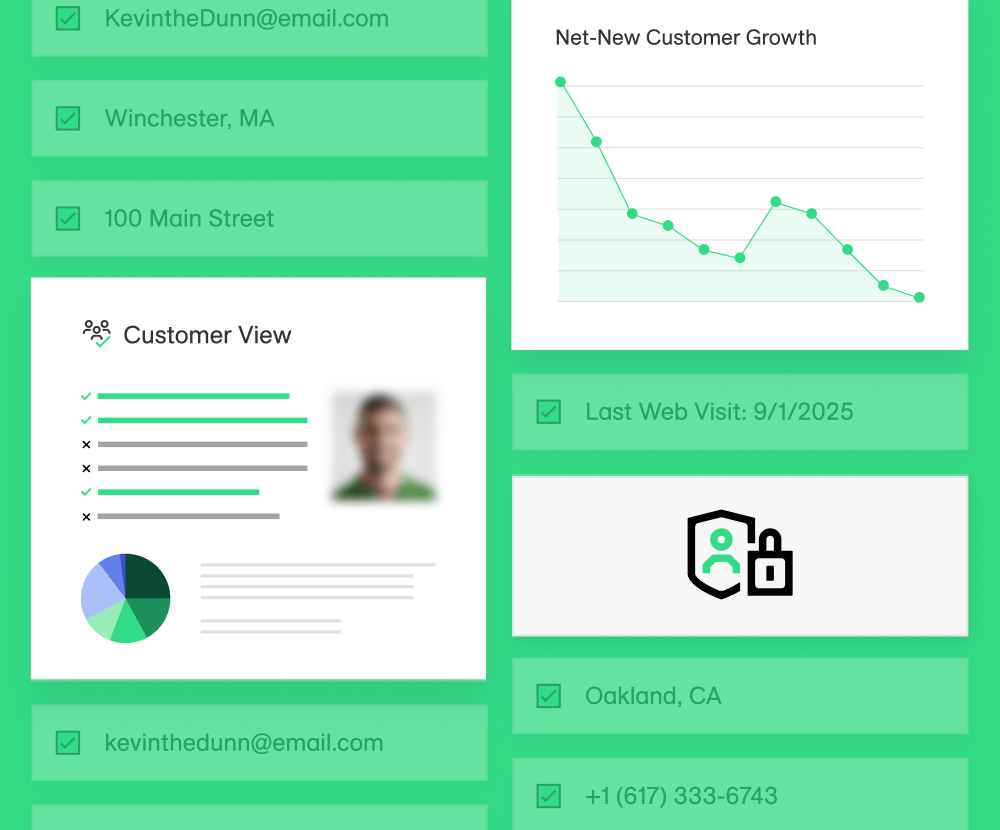
Customer data platforms (CDPs) were built for a simpler data reality. In the past, customer identity was relatively stable, there were fewer channels, and performance could be measured within individual platforms. That reality no longer exists.
Today, marketing teams are under pressure to prove impact across fragmented customer journeys, rising media costs, and increasing regulatory constraints. As LiveRamp CEO Scott Howe recently told EMARKETER, the modern marketer is operating in a “war for signals,” where the ability to connect data across environments, not just collect it, determines who wins.
CDPs play a critical role in organizing first-party data. But on their own, they struggle to resolve identity across devices, reach new audiences, or measure performance holistically. As a result, many brands find themselves lacking the insights needed to deliver on their goals.
Understanding where CDPs fall short and why those limitations matter to growth is the first step toward making them work as part of a more connected data strategy.
Key takeaways
- First-party data is essential, but has its limits. CDPs are critical for organizing owned data, but first-party signals alone can’t support the scale, activation, or insight required to meaningfully impact today’s fragmented customer journeys.
- CDPs can organize data but struggle with identity, reach, and measurement. They aren’t designed to resolve identities across devices and channels or deliver the connected signals needed to activate everywhere your customers spend time.
- Extending a CDP with data collaboration drives stronger outcomes. LiveRamp enhances your CDP investment with secure access to second- and third-party signals, identity resolution, and cross-channel measurement and activation. Pairing your CDP with LiveRamp’s data collaboration platform offers richer insights and broader reach to fuel growth.
{{personalization-playbook}}
6 CDP limitations that hold back business growth
As customer journeys stretch across more channels and touchpoints, CDPs simply can’t keep up. Most weren’t designed to resolve identity at scale or enable cross-channel growth, which results in critical gaps that limit reach, insight, and performance. Common limitations that can stall growth include:
- Limited customer view
- Limited ability to personalize at scale
- Inability to drive net-new customer growth
- Inability to measure marketing impact holistically
- Inefficient media optimization
- Data governance and compliance gaps
1. Limited customer view
Customer data platforms are designed to serve as a centralized system for first-party customer data. Given this focus on owned data, most CDPs struggle to deliver a truly complete view of the customer across channels.
Moreover, most CDPs rely on hashed email addresses to resolve customer identities across channels. While hashing obscures raw data, it doesn’t solve the underlying challenge of identity fragmentation.
Customers frequently use multiple emails, switch devices, or interact in channels where email isn’t available, resulting in incomplete and sometimes misleading customer records. Instead of a unified view, brands are left with fragmented profiles that fail to reflect the full customer journey.
The business consequences include:
- Inaccurate customer profiles that obscure true behaviors and preferences
- Lower match rates that limit addressability and reduce activation scale
- Missed opportunities to influence the full customer journey, as interactions can’t be connected end to end
2. Limited ability to personalize at scale
True personalization requires the ability to reach customers and prospects consistently across channels, devices, and environments. Most CDPs struggle with this.
Not only are CDPs limited to owned data, their data activation capabilities are often also limited to a relatively small number of destinations, typically concentrated in walled gardens and a handful of paid media platforms. When you need to reach customers across connected TV, retail media, audio, publisher-direct inventory, or emerging channels, personalization quickly breaks down.
Even within supported channels, audience matching via hashed PII is often inconsistent, leading to lower reach and uneven personalization across platforms. As a result, brands can’t reliably deliver relevant messaging everywhere their audiences spend time.
This limitation leads to:
- Inconsistent customer experiences across channels and devices
- Reduced effectiveness of personalization efforts, due to lower match rates
- Limited flexibility to test and scale new channels or partners
3. Inability to drive net-new customer growth
CDPs are effective at segmenting customers you already know. But because CDPs operate within the boundaries of owned data, they struggle to connect known customers with unknown prospects. This limits your ability to uncover new segments, understand emerging demand, and expand beyond the same audience pools your competitors are targeting.
Without access to broader data inputs and identity infrastructure, advanced prospecting techniques like lookalike modeling are either unavailable or confined to channel-specific environments. As a result, acquisition efforts become fragmented and difficult to scale, relying on incremental tweaks rather than insight into untapped demand.
The impact includes:
- Limited ability to identify high-value prospects
- Inconsistent audience definitions across platforms
- Reduced reach beyond walled gardens
- Slower market share growth and higher acquisition costs
4. Inability to measure marketing impact holistically
Measurement is where many CDP limitations become most visible. CDPs typically support owned customer journey mapping, basic site analytics, and limited signal sharing through conversion APIs. These capabilities offer some directional insight, but true cross-media measurement requires identity continuity and analytical infrastructure capable of connecting outcomes across the full media mix.
Because CDPs weren’t built for this level of interoperability and attribution, they struggle to show the true business impact of marketing investments.
Left unaddressed, this results in:
- Incomplete visibility into campaign performance across channels
- Inconsistent attribution, particularly for upper-funnel and cross-platform activity
- Difficulty comparing effectiveness across media types and partners
- Limited confidence in measurement-driven decisions
5. Inefficient media optimization
Effective optimization depends on seeing how audiences, ad frequency, and performance interact across channels. But because CDPs don’t maintain identity continuity across platforms, they struggle to detect audience overlap or manage ad exposure frequency holistically.
This forces you to make optimization decisions within individual channels or platforms, rather than across the full media mix, leading to redundant impressions, uneven exposure, and budget inefficiencies that are difficult to identify or correct.
The consequences include:
- Overlapping audiences across channels without visibility or control
- Overfrequency that contributes to waste and customer fatigue
- Inefficient media spend, driven by duplicated impressions
- Limited ability to reallocate budget toward what’s actually driving results
6. Data governance and compliance gaps
As brands activate audiences across more paid media and partner platforms, regulations and compliance requirements become increasingly complex. Many of the challenges described above are compounded by the way CDPs support activation through repeated sharing of hashed PII. Though this method allows CDPs to support activation to major channels like Google and Meta, it creates operational and governance challenges over time.
CDP governance challenges include:
- Expanded data exposure as sensitive identifiers move across multiple partners and platforms
- Increased compliance complexity as industry regulations continue to evolve
- Greater reliance on PII-derived identifiers than is ideal for long-term scalability
Turning customer data into measurable business outcomes requires connected workflows across the marketing ecosystem. Explore the LiveRamp platform.
As data ecosystems become more fragmented, organizations need more than a standalone platform. Learn why organizations choose LiveRamp to connect data, collaborate across partners, and support marketing performance at scale.
Solving CDP challenges with data collaboration
CDPs were built to manage data, not to drive growth. When data stays siloed, insight and performance stall. LiveRamp’s data collaboration platform changes that.
LiveRamp extends the value of your CDP by connecting it to a broader ecosystem of first-, second-, and third-party data. By adding enterprise identity solutions and interoperability on top of your existing stack, LiveRamp turns organized data into actionable intelligence to enable growth, reach, and measurement at scale.
Key advantages of LiveRamp’s data collaboration solution include:
- Enterprise identity at scale: Resolve identities consistently across your entire brand portfolio, ensuring continuity across channels, devices, and partners. Improve identity match rates by more than 50% compared with hashed email-based activation.
- Secure ecosystem connectivity and data collaboration: Connect first-, second-, and third-party data in a secure, responsible way without over-reliance on PII-based matching. And with 500+ direct media platform integrations, LiveRamp enables activation, measurement, and collaboration wherever your customers engage, not just inside walled gardens.
- More precise, adaptive, and scalable segmentation: Use machine learning and AI-powered natural language prompts to quickly build outcome-based audiences and scalable lookalikes from your best customers. Start with person-based, agnostic models, enhance with first-, second-, or third-party data, and continuously optimize segments to improve reach and relevance.
- Enterprise-wide innovation: Power your full marketing stack with a neutral, agnostic platform that keeps data portable and consistent across cloud environments, CRMs, CDPs, agencies, and media partners so you can unlock advanced use cases like audience enrichment, prospecting, and clean room collaboration.
For example, U.S. Bank partnered with LiveRamp and Adobe Real-Time CDP to improve audience targeting and reach. With LiveRamp, the bank was able to seamlessly activate audiences across Facebook, Google, LinkedIn, Pinterest, and The Trade Desk without the need for inefficient, piecemeal integrations. By minimizing operational overhead and risk by resolving data to RampID, the bank could satisfy stringent data governance controls in a unified manner across all bidding platforms. As a result of this streamlined delivery, U.S. Bank achieved a two- to three-times increase in match rates compared to its previous point-by-point identity and activation solutions, significantly boosting engagement and marketing performance.
In short, CDPs are most powerful when they’re part of a broader data collaboration strategy. Schedule a demo to learn how LiveRamp can extend the value of your CDP and help you connect data, audiences, and measurement across your entire ecosystem.
{{demo-live-connectivity}}
FAQs about CDPs
Still have questions about CDP challenges and how to overcome them? We’ve got answers.
What are the common challenges of using a CDP?
While CDPs are valuable for organizing first-party data, many brands encounter limitations as their marketing needs grow.
Common CDP challenges that make it harder to scale business outcomes include:
- Incomplete customer views due to limited identity resolution
- Difficulty identifying net-new audiences
- Constrained activation beyond walled gardens
- Fragmented measurement
- Inefficient optimization
- Increasing data governance and compliance complexity
Why do CDPs have limited identity resolution?
Most CDPs rely primarily on hashed, first-party identifiers such as email addresses to connect customer data. This approach breaks down as customers use multiple emails, switch devices, or engage in channels where email isn’t present. Without a broader identity framework, CDPs struggle to resolve identities consistently across channels, devices, and partners, resulting in fragmented profiles and lower match rates.
Can a CDP help with customer acquisition?
CDPs segment known customers and activate those audiences in select channels. However, because they are limited to owned data, CDPs struggle to identify and reach new, high-value prospects at scale. Advanced acquisition strategies – such as prospecting, lookalike modeling, and cross-channel audience expansion – typically require access to additional data and identity capabilities beyond what most CDPs provide.
How can brands overcome CDP limitations?
Brands can overcome CDP limitations by extending their CDPs with data collaboration and enterprise identity infrastructure. Connecting first-, second-, and third-party data in a secure, responsible way enables stronger identity resolution, richer audience insights, broader activation, and more holistic measurement without replacing existing systems.
Is a data collaboration platform the same as a CDP?
No, a data collaboration platform is not a replacement for a CDP. CDPs are designed to organize and activate first-party data, while data collaboration platforms are built to connect data across partners, platforms, and ecosystems. Together, they enable brands to achieve measurable growth through connected data.
What’s the difference between a CDP and a DMP?
When comparing a CDP vs. DMP, a customer data platform (CDP) primarily uses first-party customer data to support personalization, analytics, and customer engagement. A data management platform (DMP) traditionally relies on anonymous third-party data to build advertising audiences. As third-party cookies decline, many organizations are increasingly investing in first-party data strategies powered by CDPs.
.jpg)
Demo Live/Connectivity
Build precise, high-value audiences and reach them at scale with personalized experiences.
The AI-Powered Personalization Playbook
Reach, resonate, and drive revenue across the modern consumer journey