The Ultimate Guide to Identity Resolution: What It Is, How It Works, Why It Matters
Identity resolution helps you connect consumer data from a variety of sources to an individual or household in a responsible manner. As signal loss continues to challenge marketers, your ability to recognize customers at every touchpoint can determine whether your campaigns deliver meaningful results.
Key takeaways
- Identity resolution connects the dots between consumers' digital footprints to deliver a complete picture of their online behavior across devices, channels, and touchpoints.
- Deterministic and probabilistic matching work together to link disparate data points with strong precision and create consistent, actionable customer profiles.
- A robust identity strategy helps protect against signal loss while supporting your customer privacy program requirements and data governance standards.
- LiveRamp's identity solutions deliver addressability throughout the entire digital ecosystem, helping you engage customers where it matters most.
Today’s digital landscape has fragmented dramatically. Consumers interact with brands on an average of 21 connected devices per household, creating disjointed customer journeys that span mobile apps, websites, email, social media, CTV, and in-store experiences. Without a way to connect all these interactions, you're left with incomplete customer profiles that lead to wasted ad spend and missed opportunities.
Instead, identity resolution now leverages specific technical approaches – like referential or authenticated identities – to address distinct needs such as display advertising, clean rooms, or customer profile compilation. This specialized landscape makes a comprehensive partner like LiveRamp even more vital for brands navigating these silos.
As consumer expectations for responsible data practices rise, a robust identity strategy is increasingly important. Identity should serve as the foundation of everything you do across your enterprise.
{{identity-explainer}}
What is identity resolution?
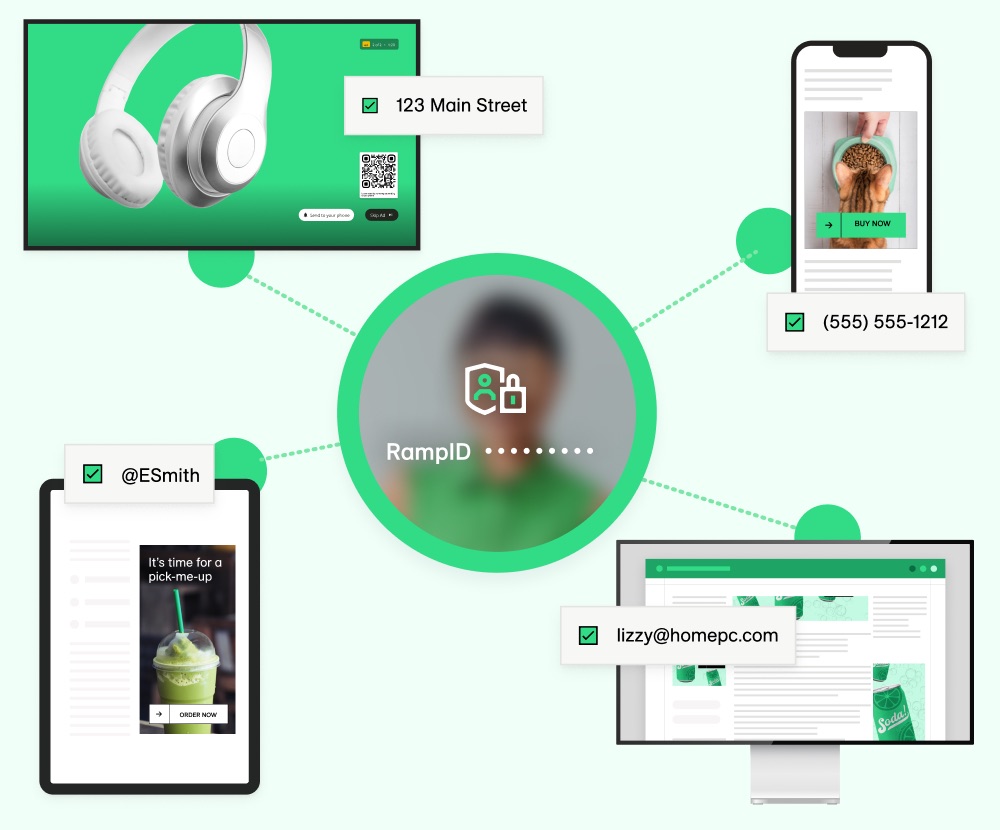
Identity resolution is the process of linking consumers' digital footprints to give you a more complete picture of their online behavior across devices, channels, and touchpoints. It’s a key component of effective data collaboration, promoting consistency and accuracy through multiple platforms and partners.
The process employs advanced algorithms to link disparate pieces of data to the correct individuals. This creates a comprehensive picture of a user's interactions on multiple platforms. By resolving identities across channels and devices, you can recognize customers when they interact with your brand.
For example, a customer browses your website on their laptop, sees your ad on Instagram via mobile, and later completes a purchase through your app. Without identity resolution, these appear as three separate users. With it, you understand this is a single customer journey and you can deliver relevant messaging at each stage.
Identity resolution can help mitigate signal loss so you can tailor campaigns to customers' behaviors, preferences, and interests.
How does identity resolution work?
Identity resolution combines data management strategies and advanced analytics to address signal loss and establish more consistent identifiers throughout customer journeys. Understanding the key elements helps you implement identity resolution effectively.
Tokenized data
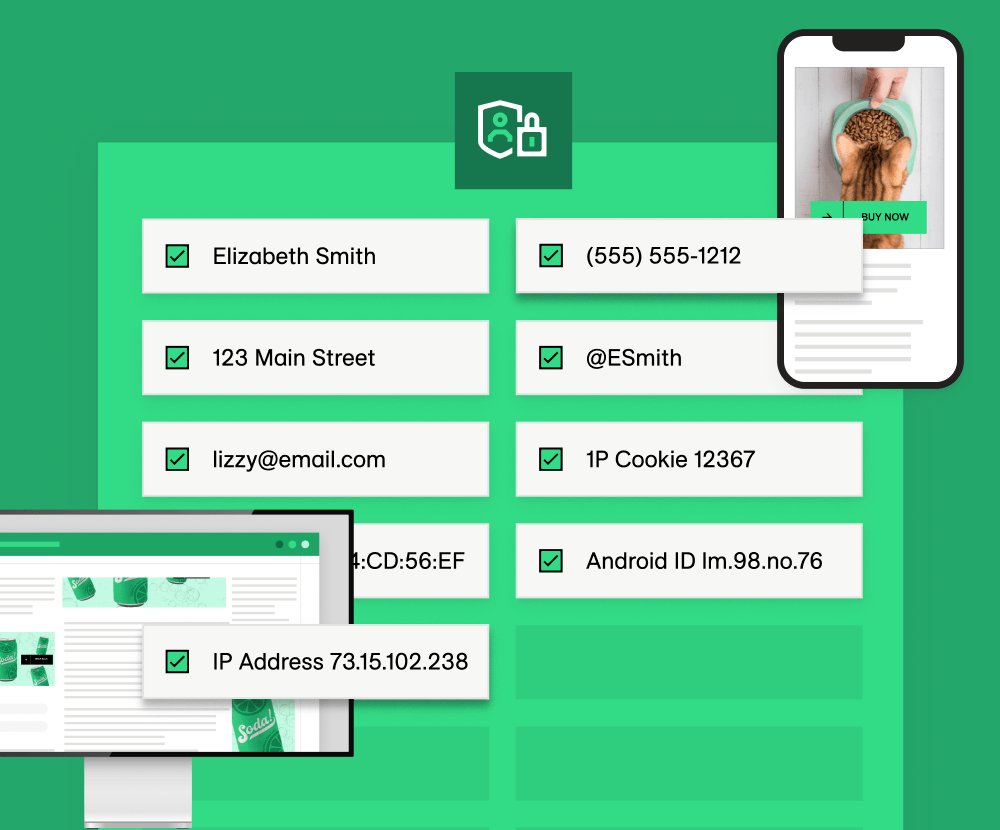
Tokenized data includes data points that don't directly identify an individual but help you understand a person's online activities and preferences. For example, a mobile ad identifier (MAID) is a unique identifier created by a mobile device's operating system and shared with apps downloaded to the device.
MAIDs help you understand an individual's behavior without needing PII. Identity resolution collects and connects these datasets, then resolves them down to an individual entity while supporting your customer privacy program requirements.
Offline data
Offline data comprises PII, such as an individual's name, postal address, email address, and telephone number. Your organization compiles this data through ongoing customer interactions and stores it in an offline reference graph. This foundational data anchors digital behaviors to known individuals.
Resolution
The resolution process uses advanced algorithms and matching logic to accurately link disparate data sources and create consistent identities. You can perform resolution at either the individual or household level depending on your business objectives. In both cases, resolving identities helps you personalize customer experiences across channels.
Deterministic matching
Deterministic matching links different identifiers using exact, verified data points. When someone starts a new job, deterministic matching can link their new work email to accounts associated with their previous one.
This approach offers strong precision because it relies on known identifiers like email addresses, phone numbers, or user IDs. For higher precision and widest reach, this step should use a third-party offline reference graph.
Probabilistic matching
Probabilistic methodologies complement deterministic matching to create a fuller picture of online identity. For example, if two devices consistently connect from the same IP address, use the same Wi-Fi network, and share similar browsing patterns, probabilistic matching infers they likely belong to the same household.
Probabilistic matching uses statistical modeling to understand these groupings and assign them to identities at varying confidence levels. This approach expands your addressable audience beyond what deterministic data alone can reach. While less precise than deterministic methods, it offers greater scalability when deterministic data is unavailable.
The business value of identity resolution
Identity resolution delivers tangible business impact to your marketing organization. According to Forrester Research, effective identity resolution solutions provide organizations with “the precision, scale, and reach for marketers to develop a complete view of their customers.”
The same research found that marketers implemented identity resolution solutions to manage data, target audiences, and personalize experiences.
At LiveRamp, we see multiple benefits accruing to brands that implement identity resolution:
Reduce wasted ad spend. Avoid showing the same ad to the same person across multiple channels, or continuing to promote products they've already purchased. Identity resolution lets you suppress converted customers, cap frequency per channel, and help every impression work harder.
Whirlpool used identity resolution to create a 360-degree view of their consumer, allowing them to identify exactly which shoppers were already interacting with their retail partners versus their direct-to-consumer site.
The Business Impact:
- 5x greater reach to addressable audiences.
- Eliminated 200,000 duplicated audiences, directly reducing wasted media spend and improving acquisition costs.
- Gained the necessary stakeholder buy-in to extend data collaboration across all 13 global brands
Improve measurement and attribution. When you can't connect touchpoints to the same individual, you can't understand which channels actually drive results. Identity resolution provides the connected customer view you need for accurate cross-channel measurement.
Deliver personalized experiences at scale. Today's customers expect relevant interactions at every touchpoint. A complete view of each customer's preferences, behaviors, and brand history makes this possible.
Tailored Brands built a safe identity infrastructure that resolved all known and tokenized digital data to a single identifier (RampID). This allowed them to connect in-store and online data to deliver personalized experiences across the entire journey.
The Business Impact:
- 26% higher ROAS on web for Men’s Wearhouse.
- 42% increase in incremental revenue for Jos. A. Bank.
- Nearly doubled customer match rates on Google.
Support responsible data practices. A centralized identity framework helps you support honoring consumer preferences consistently across all systems, supporting your data governance requirements and building consumer trust.
Understanding the value of identity resolution is one thing – seeing how it works in your organization is another.
Effective identity strategies depend on transparency, governance, and responsible data stewardship. Learn more about LiveRamp's approach to data ethics and privacy.
Types of identity resolution use cases
Forrester Research identifies customer data onboarding and identity graph management as the core use cases buyers most frequently seek from identity resolution vendors. Beyond these, extended use cases like audience building, data clean rooms, and identity graphs are becoming increasingly critical for sophisticated marketing organizations.
LiveRamp enables identity resolution in a variety of ways to help customers create unified, connected customer views.
Enterprise identity
Enterprise identity involves resolving digital data within your organization's own four walls. LiveRamp matches and resolves your first-party customer and prospect data, including transaction, CRM, and CDP data, as well as information from call center inquiries and live chats.
Business intelligence and analytics teams most often use enterprise identity to gain a connected customer view for evaluating metrics like cost of acquisition, churn risk, lifetime value, and other KPIs. LiveRamp lets teams customize identity rules, infrastructure, and identifiers to align with your business priorities.
Our methodology is designed to deliver high-quality matches across devices and platforms in identifying and linking the same user on multiple devices and platforms, without requiring you to build your own. Your identity framework remains consistent and clear, so you get the most accurate and connected customer view possible.
RampID
Building an effective, engaging modern customer experience requires data connectivity: the linking of disparate datasets across ecosystems and identity environments. RampID serves as an important part of the data connectivity story.
LiveRamp's durable, responsible identifier enhances addressability so you can maximize your marketing impact. You can reach audiences at scale, across major markets and channels, to deliver personalized experiences across browsers, mobile devices, CTV, and anywhere else customers spend time.
RampID helps you deliver more relevant content and eliminate the digital echo chambers of repetitive ads and irrelevant messaging. An example: showing a discounted plane ticket offer to a customer after they've already booked a flight only frustrates that customer. RampID helps reduce this friction so you can deliver the right messages at the right times.
Data clean rooms
Data collaboration across ecosystems fuels insight-driven innovation, but without the right infrastructure, it can introduce data leakage and compliance risks. The LiveRamp Clean Room offers advanced controls and permissioning, along with privacy-enhancing technologies, so you can unlock powerful measurement tools and analytics that improve business outcomes.
One key use case for data clean rooms is identity translation: the process of translating identifiers among different identity environments. Identity resolution helps you generate stronger ROI from your clean room investments by enabling accurate overlapping and matching of datasets from multiple platforms and partners.
Common identity resolution challenges marketers face
As industry regulations have matured, this has changed the ways brands access, use, and share customer data. With increasing signal loss, connecting and analyzing data throughout the digital ecosystem is more complex than ever.
Signal deprecation. Signal loss imposes a real ceiling on the efficacy of identity solutions. Forrester Research highlights that in this environment, "nobody has enough owned data and resolved identities to fully operate across the marketing ecosystem." This makes data collaboration and identity interoperability across partners a premium requirement. To overcome these limits, brands must prioritize identifiers that are portable and recognized across different environments
Fragmented data sources. Customer data often lives in siloed CRM systems, marketing platforms, transaction databases, and customer service tools. Connecting these disparate sources requires sophisticated matching logic and a consistent identity framework.
Balancing personalization and privacy. Consumers expect personalized experiences while valuing brands that respect their privacy. Effective identity resolution must support your customer privacy program requirements while enabling meaningful personalization.
Scaling across channels. As consumers interact with brands on more channels and devices, maintaining consistent identity becomes more challenging. You need a partner who can connect and translate any combination of digital identifiers at scale to bridge gaps between channels and publishers, enabling cross-screen and cross-media measurement.
Identity is foundational to effective marketing and measurement. Learn why organizations choose LiveRamp to build a more connected view of customers across channels and platforms.
How LiveRamp identity solutions can help
To deliver personalized campaigns at scale, you want the most accurate, connected view of your customers built on well-defined identity rules that apply consistently in every consumer interaction. These identity rules should align with your specific operational goals and customer engagement strategies.
LiveRamp's identity solutions create a holistic, connected view of customer data across your enterprise and beyond. We power addressability throughout the entire digital ecosystem so you can engage customers where it matters most.
What sets LiveRamp apart
- Broad scale and reach across the global digital ecosystem
- Durable, responsible identifiers designed to remain effective as signals deprecate.
- Flexible collaboration capabilities that work with your existing technology investments
- Security-focused infrastructure compatible with your data governance requirements
- Demonstrated accuracy backed by an industry-leading offline identity graph
Put identity resolution to work
Identity resolution isn't just a technology decision. It's a strategic foundation that determines your ability to understand, reach, and engage customers across every touchpoint. The brands that invest in robust identity capabilities will be positioned to thrive as signal loss accelerates.
Ready to transform your identity strategy?
Contact us to learn how our identity resolution expertise can fuel your business goals.
{{commscore-match-rate}}
Frequently asked questions about identity resolution
Have questions? Here are answers to the ones we hear most often.
What are identity graphs?
An identity graph is a data structure that maps relationships between various identifiers and links them to a single individual or household. It provides a detailed, unified view of customer interactions across multiple touchpoints.
What is the role of identity resolution in identity graphs?
Identity resolution accurately and continuously updates the connections between identifiers within identity graphs. When a customer logs in on a new device or updates their contact information, identity resolution works to match these new data points to the existing customer profile.
How does identity resolution improve cross-media marketing?
By linking customer data across websites, apps, email, and in-store visits, identity resolution helps you create a unified customer profile. You can deliver consistent messaging, personalized offers, and relevant experiences at every touchpoint.
Can identity resolution work for both B2B and B2C brands?
Yes. For B2B, identity resolution links company and decision-maker data, helping brands tailor messaging and improve account-based marketing. For B2C, it connects individual consumer data across touchpoints – and because data collaboration and identity interoperability with partners is critical for reach and addressability, it's especially impactful. The goal is the same: unified, actionable customer profiles.
How does identity resolution support customer retention?
By creating accurate, comprehensive customer profiles, identity resolution enables you to better understand customer needs, preferences, and behaviors. This insight allows for personalized offers and engagement strategies that drive loyalty and improve retention.
Why is now the right time for brands to adopt identity resolution?
Between signal loss and the increasing demand for responsible data practices, now is the ideal time. Identity resolution empowers you to maintain effective, personalized marketing strategies while navigating signal loss and meeting changing consumer expectations.
SOURCE: ”The Identity Solutions Landscape, Q4 2025”, Forrester Research, Inc., December 30, 2025.

Identity Explainer
How to fuel unified customer experiences with connected data