

AI-Powered Campaign Analysis for Better Marketing Decisions
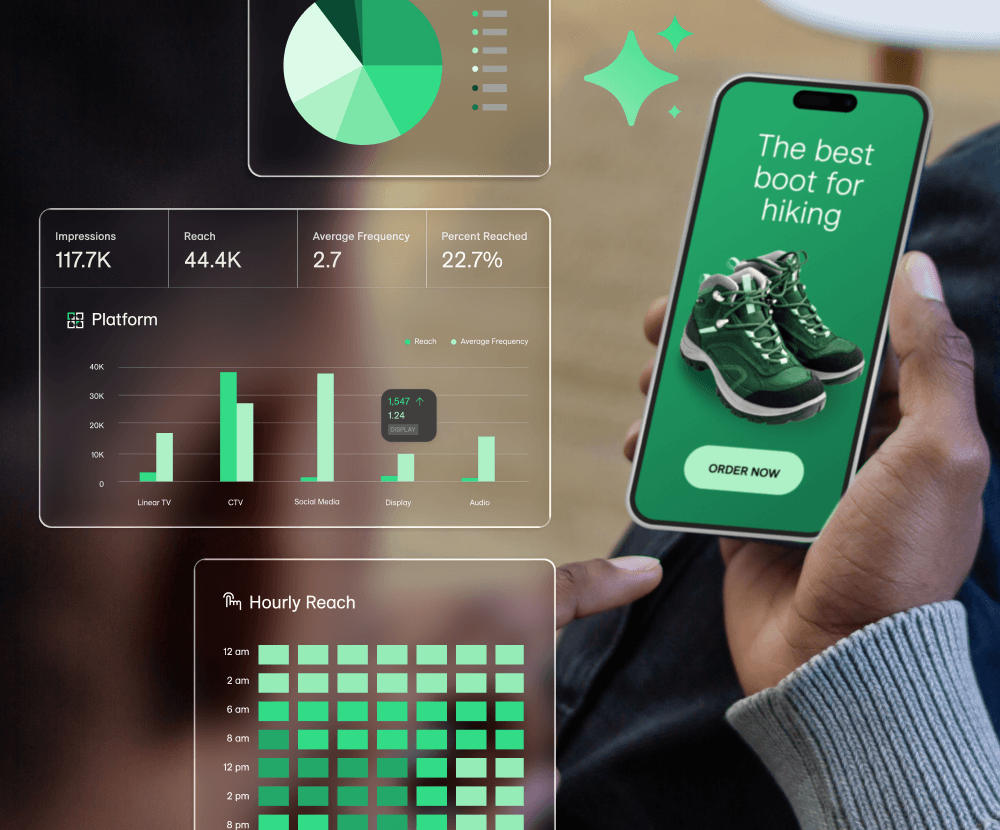
Every campaign generates data about your audiences, creative, channels, and outcomes. The challenge is turning all of those signals into a clear picture of what’s working, what isn’t, and where to focus next.
AI is quickly becoming part of that process, but you may still be figuring out how to apply it across campaigns. According to the IAB, only 30% of agencies, brands, and publishers have fully integrated AI across the media campaign lifecycle.
AI-powered campaign analysis can help close that gap by processing large volumes of data to surface patterns, flag performance changes, and reduce manual reporting. With connected, reliable data and human expertise behind the analysis, you can spend less time piecing together campaign results and more time using them to plan your next move.
Key takeaways
- AI-powered campaign analysis uses technologies such as machine learning, predictive analytics, and automation to evaluate performance and reveal trends.
- Connecting campaign and customer data can give AI a more complete view of performance across audiences, channels, and platforms.
- AI can help you identify patterns, forecast potential outcomes, and reduce manual analysis, but human judgment remains essential.
- Clear goals, consistent measurement practices, and strong data governance can help you get more reliable insights from AI.
- LiveRamp helps you connect data across the advertising ecosystem to support measurement, collaboration, and AI-powered marketing.
What is AI-powered campaign analysis?
AI-powered campaign analysis is the use of artificial intelligence to evaluate marketing campaign data and turn it into insights that can inform your strategy. Using machine learning, predictive analytics, automation, and other AI capabilities, you can:
- Analyze large volumes of campaign data
- Identify patterns and performance changes
- Forecast potential outcomes
- Surface insights and recommendations
Traditional campaign analysis often requires you or your analysts to pull reports from individual platforms, reconcile different metrics, and look for trends themselves. AI can accelerate those steps, helping you understand performance without manually reviewing every report or dataset.
That speed doesn’t eliminate the need for marketing expertise. You still need to evaluate AI-generated insights against your campaign goals, customer knowledge, and broader business context.
How does AI analysis work?
AI-powered campaign analysis turns raw campaign information into insights you can use to evaluate and refine marketing performance. Although the specific process depends on your technology and goals, it generally involves connecting data, analyzing results, identifying important changes, and translating those findings into potential actions.
- Collect and connect campaign data. Your campaign data may live across ad platforms, customer relationship management systems, ecommerce platforms, publishers, and other sources. Bringing those signals together gives AI a more complete view of the customer journey and the context it needs to evaluate campaign performance.
- Analyze performance across campaigns. Once your data is connected, AI can process information across campaigns, platforms, channels, audiences, and time periods. This allows you to compare results at scale, such as how an audience performs across several channels or how current performance compares with previous campaigns.
- Identify patterns and anomalies. AI can compare campaign results against historical performance, benchmarks, and goals to surface changes that deserve attention. For example, it can flag a drop in conversion rate, an increase in acquisition costs, or a shift in audience response so you can investigate what may be driving the change.
- Generate insights and recommendations. AI can translate its analysis into accessible insights that help you determine where to focus your attention. You can then assess those findings against your campaign objectives, customer knowledge, market conditions, and other business considerations before taking action.
What technologies support AI campaign analysis?
Several AI technologies can contribute to campaign analysis, with each playing a different role in turning marketing data into usable information.
Machine learning
Machine learning models analyze campaign data to detect patterns and relationships. They can help you compare performance across audiences, placements, channels, and other variables at a scale that would be difficult to evaluate manually.
Predictive analytics
Predictive analytics uses historical data and statistical models to estimate potential future outcomes. In campaign analysis, you can use these models to forecast outcomes such as customer behavior, conversion rates, and return on investment, then factor those projections into planning and optimization decisions.
Generative AI and LLMs
Generative AI and LLMs can make complex campaign data easier to interpret. They can turn analysis into summaries, reports, visualizations, or recommended next steps and allow you to explore performance using natural-language questions.
Agentic workflows
AI agents can take on multi-step workflows handling several tasks in sequence. In campaign analysis, an agent might monitor performance, identify an unexpected change, analyze contributing factors, and surface a recommendation for your review. As these capabilities become more autonomous, clear parameters around data access, permitted actions, and human approval become increasingly important.
What metrics can AI-powered analysis help you evaluate?
The metrics you analyze should reflect what you’re trying to accomplish. A campaign designed to build awareness requires a different view of success than one focused on acquisition or sales.
Depending on your goals, AI-powered campaign analysis can help you evaluate metrics such as:
- Clickthrough rate (CTR)
- Conversion rate
- Cost per acquisition
- Return on ad spend (ROAS)
- Reach and frequency
- Audience performance
- Creative and placement performance
- Channel-level performance
- Attribution
- Incremental lift
- Budget utilization and campaign pacing
Evaluating relevant metrics together can give you a clearer picture of performance. A high CTR, for example, may look positive on its own, but cross-media measurement can help you connect it with conversion and outcome data to determine whether those clicks contributed to your business goals.
What are the benefits of AI-powered campaign analysis?
AI-powered campaign analysis can change how you evaluate performance and apply what you learn. Key benefits include:
More connected campaign insights
AI can help you analyze relationships across datasets to uncover behavioral patterns, performance trends, and connections that may be difficult to identify from separate reports. This can help you understand how audiences, channels, and other factors contribute to campaign outcomes.
Earlier visibility into performance changes
Continuous analysis can surface significant changes or anomalies while a campaign is still active. For example, you can spot shifts in conversion rates, audience response, or channel performance sooner and investigate what may be driving them.
Campaign forecasting support
Predictive models can use historical and current data to estimate potential campaign outcomes. These forecasts can help inform decisions about budgets, audiences, and channel strategies alongside your own market and customer knowledge.
Less manual reporting and data analysis
Automating parts of reporting and analysis can reduce the time you spend collecting data, reconciling results, and identifying key takeaways. This gives you more time to interpret performance and apply those insights to your campaigns.
More evidence-based decisions
A wider range of performance signals can give you more context for campaign decisions. You can use a broader set of results to determine where to adjust your strategy.
Common challenges with AI analysis
The quality of AI-powered campaign analysis depends on the data, measurement practices, and oversight behind it. Understanding common challenges can help you identify where stronger foundations or controls may be needed.
Fragmented or incomplete campaign data
When campaign and customer information sits across disconnected systems, AI may only see part of the customer journey. Missing or duplicated records can further limit the accuracy of the patterns and insights it surfaces.
How LiveRamp helps: LiveRamp’s identity and data collaboration capabilities help connect customer signals across the ecosystem, creating a more consistent foundation for measurement and analysis.
Newton Research has seen how bringing those data sources together through LiveRamp can make it easier to put them to use.
As Ethan Settel, VP of Sales at Newton Research, explains: “With Newton running on top of the LiveRamp Clean Room and Cross-Media Intelligence, we found that our customers are able to see immediate actionability out of data sources they otherwise might have been banging their head against the wall for weeks or months.”
Inconsistent tracking and attribution
Platforms may report on the same campaign using different definitions, attribution windows, or methodologies. These inconsistencies can make it difficult for AI to accurately compare performance across channels.
How LiveRamp helps: LiveRamp supports measurement across media partners through a common identity and collaboration foundation. Cross-Media Intelligence provides a de-duplicated view of performance across publishers, platforms, and channels to help you evaluate reach, frequency, and outcomes together.
Limited visibility into ad performance on AI destinations
Advertising inside AI assistants is a new channel, and marketers often have limited visibility into how those ads perform. Measurement tools for these environments are still developing.
How LiveRamp helps: LiveRamp is partnering with OpenAI to help advertisers measure ChatGPT campaigns and is building the foundation for addressable AI.
Data privacy and governance concerns
Using AI for campaign analysis raises questions about which systems can access customer data, how that information can be used, and who can take action on it. Without appropriate controls, broader data access can introduce privacy, security, or compliance risks.
How LiveRamp helps: LiveRamp supports data governance with configurable data-access permissions and privacy-enhancing technologies that help you control how data is accessed and used across collaboration environments.
Best practices for AI analysis
Use these best practices to structure your AI-powered campaign analysis, from defining what you want to measure to applying what you learn.
Define clear campaign goals and KPIs
Start with the business objective for your campaign, then select KPIs that reflect that goal. Clear objectives give AI a relevant framework for analysis and help you focus on the insights most useful to your strategy.
Audit and standardize campaign data
Review campaign data for missing fields, duplicate records, and outdated information, then standardize naming conventions, campaign tags, formats, and metric definitions. This makes it easier for AI to compare performance accurately across sources.
Connect campaign and customer data
Connect campaign metrics with customer and outcome data to build a more complete view of performance. Data clean rooms can help bring those datasets together across collaboration environments while maintaining controls over how information is accessed and used.
Establish governance and human oversight
Define which data AI systems can access, how it can be used, and which actions require human approval. These guardrails for AI become increasingly important as agents take on more complex workflows and move from generating insights to taking action.
Validate AI-generated recommendations
Review the evidence and context behind AI-generated recommendations before acting on them. Controlled experiments can help you test whether a proposed change improves performance before applying it more broadly. Avoid relying solely on AI-generated recommendations and consider the full business context when making campaign decisions.
Apply learnings to future campaigns
Use what you learn about audiences, channels, creative, and outcomes to refine future campaigns and establish stronger benchmarks. Feeding results back into the analysis process can also provide more context for future recommendations.
Build a stronger foundation for AI analysis
As AI becomes a bigger part of campaign analysis, you need access to the right data to turn its capabilities into useful insights. LiveRamp connects data across platforms, partners, and channels to support analysis and measurement while maintaining control over how that data is used. These capabilities can also support more advanced agentic AI workflows.
Chalice AI, for example, uses LiveRamp to connect first-party signals with custom AI modeling in trusted execution environments. Adam Heimlich, CEO of Chalice AI, explains, “Just as language is now fuel for AI reasoning, consumers and their attributes help AI drive the most effective possible ad targeting. LiveRamp is essential for allowing Chalice to do this for advertisers in trusted execution environments like the LiveRamp Clean Room.”
With a stronger data foundation, you can use AI-powered analysis to inform campaign decisions while keeping your expertise and business goals front and center.
Get in touch to learn more about how LiveRamp can help you turn campaign insights into measurable outcomes.
{{marketers-field-guide-ai}}
AI-powered campaign analysis FAQs
What data do you need for AI-powered campaign analysis?
AI-powered campaign analysis can use impressions, clicks, conversions, spend, audience attributes, creative performance, customer interactions, and business outcomes. The specific data you need depends on your campaign objectives and the questions you want to answer.
Can AI analyze campaign performance across multiple marketing channels?
Yes. With access to compatible data across publishers, platforms, and channels, AI can analyze performance across multiple environments and provide a more complete view of campaign results.
How often should I generate campaign analysis reports?
The right cadence depends on your campaign length, goals, media spend, and how quickly you can act on new information. Fast-moving campaigns may benefit from frequent analysis, while longer-term campaigns may require less frequent reporting.
How can AI automate campaign reporting?
AI can process campaign data, identify important changes, and turn results into summaries, visualizations, and other reporting outputs. More advanced workflows can continuously monitor performance and surface insights as changes occur, helping you stay informed about your campaign's results.
How accurate is AI-powered campaign analysis?
Accuracy depends on factors such as data quality, completeness, model design, and tracking consistency. Validate AI-generated findings against your source data and business context before using them to inform significant decisions. Human judgment in combination with AI-powered analysis is the secret to success.
Can AI-powered campaign analysis replace human analysts?
AI can automate parts of campaign analysis and process large volumes of information, but human expertise remains important. Your team still needs to interpret findings, provide strategic context, and determine how insights should influence marketing decisions. There is no replacement for human judgment.
How can you protect customer data when using AI for campaign analysis?
You can protect customer data by limiting the information AI can access to only what’s required for specific use cases. It’s also important to maintain appropriate controls around its use. Permission controls, privacy-enhancing technologies, secure collaboration environments, and ongoing governance can provide additional safeguards.

The Marketer’s Field Guide for Selling to AI
How to reach and optimize for your customers’ AI platforms, assistants, and agents