

What to Look for in a Data Clean Room Provider: A Guide

Data clean rooms hold enormous potential for marketing: sharper audience analytics, cross-channel optimization, and stronger measurement and attribution are just a few of the clean room use cases fueling smarter campaigns and deeper customer insights. But clean rooms differ widely, and the right choice can determine whether your data collaboration strategy thrives or stalls. This guide walks you through what to look for in a clean room, how different clean room types compare, and which providers are leading the field – so you can make a confident, well-informed choice that aligns with your goals, partners, and data governance requirements.
Key takeaways
- Data clean rooms fall into five categories: fully interoperable, clouds/warehouses, walled gardens, agency-owned, and niche.
- Look for solutions that are interoperable across tech stacks and platforms and easy for both business and technical teams to use.
- Network scale and partner activation from within the clean room are key to long-term ROI.
{{interactive-clean-room-guide}}
What is a data clean room?
A data clean room is a secure environment that allows multiple parties – such as brands, media companies, and retailers – to responsibly collaborate with data.
Clean rooms also enable controls and permissions that all participants agree upon, furthering a shared principle of data minimization among collaborators. In a marketing context, clean rooms unlock richer audience analysis, more seamless data activation and campaign optimization, better personalization, and more accurate measurement.
How does a data clean room solution work?
A data clean room works by securely combining datasets from different parties – such as customer information, transaction records, or advertising impressions – creating a protected environment for personal data. At their core, clean rooms connect directly to data sources, typically cloud storage platforms, through secure pipelines that allow access without moving or copying the data, reducing transfer risks and ensuring each party retains control. Once connected, the clean room can power use cases ranging from simple audience overlap analysis to complex multi-touch attribution, with each project defining exactly what data will be used, how it will be analyzed, and what outputs will be shared. A system of roles and permissions governs who can access which data, what analyses can be performed, and what results can be viewed, enabling responsible data collaboration.
When do you need a data clean room provider?
A clean room adds the most value when your business question depends on data from more than one company. The IAB’s Data Clean Rooms in Commerce framework, published in September 2026 with IAB Europe, IAB Canada, IAB Australia, and BVDW, suggests five questions to ask first:
- What business question are you trying to answer?
- Does it require data from multiple parties?
- Does it need privacy-enhanced collaboration on sensitive data?
- Can your existing tools already answer it?
- Can your team operationalize the analysis?
If one party’s data is enough, the IAB notes that a clean room may not be needed. Use cases that typically depend on a clean room include audience overlap analysis, data enrichment, bring your own data (BYOD) targeting, suppression and exclusion, and retailer audience activation.
What features should you look for in a data clean room provider?
The right data clean room provider will offer a complete set of capabilities that support responsible collaboration, scale with your data and partnerships, and seamlessly integrate into your existing workflows. As you evaluate options, prioritize those that meet the following criteria:
- Network scale
- Interoperability
- User flexibility
- Actionability
- Built-in governance
1. Network scale
A clean room is only as powerful as who it enables you to partner with. Look for a clean room provider with a large, established network of partners, including brands, publishers, platforms, and agencies. A broad network increases the likelihood that your existing and potential collaborators are already integrated, making it easier to launch joint analyses.
2. Interoperability
Your ability to collaborate effectively depends on how well your clean room connects with the broader data ecosystem. If your solution isn’t built for interoperability, your partnerships – and your insights – will be limited. Choose a solution with cross-platform, cross-partner interoperability, enabling scalable collaboration without forcing everyone onto the same infrastructure or data model.
3. User flexibility
To take full advantage of data collaboration insights, your clean room should enable both technical and business users. Business intelligence tools and no-code interfaces help business users such as marketers extract insights they can apply to their work, while code-based options equip data scientists and engineers with the power to pursue their own analytics. This dual-mode approach ensures broader adoption and efficiency across your company. It also opens the door to standardized workflows, pre-approved legal frameworks, and shared measurement protocols that accelerate time to value.
4. Actionability
A strong provider turns intelligence into impact across your marketing and media channels by enabling audience activation from directly within the clean room. Imagine a restaurant chain using a clean room to connect mobile app orders with in-store purchases. It can identify customer segments most likely to try new menu items, tailor offers for higher relevance, and activate those audiences directly from the clean room across email, mobile push, or paid media – all while embracing a privacy-by-design approach to activation.
5. Built-in governance
Choose a provider with embedded governance features that ensure data is used responsibly, securely, and aligned with stakeholder agreements. Clear controls over how data can be accessed, combined, and activated raise standards for data collaboration. This helps your teams unlock meaningful insights while respecting internal policies and external regulations. Ask each provider which privacy-enhancing technologies (PETs) it supports, such as aggregation thresholds, differential privacy, and confidential computing. Then ask about industry standards.
Types of data clean rooms
Data clean rooms come in several forms, each with its own strengths, limitations, and best-fit use cases. Understanding the differences can help you choose the right solution based on your tech stack, compliance requirements, and data collaboration goals. Let’s look at the following data clean room types:
- Fully interoperable
- Clouds/warehouses
- Walled gardens
- Niche
Fully interoperable
Fully interoperable clean rooms are built to connect seamlessly across clouds, platforms, identity systems, and data partners. They enable flexible, scalable collaboration without requiring all parties to be on the same infrastructure or use the same data model. This type of clean room is ideal for brands and media channels looking to maximize reach, minimize lift, and activate insights across a wide partner ecosystem.
Providers:
- LiveRamp offers the only fully interoperable clean room that allows marketers to securely collaborate with a wide range of partners without moving or replicating data.
Clouds/warehouses
Warehouse-native clean rooms are embedded within cloud data platforms and leverage native processing, governance, and security capabilities. While they offer strong performance and familiarity for technical teams, they often require all collaborators to be on the same cloud or invest in custom integrations, which can slow down cross-partner work.
Providers:
- AWS Clean Rooms allows data owners to collaborate on AWS-native datasets with built-in privacy controls.
- BigQuery Clean Rooms serves companies already using Google Cloud’s analytics stack.
- Snowflake Clean Rooms use Snowflake’s secure data sharing and analytics to support multi-party collaboration.
- Databricks Delta Share enables data sharing and collaboration across Databricks users using open standards.
Walled gardens
Walled garden clean rooms are proprietary environments provided by major advertising, retail, and content platforms. They enable privacy-inclined analysis and campaign measurement within their own ecosystems, but opportunities for data collaboration are strictly limited to that platform’s properties or data. Only fully interoperable clean rooms – such as LiveRamp – can bridge these gaps by enabling audience matching, measurement, and activation beyond walled gardens and with other partners.
Providers:
- Google Ads Data Hub (ADH) lets advertisers analyze campaign performance using Google’s owned and operated data.
- Amazon Marketing Cloud (AMC) provides detailed reporting across Amazon’s advertising and shopping ecosystem.
- Facebook Advanced Analytics (FAA) allows for privacy-inclined analysis of campaign and audience data within Meta’s platforms.
Niche
Niche clean room providers typically focus on specific technologies or vertical use cases. While they may not offer the same scale or partner network as larger platforms, they can provide lightweight deployment, novel privacy approaches, or fast experimentation.
Providers:
- Decentriq specializes in privacy-enhancing technologies such as confidential computing to support sensitive data collaboration.
- Optable focuses on media companies and publishers, offering a lightweight clean room solution for audience activation and campaign measurement.
- Appsflyer offers a clean room tailored for mobile-first environments, enabling collaboration between app developers, advertisers, and measurement partners.
Best data clean room providers
Here’s a breakdown of leading clean room providers and their strengths, limitations, and degree of interoperability, so you can find the right fit for your data strategy.
LiveRamp
Type: Fully interoperable
Good for: Brands, agencies, publishers, platforms, and commerce media networks looking to scale data partnerships across cloud environments, walled gardens, and publishers. Trusted by global brands and publishers such as Snap, Comcast, and Microsoft, LiveRamp’s complete interoperability makes it the most flexible solution for secure collaboration and cross-channel measurement. Snap uses Quick Start Media Insights for the LiveRamp Clean Room to give advertisers standardized use cases such as match testing, audience profiling, reach analysis, and attribution. As Christopher Cox, Head of Partnerships – Revenue Product at Snap, puts it, “It’s an easy button.”
Additionally, the IDC MarketScape named LiveRamp a Leader in its 2025 assessment of data clean room technology for advertising and marketing. Purpose-built for today’s complex data ecosystem, the LiveRamp Clean Room features a cloud-native architecture that enables secure, zero-copy collaboration across all major cloud platforms – including AWS, Azure, GCP, Snowflake, and Databricks.
With native integration of RampID – the most durable, interoperable, and secure identifier for connecting the ecosystem – the LiveRamp Clean Room offers turnkey activation to more than 350 destinations. This also enables single, de-duplicated reporting across screens and platforms via Cross-Media Intelligence for unified media measurement.
Considerations: Some prospective users may prefer to complement RampID with other identity frameworks. LiveRamp supports a broad range of identity solutions to meet partners where they are. You also don’t need to adopt the entire platform. LiveRamp’s solutions are modular, so you can implement only the components that best suit your business needs.
Snowflake
Type: Cloud/warehouse
Good for: Data-savvy companies that want to build flexible, custom clean room workflows within their existing cloud infrastructure. Snowflake’s SQL-based clean room framework runs on its Data Cloud, enabling secure, privacy-preserving collaboration while keeping each party’s data siloed. It’s well-suited for technical teams that require granular control and want to scale data partnerships without moving data.
Considerations: Requires all collaborators to be in Snowflake or integrated via technical workarounds. Not business-user friendly and often dependent on strong in-house data engineering resources.
InfoSum
Good for: Brands working with WPP or within its media ecosystem. InfoSum’s patented “non-movement of data” approach enables secure data matching and analytics across parties, making it well-suited for audience enrichment, identity resolution, and media measurement – especially when working with multiple WPP-affiliated partners.
Considerations: While InfoSum remains available to external clients, WPP may make it a less appealing option for brands seeking a fully independent solution and increase risk of vendor lock-in. The decentralized architecture requires upfront coordination and may offer less flexibility for custom analytics than platforms with direct data access.
AWS Clean Rooms
Type: Cloud/warehouse
Good for: Companies operating within AWS that want to collaborate on sensitive datasets while maintaining control and privacy. AWS Clean Rooms supports SQL-based queries, configurable privacy rules, and cryptographic computing, allowing for secure multi-party collaboration at scale.
Considerations: The platform is best suited for technical teams familiar with AWS infrastructure. It lacks business-user-friendly features such as pre-built dashboards or low-code interfaces, making it less accessible for marketers or analysts without SQL expertise.
Google Ads Data Hub (ADH)
Type: Walled garden
Good for: Advertisers focused on campaign performance within Google platforms, particularly YouTube and Google Ads. ADH enables analysis by combining brand-owned first-party data with Google’s event-level ad data to evaluate reach and conversion impact.
Considerations: You can’t export ADH data or connect it to external platforms. Activation and measurement are limited to Google’s ecosystem, restricting cross-platform visibility.
AppsFlyer Data Clean Room
Type: Niche
Good for: Mobile-first brands and app developers looking for secure collaboration with partners. AppsFlyer’s clean room supports custom business logic, privacy thresholds, and integration with attribution workflows – ideal for mobile marketing optimization.
Considerations: Primarily focused on mobile environments. Less applicable for cross-channel measurement or broader audience collaboration use cases.
Get started with LiveRamp
The right clean room can transform how you collaborate, measure, and activate data – but not all solutions are built to meet the demands of today’s complex marketing landscape. As a recognized industry leader, LiveRamp offers the scale, interoperability, and identity infrastructure to help you unlock high-impact insights and drive smarter outcomes across channels, clouds, and partners.
Ready to see it in action? Explore the LiveRamp Clean Room to learn more – or try it for yourself in this interactive demo.
{{demo-liveramp-clean-room}}
Data clean room provider FAQs
Choosing a data clean room provider comes with many questions on topics from integration and activation to security and scalability. Below, you’ll find answers to some of the most common queries to help you evaluate your options with confidence.
How can a data clean room provider help me solve key business challenges?
A data clean room provider enables secure data collaboration across walled gardens, channels, and partners – helping you make smarter marketing decisions from audience analysis and campaign optimization to measurement and attribution.
How does the LiveRamp Clean Room support my industry-specific needs?
LiveRamp offers tailored clean room capabilities for verticals such as retail, CPG, media, financial services, and healthcare – helping each industry address unique data collaboration and compliance requirements.
Can LiveRamp help me activate data with my partners securely?
Yes. With permissions that support customer privacy program requirements and built-in identity resolution, LiveRamp enables secure activation to more than 350 destinations, including demand-side platforms (DSPs), retail media networks, and walled gardens – without exposing raw data.
Is LiveRamp compatible with my current tech stack and data partners?
Yes. LiveRamp is the only clean room provider built for full interoperability across platforms, clouds, and partners. The LiveRamp Clean Room integrates with your existing tools and data ecosystems, so you can collaborate and activate without technical roadblocks or data silos.
How does LiveRamp’s built-in identity resolution help support data activation?
RampID powers LiveRamp’s identity resolution infrastructure. It’s the most durable, interoperable, and secure identifier for connecting the ecosystem. It unifies fragmented data across sources, devices, and channels to enable precise audience matching and consistent activation, even as cookies and other identifiers fade.
What security controls are built into the LiveRamp Clean Room?
LiveRamp’s platform includes granular permissioning, role-based access controls, audit trails, and data minimization. These features help you align with your internal privacy policies and industry regulations, supporting your data’s intended use.
Can a data clean room work without moving raw data?
Yes, but not every provider works this way, so ask how each one handles data movement. LiveRamp embeds its capabilities directly within major clouds, including AWS, Microsoft Azure, Google Cloud, Snowflake, and Databricks, so your data doesn’t need to move. Check each provider’s data residency approach before you commit.
How do walled-garden clean rooms differ from interoperable clean rooms?
Walled-garden clean rooms, such as Google Ads Data Hub and Amazon Marketing Cloud, analyze your data against one platform’s own ad and shopping data. Their insights stay within that ecosystem. Interoperable clean rooms connect across clouds, platforms, and partners, so you can match, measure, and activate audiences beyond any single walled garden.
How quickly can I get started with the LiveRamp Clean Room?
With LiveRamp’s Quick Start Insights, you can start generating insights and activating campaigns within weeks. With standardized legal agreements, pre-configured workflows, templated queries, and ready-to-use dashboards, Quick Start Insights removes many of the technical and contractual barriers that typically slow down data collaboration.
Which LiveRamp partners offer standardized insights for media intelligence?
LiveRamp’s Quick Start Insights for Media Intelligence includes ready-to-use dashboards and standardized reporting from partners such as Snap, SiriusXM Media, Roku, DIRECTV Advertising, and more – allowing you to activate campaigns and optimize performance faster.
Can the LiveRamp Clean Room help me measure my marketing performance?
Yes, with LiveRamp’s Cross-Media Intelligence solution, customers can access de-duplicated, truly cross-media measurement via the LiveRamp Clean Room, powering unified reporting based on first-party data, and leading to better insights and more effective investments.
What are examples of leading companies using the LiveRamp Clean Room?
Companies such as Snap, Comcast, and Microsoft use LiveRamp to improve personalization, campaign measurement, and cross-partner collaboration. SiriusXM Media partnered with LiveRamp to launch the first clean room built for the audio market. Target’s media network, Roundel, partners with LiveRamp on RampID and conversion APIs to power data collaboration with its brand partners.
{{beyond-the-signal}}

Interactive Clean Room Guide
View this interactive guide to learn about 12 clean room strategies to boost advertising effectiveness.
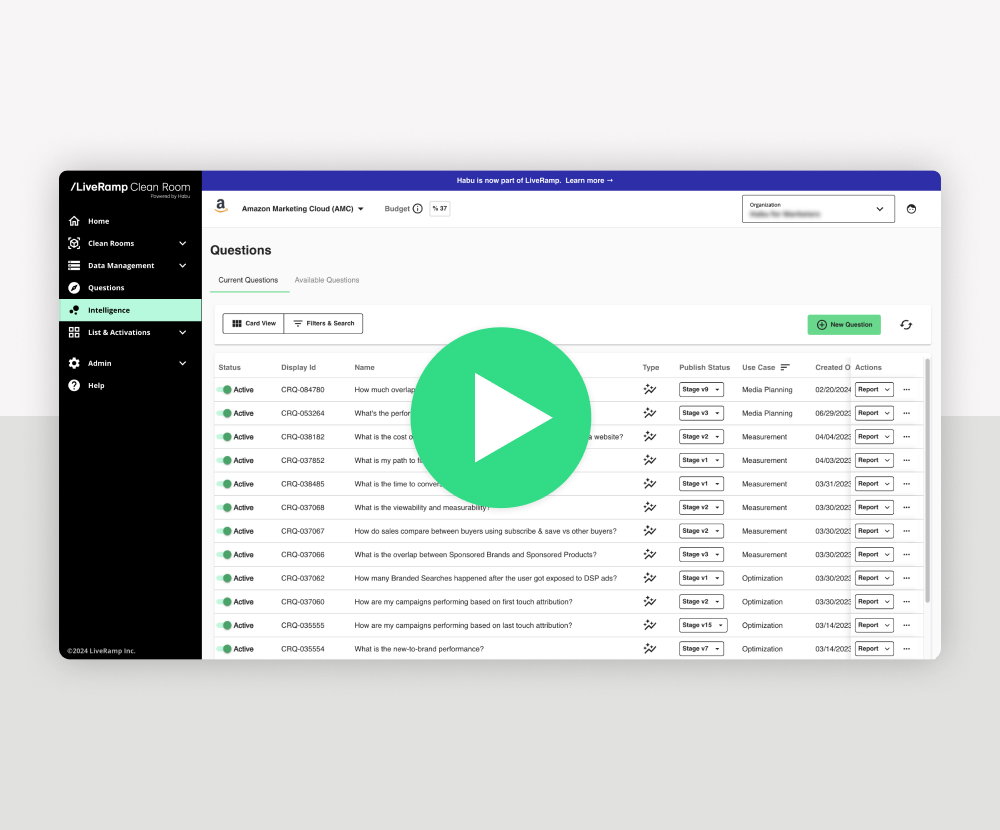
Demo Liveramp's Clean Room
Discover the power of the LiveRamp Clean Room
