

Top Data Clean Room Use Cases for Modern Marketers
.jpg)
The way marketers use data is changing. With evolving regulations, increasing signal loss, and rising consumer expectations around data usage, the need for secure, collaborative environments has never been greater.
Enter the data clean room – a neutral, secure environment where multiple parties can bring data together for analysis and activation, without exposing raw records or compromising personal data.
For marketers across industries, clean rooms make it possible to deepen customer understanding, optimize campaigns, and measure effectiveness to make smarter business decisions.
Key takeaways
- Data clean rooms allow marketers to generate insights from shared data without exposing any party’s personal data.
- Use cases progress from audience overlaps and optimal frequency by campaign to reporting customization, multi-touch attribution, and more advanced machine learning use cases.
- Successful deployments depend on interoperability, actionability, durable identity resolution, and strong governance controls.
What is a data clean room used for?
Clean rooms enable multiple parties like brands, media networks, and advertisers to engage in secure data collaboration. When you enrich your first-party customer data with complementary datasets from partners, you can fill gaps in customer knowledge and build a more accurate, actionable view of your audience.
By design, clean rooms prevent raw data from leaving the protected environment, while still allowing participants to extract insights that inform marketing strategies.
This makes clean rooms a crucial bridge between the responsible use of customer data and the insight-driven demands of modern marketing. Increasingly, they’re also becoming core components of digital transformation strategies, helping organizations move from siloed datasets to responsible collaboration ecosystems.
{{whats-your-measurement-maturity}}
Common data clean room use cases
Clean rooms unlock practical applications for marketers, from building richer audience segments to coordinating cross-channel activations. These use cases give teams the tools to understand what’s working, optimize spend, and build more effective data partnerships.
Audience overlaps
Audience overlap analysis between your brand and a single publisher or retailer visualizes where your audiences intersect. This helps you understand which partners can efficiently reach your priority customers and where you have opportunities to expand reach.
In this analysis, your brand contributes first-party CRM data while the publisher contributes audience exposure data. These datasets are securely matched in your clean room to determine the percentage of individuals that appear in both sets. The clean room provides aggregate-level metrics – such as overlap by attribute, overlap by segment, and overlap index – without exposing underlying personal data to either party.
Optimal frequency by campaign
Optimal frequency analysis helps you understand how often audiences are exposed to your ads and which frequency ranges drive the strongest outcomes. This use case helps you avoid overexposure (wasting impressions) and underexposure (missing conversion opportunities).
In this setup, your brand provides anonymized CRM data, while the publisher contributes corresponding exposure data showing how many times individuals saw your ads. Clean room analysis maps ad frequency to downstream performance metrics such as clicks, conversions, or revenue. The output often takes the form of frequency distribution charts, conversion rate by exposure count, and calculated saturation and waste ranges.
Media measurement and attribution
Attribution identifies which publishers or platforms drive conversions and the timing between ad exposure and conversion events. This analysis helps you understand which channels are closing the loop with your target audiences.
In this scenario, your brand provides audience conversion data while the publisher contributes exposure data for the same audience. Clean room analysis traces which touchpoint occurred most recently before each conversion event and outputs the share of conversions credited to specific publishers as well as conversion timing (latency) and attribution amount.
For example, DICK’S Sporting Goods leveraged LiveRamp’s cross-screen measurement capabilities to unify campaign tracking across digital, in-store, and app-based channels. This approach provided clear attribution from media investments to onsite conversions and sales, helping DICK’S demonstrate value to brand partners and continuously improve campaign effectiveness.
Reporting customization
Reporting customization moves beyond basic data sharing between a single brand and publisher. Here, you and your clean room partner design tailored queries, filters, and aggregations that serve your brand’s specific needs.
Your brand contributes first-party datasets – such as customer segments, product categories, or conversion events – while your publisher may contribute audience exposure and engagement data. Within the clean room analysis, you now have a more active role in defining exactly how data should be processed, structured, and output. This may involve custom SQL queries, joining multiple data tables, and applying advanced statistical or business logic.
Incrementality
Incrementality analysis determines the true lift a campaign generates – measuring the conversions that were directly caused by your media exposure rather than those that would have happened anyway. Incrementality requires more advanced clean room skills and a deeper understanding of experimental design.
To complete an incrementality analysis, your brand provides anonymized conversion and audience data, while your publisher partner supplies exposure logs and audience identifiers. Inside the clean room, these datasets are combined to create treatment and control groups, either through randomized test design or matched audience methodologies. The analysis compares conversion rates between exposed and unexposed audiences to isolate the incremental impact of your media.
Multi-touch attribution
Multi-touch attribution (MTA) in a clean room environment evaluates the contribution of each marketing touchpoint across multiple publisher partners, moving beyond single-channel views or last-click attribution to understand the full path to conversion.
In this scenario, your brand provides anonymized conversion data, user identifiers, and transaction details, while multiple publishers contribute exposure data for overlapping audiences. Inside the clean room, these datasets are stitched together to reconstruct full customer journeys across channels and platforms. MTA models – such as linear, time-decay, or position-based – are then applied to distribute credit proportionally among the touchpoints that influenced each conversion.
Customer journey mapping
Customer journey mapping creates a holistic view of how customers progress from initial awareness to conversion and beyond by integrating datasets from your brand and multiple publishers into comprehensive, sequential paths.
Your brand contributes rich first-party data – such as CRM records, transaction histories, loyalty program activity, and digital engagement logs – while publishers provide impression, click, and content consumption data. Within the clean room, these disparate datasets are matched on anonymized identifiers and organized into time-sequenced paths that reveal the order, frequency, and context of touchpoints across channels and partners.
Machine learning enablement and support
Supporting machine learning use cases in a clean room environment demands advanced data collaboration techniques, in which a brand applies sophisticated algorithms to multi-partner datasets to predict outcomes, segment audiences, and/or optimize campaigns in near-real time.
In this scenario, your brand contributes its first-party data – such as detailed transaction histories, product affinities, and engagement patterns – while multiple publishers and partners provide exposure and behavioral datasets. Within the clean room, these inputs are fed into custom or pre-built machine learning models, which may include lookalike audience generation, churn prediction, lifetime value forecasting, or propensity-to-convert scoring. To pursue these analyses, brands must have a strong grasp of statistical modeling and data science techniques, including the ability to design queries, prepare features, and train models within the clean room.
{{clean-room-buyers-guide}}
What makes a clean room use case successful?
While core features like security permissioning and tools to enable regulatory compliance configurations are table stakes for any data clean room, the solutions that drive the most value go further.
Success depends on the ability to connect with a wide partner network, resolve identities accurately across platforms, and activate insights directly within the marketing ecosystem. Data clean room providers that offer this breadth of capabilities are true enablers of business growth and innovation.
Interoperability across cloud and partner ecosystems
Effective clean rooms operate seamlessly across major cloud platforms like GCP, AWS, Azure, and Snowflake, ensuring compatibility with a wide range of data environments. Interoperability with partner systems enables broader collaboration and access to more data sources, amplifying the value of any single clean room deployment.
Wide network scale
A clean room’s value increases exponentially as part of a large and trusted network. Platforms with true network scale connect you to a broad ecosystem of brands, publishers, agencies, and technology partners, making it possible to collaborate with more parties and access a wider variety of datasets. This reach accelerates audience discovery and activation, unlocking better marketing outcomes.
Strong identity resolution capabilities
Accurate customer data matching is foundational to any successful clean room use case. Brands and partners often bring data from a variety of sources, ranging from CRM systems and transaction logs to ad platforms and website interactions. Effective identity resolution allows organizations to link, match, and deduplicate records across these disparate datasets, creating a unified and reliable view of each individual or household.
With native integration of RampID – the industry's most durable, interoperable, and secure identifier – the LiveRamp Clean Room delivers activation to more than 350 destinations and enables unified measurement across fragmented identity systems.
Actionability and data activation
Some clean rooms only provide data analysis capabilities. But to generate real value, you need a provider that enables direct activation of insights across all relevant marketing destinations. Users should be able to move from audience discovery and modeling within the clean room to real-world execution everywhere consumers spend time without complex workflows.
Breadth of use cases
A flexible clean room should support a wide range of use cases, from audience analytics and overlap analysis to incrementality testing, attribution, and cross-channel activation. The more use cases supported, the more strategic value the clean room delivers to your business.
Built-in governance
Maintaining clean room security requires strong access controls over who can see and use specific data elements. The ability to set permissions at the row, column, or field level (customized for each partner and use case) ensures that sensitive information remains protected and is only accessible to authorized parties. This level of precision not only enables collaboration partners to support data governance practices set by regulations – as well as internal policies – but also fosters trust and flexibility in complex, multi-stakeholder collaborations to help brands and publishers use data only for its intended purposes.
Flexibility and ease of use for business and technical teams
Clean room solutions that prioritize flexibility and intuitive design for both technical experts and business stakeholders stand out from the crowd. For technical users, advanced clean rooms provide centralized data management, granular security controls, and auditability that simplify governance and integration. Meanwhile, business users benefit from self-serve features and streamlined workflows that let them analyze and activate data without heavy reliance on IT. This balance lightens the support load for technical teams, speeds up adoption, and empowers both groups to collaborate more effectively.
Data collaboration works best when it's built on responsible data practices. Learn more about LiveRamp's approach to data ethics and privacy.
Bring your use case to life with the LiveRamp Clean Room
The right data clean room can turn your most ambitious marketing ideas into measurable results.
The LiveRamp Clean Room is built to handle advanced data collaboration use cases securely and at scale. With industry-leading interoperability, identity resolution, actionability, and built-in governance, LiveRamp empowers both business and technical teams to innovate with confidence and deliver results.
Explore how your organization can maximize the value of your data to accelerate marketing results by bringing your most ambitious clean room use cases to life with LiveRamp.
{{demo-liveramp-clean-room}}
Clean room use case FAQs
As clean rooms become an essential part of the modern marketing technology stack, many marketers have questions about how these environments work and where they add value. Below are answers to some of the most frequently asked questions about clean room use cases and implementation.
What’s the most common use case for data clean rooms?
Audience overlaps and measurement are the most common uses for data clean rooms. These use cases help brands improve targeting and measure campaign effectiveness while ensuring each party’s privacy and governance controls are enforced.
Can clean rooms help brands collaborate with retail media partners?
Yes, clean rooms are purpose-built to facilitate secure collaboration between brands and retail media partners. Retailers, publishers, and CPG brands can unify purchase and engagement data, enabling smarter campaign planning and performance measurement across retail media networks. This model also unlocks new avenues for monetizing first-party data since partners can gain insights and activate audiences under strict usage terms.
Pinterest’s partnership with Albertsons Media Collective shows this approach in action. Using the LiveRamp Clean Room, they connected ad exposure data with sales data to enable closed-loop reporting, delivering a 16% lift in sales and units and a 19% lift in buyers for a Triscuit campaign with Mondelez International.
How do I know if a clean room is right for my vertical?
If your industry relies on rich customer data, needs to collaborate on data with partners, or faces strict regulatory requirements, a clean room can likely support your objectives. From retail and financial services to healthcare and media, clean rooms are widely adopted across sectors.
Is data activation part of clean room use cases?
Yes. Leading clean rooms, including LiveRamp’s, enable you to activate to hundreds of partners directly from the clean room environment, turning analysis into action.
Can I use a clean room without moving my data?
Yes, the LiveRamp Clean Room supports federated analysis, allowing you to keep data in its original location while still enabling secure collaboration and analytics. However, not all clean rooms offer this capability. Some require data to be copied or moved into a central environment for processing. Be sure to evaluate your options based on your organization’s data residency requirements and collaboration needs.
How do clean rooms support privacy and governance controls?
Data clean rooms provide a secure environment for collaboration and analysis while enabling collaboration to adhere to each party’s privacy and governance controls, offering configurations that automate data protection.
How do I get started with the LiveRamp Clean Room?
Getting started is easy. LiveRamp’s Quick Start Media Insights provides ready-to-use media intelligence packages for use cases like audience overlaps, optimal frequency, and last-touch attribution metrics across premium publishers.
Want to dig in deeper? Take a self-guided demo of the LiveRamp Clean Room to explore how it can support your specific use cases.
What's your measurement maturity?
Take our quick assessment to see where you stand & how to improve.
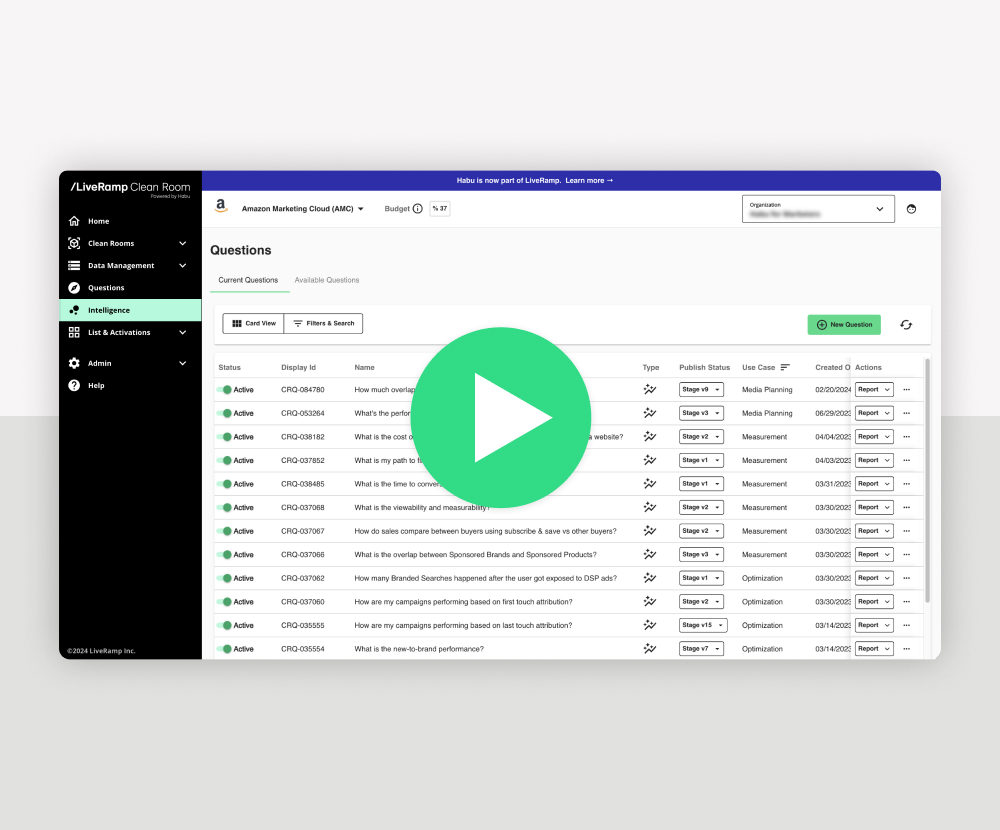
Demo Liveramp's Clean Room
Discover the power of the LiveRamp Clean Room
Clean Room Buyer's Guide
Find the right clean room partner to unlock insights, optimize performance, and prove real value.