

What Is a Data Marketplace?
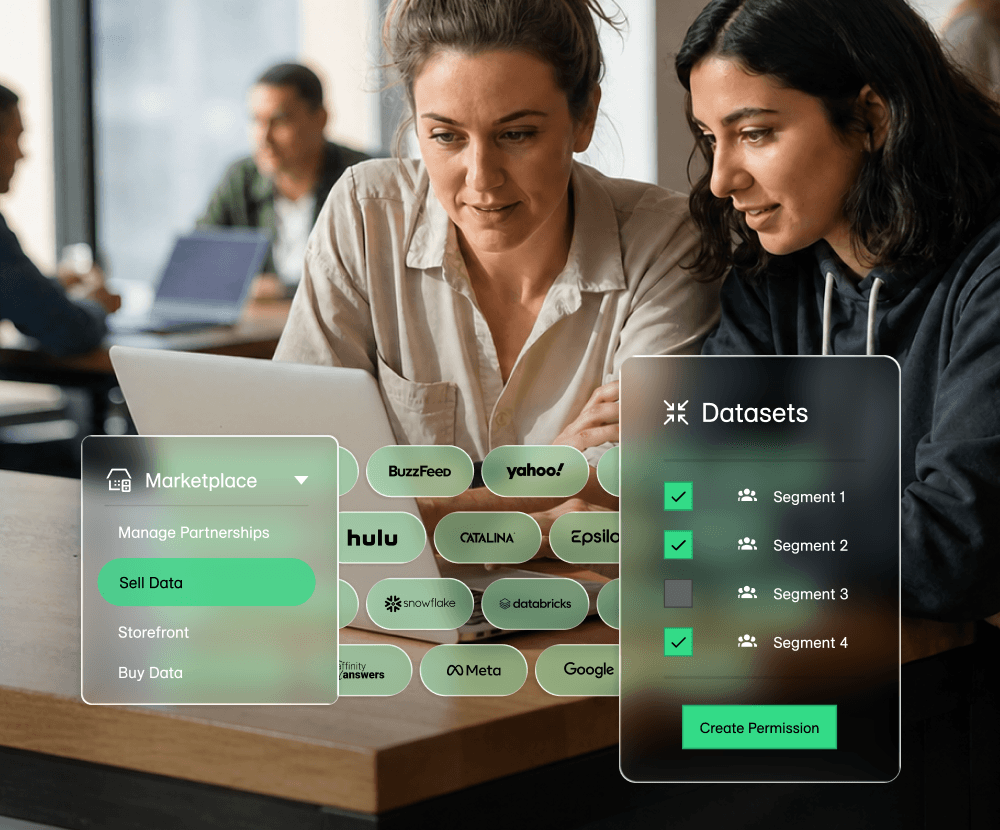
No matter how much first-party data you have, you’ll never see the whole customer picture on your own – and if you’re sitting on data other companies need, you’re leaving revenue on the table by keeping it to yourself. A data marketplace bridges that gap: a platform where companies buy, sell, and license audience segments defined by available demographic attributes, behavioral signals, and purchase intent with governance controls that keep every party in charge of their data.
This guide breaks down how a data marketplace works, how it compares to data exchanges and data catalogs, and what to look for in a platform worth investing in.
Key takeaways
- A data marketplace connects data sellers and buyers through a curated catalog of audience segments defined by user attributes,behavioral signals and purchase with built-in governance that manages access and terms.
- Marketers use data marketplaces to extend reach beyond their own first-party audiences, enrich customer profiles with signals they do not have, and improve the precision of lookalike models and measurement.
- Data owners use marketplaces to monetize proprietary data at scale – turning transaction histories, engagement signals, and behavioral insights into recurring revenue without losing control of the underlying assets.
- Not all data marketplaces are created equal. Neutrality, activation breadth, segment transparency, and governance quality all vary, and those differences determine the value you actually get.
What is a data marketplace?
A data marketplace is a centralized platform where data sellers list curated datasets as segments. In these platforms, buyers discover, evaluate, and activate those datasets. In marketing, what changes most often are audience segments, consumer attributes, transaction signals, geographic data, and behavioral indicators – the building blocks of campaigns, measurement, and personalization.
Every data marketplace has four core components:
- Sellers – the retailers, publishers, and measurement firms that package and list their audiences.
- Buyers – the brands, agencies, and advertisers activating and licensing that data to fuel campaigns.
- Discovery – the searchable catalog where buyers browse available segments by category, geography, methodology, or audience size.
- Governance – the permissioning controls that determine who can access what, under which terms, and for which purposes.
That governance layer separates a responsible marketplace from a simple file transfer or a one-off data share. Without it, every transaction requires a bespoke contract or a leap of faith. With it, data moves at scale between parties who may never have worked together, under terms both sides can trust.
How a data marketplace works
The data marketplace experience looks different depending on which side of the transaction you sit on.
For the buyer
It starts with a question: who are you trying to reach, and what do you know about them today? A demand generation marketer planning a CTV campaign for an auto brand, for example, might need to reach households actively researching SUVs in three metro areas. Her first-party data tells her who already owns the brand. The marketplace fills in the rest.
She searches the catalog, filters by in-market auto segments, reviews the methodology and recency of each option, and selects the segment that fits. From there, she pushes it directly into her DSP, a streaming platform like Netflix, or a media network for activation – or into an analytics environment for enrichment and measurement.
For the seller
A national retailer sits on years of transaction data – purchase frequency, basket composition, category affinities – that brands would pay to access. But building and managing individual partnerships with every potential buyer is slow and hard to scale.
A marketplace changes what’s possible. The retailer packages its first-party data into audience segments, sets pricing and usage terms, and lists them in the catalog. Governance controls let the seller decide exactly who can access each segment, what use cases are permitted, and whether the data can be combined with other sources.
Data Marketplace vs. Data exchange vs. Data catalog
"Data exchange" and "data catalog" often come up alongside "data marketplace," but they describe different things. A data exchange connects a smaller number of known parties for bilateral sharing under negotiated terms, without the curated catalog or standardized marketplace. A data catalog is entirely internal: it helps teams find and govern data they already own, with no commercial or external component.
What marketers gain from tapping into an audience data marketplace
First-party data tells you about the customers you already know, but you need to reach a bigger audience to fuel growth. With traditional audience signals fading, and an increasingly fragmented customer journey, even well-resourced teams struggle to keep a complete picture. A data marketplace is how modern marketers close that gap.
Go beyond your own audience. Your loyalty file and CRM represent known customers. Marketplace segments let you reach qualified prospects who look like your best buyers but have never interacted with your brand. Whirlpool, for example, used LiveRamp to build lookalike audiences from KitchenAid's connected first-party data – reaching five times more shoppers without cannibalizing existing sales.
Layer in attributes you do not collect. You may know what customers buy from you, but not what they buy from a partner, their streaming habits, or whether they are in-market for a related category. Data enrichment through a marketplace adds those dimensions to existing profiles, which sharpens your segmentation and personalization efforts.
Find buyers closer to a decision. Transaction-level and behavioral signals available through marketplace data can surface consumers who are actively shopping your category right now – not six months ago. That kind of recency turns broad awareness campaigns into something closer to intent-driven spend.
Strengthen your modeling inputs. To take lookalike modeling to the next level, you can start by enriching your first-party data with behavioral, available demographic segments, and other signals from trusted third-party providers. This sets you up to produce higher-performing segments and surface audiences your own data would never have surfaced.
Picture a quick-service restaurant chain: It has strong app loyalty data but limited visibility into the broader dining market. By leveraging behavioral and location-based segments through a data marketplace, the brand can identify audiences likely to dine out frequently at competitors, reaching them with relevant offers on CTV and programmatic, and measure the resulting lift in store visits. Without a months-long negotiation.
The applications extend well beyond retail. The American Cancer Society used marketplace data to enrich its first-party donor data, expanding its addressable audience and boosting acquisition ROI through data collaboration – results that wouldn't have been possible with its existing donor records alone.
What data owners gain from a data marketplace
Most retailers, publishers, financial services companies, and measurement providers are sitting on valuable first-party data. A marketplace is the fastest path to turning that data into a revenue line, without building and managing buyer relationships one at a time.
The economics are straightforward: package your proprietary data into audience segments, list them where buyers are already looking, and earn revenue every time someone targets a segment for activation or analytics. Data monetization platforms handle the distribution mechanics.
But the revenue pitch is only half the conversation. The harder questions are about control.
- Will my data be resold without my knowledge? In a well-governed marketplace, no. You set the terms at the segment level – who can buy, what use cases are permitted, whether combining with other sources is allowed. Data sellers retain that authority, and the marketplace supports it. Look for a marketplace that supports those terms for you.
- Will I know what is actually happening with my data once it is out there? That depends on the platform. The right data marketplace gives you visibility into which segments buyers are activating at scale, and where demand is growing. That reporting is what turns a static catalog into an optimized data product strategy.
- Is the distribution actually broad enough to be worth it? This question separates marketplace distribution from glorified file sharing. Your segments need to be discoverable by the brands and agencies that will actually use them, and those buyers need to be able to push the data directly into the DSPs, media networks, and analytics environments where they spend. If the marketplace can’t connect to those workflows, the revenue ceiling is low.
5 questions to ask while evaluating a data marketplace
If you're comparing data marketplace platforms – as a buyer sourcing third-party segments or a seller choosing where to distribute – these are the criteria that matter most.
1. Does the marketplace have a stake in which data you choose?
Ask this one early. A marketplace that has its own data to monetize has a reason to surface it ahead of everyone else’s – which buries good segments for sellers and narrows the choice for buyers. A neutral marketplace has no horse in the race, so the best data for the job is the data you find.
2. Where can the data actually go?
A segment you cannot activate is a segment you paid for and did nothing with. The enterprise data marketplace you choose should connect to hundreds of activation destinations: programmatic platforms (such as DSPs and SSPs), streaming and CTV, media networks, and commerce media environments. The broader that footprint, the more use cases your data investment supports.
3. Can you see how the segments are built?
Before activating anything, you should know the methodology behind it – how the segment was constructed, when it was last refreshed, how large the addressable audience is, and what data sources feed it. That transparency gives buyers confidence and rewards sellers who invest in quality.
4. How granular are the governance controls?
Data governance is where consumer trust lives. Both sides of the transaction need nuanced controls: permissions by use case, by buyer, by data combination rules, and enabling compliance across evolving regulatory requirements.
5. How many ways can you put the marketplace’s data to work?
Activation is the primary use case for most buyers. However, a data marketplace can also help you sharpen a lookalike model, close gaps in measurement, or enrich profiles in your own analytics environment. Look for one that delivers on multiple fronts – into your media destinations and into the environments where your team does its analysis.
Where the LiveRamp Data Marketplace fits
The LiveRamp Data Marketplace is a neutral platform – LiveRamp connects you with more than 200 trusted third-party data sellers with more than 800K+ curated segments spanning across behavioral, geographic, transaction-level, and CTV audience data, with activation across 600+ destinations. It’s part of the LiveRamp data collaboration network, the partner of choice for 900+ brands and platforms, including 400+ brand customers such as 20 of the 25 largest US advertisers and 30% of the Fortune 500.
{{data-marketplace-demo}}
Frequently Asked Questions
What is a data marketplace?
A data marketplace is a commercial platform where organizations buy, sell, and activate curated datasets – typically audience segments, available demographic attributes, and behavioral signals used in marketing. It brings together multiple sellers and buyers in a centralized catalog with governance controls that manage access, permissioning, and usage terms.
What is an example of a data marketplace?
The LiveRamp Data Marketplace connects brands and agencies with 200+ trusted data sellers and 800K+ audience segments spanning behavioral, geographic, transaction-level, CTV data and more. Buyers can activate segments across 600+ destinations, including DSPs, SSPs, streaming platforms, and media networks.
How do data marketplaces enable data monetization?
They give data owners a scalable distribution channel. Retailers, publishers, and financial services companies package proprietary first-party data into audience segments, list them in the marketplace with defined pricing and usage terms, and earn revenue each time a buyer activates a segment for campaign activation or analytics. It also enables data sellers the opportunity to aggregate and package data for activation.
What is the difference between a data catalog and a data marketplace?
A data catalog is an internal tool for discovering, permissioning, and governing datasets within a single organization. A data marketplace is an external, commercial platform where multiple sellers list data and multiple buyers activate it. One is about internal accessibility; the other is about external distribution and revenue.
How much does data on a data marketplace cost?
It varies by data type, use case, and pricing model. Common structures include cost-per-thousand (CPM) pricing for audience activation or percent of media and flat licensing fees for analytics. Many data marketplace platforms also support custom segment builds with pricing negotiated around specific campaign requirements. LiveRamp offers flexible pricing for its data marketplace.
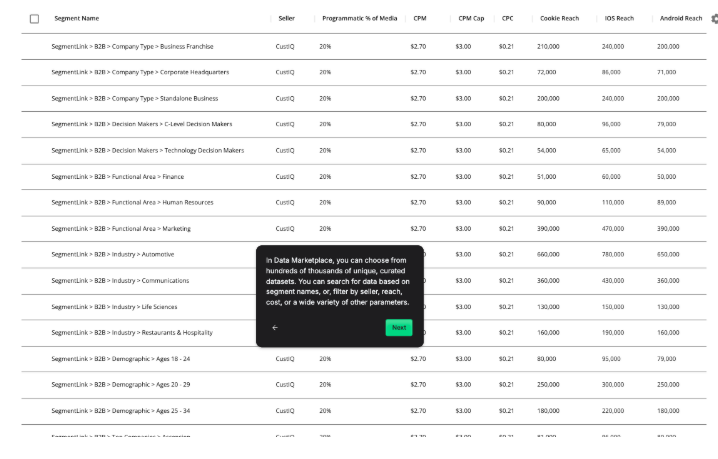
Data Marketplace Demo
Explore our interactive demo to see the power of data marketplace in action.