

Data Clean Rooms vs. CDPs: How They Work Together
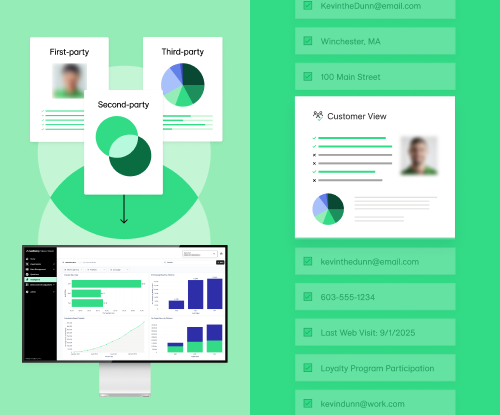
Data clean rooms vs CDPs: Both technologies play essential roles in modern data collaboration, but they serve distinct purposes. Understanding how customer data platforms (CDPs) and data clean rooms (DCRs) complement each other can help you unlock deeper customer insights, improve media performance, and collaborate responsibly across your partner ecosystem.
Key takeaways
- CDPs and clean rooms are complementary technologies, with CDPs powering internal activation and clean rooms unlocking external collaboration. Ideally, they work together to give marketers a more holistic way to collaborate.
- CDPs organize and activate first-party customer data for lifecycle marketing, personalization, and engagement across owned and paid channels.
- Data clean rooms provide secure collaboration spanning first-, second-, and third-party data with partners, publishers, and platforms to generate insights and measure campaign performance without exposing raw data.
- Identity resolution and interoperable connectivity are essential to bridging CDPs and clean rooms – unlocking consistent measurement, orchestration, and secure data collaboration across your ecosystem.
{{identity-explainer}}
How CDPs fit into a modern data strategy
A customer data platform (CDP) serves as the central repository for your organization’s first-party customer data. CDPs collect information from multiple sources – websites, mobile apps, CRM systems, point-of-sale transactions, and more – then distill that data into comprehensive customer profiles. This unified view enables marketers to orchestrate personalized experiences across email, paid media, websites, and other touchpoints.
Within the broader martech ecosystem, CDPs are strongest at activating known customer data for engagement and personalization. They help marketing teams manage segmentation, coordinate cross-channel campaigns, and improve customer experiences. However, CDPs weren’t designed for external data collaboration. When brands need to measure campaign exposure with a media partner or analyze overlapping audiences with a retailer, they need a different tool – one built for secure, multi-party analytics.
However, first-party data alone has its limits. No matter how much data you have on your own, you’ll never have a complete data set without collaboration. A more complete data story comes from a robust identity resolution layer and enrichment from trusted second and third-party partners. A connected customer view allows teams to deliver relevant, timely messages throughout the customer lifecycle.
Extending beyond first-party data
While CDPs excel at organizing first-party data, relying solely on this internal view inherently limits both reach and insight.
To complete the data story, truly, brands must extend their first-party data with trusted second- and third-party data signals. A data collaboration platform and its robust identity layer are crucial for enabling secure access to this wider ecosystem of partners, publishers, and platforms. By connecting to second- and third-party data, organizations can find net-new customers, expand their reach, and significantly improve identity match rates, turning this capability into a key differentiator for measurement and activation across all channels.
How data clean rooms fit into a modern data strategy
A data clean room is a secure environment that enables multiple parties to collaborate with data responsibly to unlock customer insights. Clean rooms provide the privacy and governance controls agreed upon by collaboration partners in order to enforce trust boundaries, ensure auditability, and prevent misuse of data.
Unlike CDPs, which manage data within a single organization, clean rooms empower partners to collaborate – so brands, publishers, platforms, and retailers can generate shared insights while each party maintains control over their own data.
A robust system of roles and permissions defines who can access data, which analyses participants can run, and what results they can see. Granular controls enable companies to collaborate responsibly with customer data.
Clean rooms unlock collaboration you can’t achieve otherwise – expanding both reach and insight. (Note: In this context, "reach" refers to the purview of your consumer knowledge – expanding your data universe by connecting with partners to discover net-new audiences, rather than just campaign ad reach).
Measure campaign performance against a publisher’s audience, quantify purchase lift with retail partners, or analyze audience overlap with streaming platforms, all while keeping each party’s raw data secure.
Identity and reach: the bridge between CDPs and DCRs
The connective tissue that makes this integration work is identity. Without a consistent identity framework that spans your CDP, your clean room environments, and your activation platforms, data remains fragmented and measurement suffers. Investing in enterprise-grade identity resolution and interoperable reach positions you to unlock the full value of both technologies – now and as the ecosystem evolves.
CDPs vs. DCRs: Key differences
While both CDPs and data clean rooms work with customer data, they serve fundamentally different purposes in your data strategy. Understanding these distinctions helps you deploy each technology where it delivers the most value.
- CDPs are designed strictly as orchestration and activation tools for customer engagement. Standard CDPs are not built for in-platform measurement or advanced insights. Instead, they unify your first-party data to power personalization, segmentation, and cross-channel campaign orchestration.
- Clean rooms are built for secure collaboration and analytics across organizations. They enable brands to analyze permissioned datasets with partners to generate insights, measure performance, and inform media strategies.
Data sources
- CDPs rely on first-party data collected from your owned touchpoints – website interactions, app usage, purchases, email engagement, and loyalty programs.
- Clean rooms can incorporate first-, second-, and third-party data in a secure and compliant way. By bringing together datasets from multiple parties, clean rooms unlock insights that neither organization could generate independently.
Sharing and collaboration
- CDPs are internal systems. They consolidate first-party data data across your organization’s departments and systems, making customer information accessible to marketing, analytics, and customer service teams.
- Clean rooms make external collaboration possible without exposing raw data. Each party contributes relevant data to a shared environment, runs approved queries, and receives aggregated results – maintaining control over their data throughout the process.
Taking action from insights
- CDPs can support real-time or near-real-time activation. When a customer abandons a cart, the CDP can trigger an email. When a segment qualifies for a campaign, the CDP can push that audience to your DSP.
- Clean rooms focus on secure analysis and measurement, but some enable activation as well. They power audience creation, partner-based targeting, and campaign optimization based on observed outcomes like exposure, purchase lift, or overlap. While activation isn’t typically real-time, clean rooms make it possible to turn collaborative insights into action across partners without exposing raw data.
Privacy and governance
- CDPs include access controls, consent management, and data governance features to help organizations manage first-party data responsibly.
- Clean rooms add another layer of protection by using secure technologies such as differential privacy, secure multi-party computation, and controlled query outputs. These techniques are designed to help companies maintain any policies they have in place, and prevent access to individual-level records by returning only aggregated results. Learn more about strategies and how clean rooms work in our interactive guide.
How CDPs and data clean rooms work together
Forward-thinking marketers deploy CDPs and data clean rooms as complementary layers in an integrated data strategy. Each technology amplifies the value of the other.
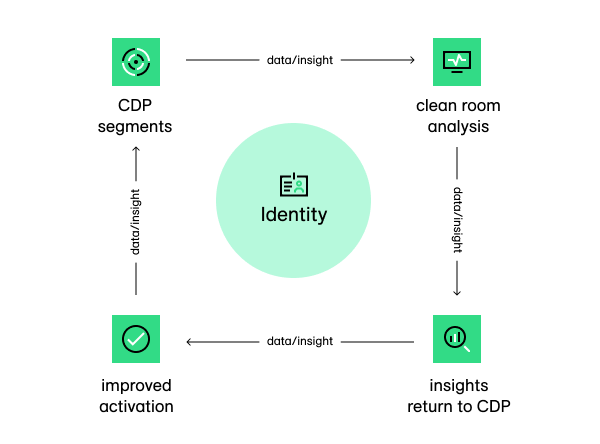
CDPs drive engagement; clean rooms power collaboration
Your CDP activates known customers across owned and paid channels – delivering personalized emails, tailoring website experiences, and pushing segments to media platforms. Clean rooms extend your reach by enabling collaboration with partners who can help you find new audiences, measure incremental lift, or understand cross-channel exposure. Together, these technologies cover the full spectrum from internal activation to external partnership.
Closed-loop insights feed CDP intelligence
Clean rooms generate valuable insights about campaign performance, audience behavior, and purchase outcomes. When you feed these insights back into your CDP, you can improve segmentation strategies, refine personalization logic, and optimize media allocation. For example, discovering that a particular audience segment converted at higher rates with a retail media partner can inform how you prioritize that segment in future CDP-driven campaigns.
Shared identity unites the ecosystem
A common identity layer is what allows CDPs, clean rooms, and activation platforms to work together more seamlessly. When all parties recognize the same individuals using consistent identifiers, you can orchestrate campaigns, measure outcomes, and close the loop between exposure and conversion. Without a shared identity, data remains siloed and measurement becomes fragmented.
{{interactive-clean-room-guide}}
The real power of combining CDPs and clean rooms emerges when you connect them through a robust identity and activation layer. These techniques are designed to help prevent access to individual‑level records by returning only aggregated results.
Identity resolution across channels
Identity resolution connects online and offline identifiers into persistent, secure IDs that enable accurate matching across touchpoints. When a customer browses on mobile, purchases in-store, and engages with email, identity resolution links those interactions into a unified view. This same identity framework powers matching within clean rooms, allowing brands and partners to understand overlapping audiences and measure cross-channel outcomes without exchanging raw customer files.
Accurate identity resolution also improves the quality of clean room analyses. When records match correctly, you get more reliable insights. When identity breaks down, measurement becomes noisy and optimization decisions rest on shaky foundations. Investing in enterprise-grade identity resolution pays dividends across both your CDP and clean room initiatives.
Interoperability and vendor independence
Modern data strategies require flexibility. Interoperable identity ensures you aren’t locked into a single ecosystem. You can collaborate across clouds, connect with clean room platforms, and activate audiences wherever your customers spend time – all while maintaining consistent identity resolution and measurement.
Interoperability matters for preparing your data strategy for the future. As the ecosystem evolves and new collaboration opportunities emerge, organizations with vendor-independent identity infrastructure can move quickly. Those locked into proprietary systems face friction every time they want to work with a new partner or test a new platform.
Common use cases powered by CDPs and clean rooms
When CDPs and clean rooms work together, they support sophisticated use cases that drive measurable business outcomes.
Retail media collaboration
Consumer brands and retailers collaborate in clean rooms to understand purchase behavior, measure campaign lift, and build high-performing audience segments. The brand’s CDP-generated segments serve as inputs, while the clean room analysis reveals which segments drove the greatest incremental sales. Those insights flow back to the CDP to refine future segmentation and activation strategies. This virtuous cycle helps brands maximize the value of retail media investments.
Omnichannel frequency management
A CDP audience can be shared within a clean room and tied directly to campaign exposure data to identify new insights and optimization opportunities like frequency management. For example, your analysis might reveal that a specific social media campaign overexposed a particular audience segment. You can then suppress that segment from your ongoing campaign tactics, improving efficiency and reducing wasted impressions. The result is a better customer experience and stronger return on ad spend.
Data clean rooms and CDPs are better together
CDPs manage customer profiles and power engagement across your owned and paid channels. Clean rooms enable collaboration and measurement with partners who hold complementary media, consumer, and behavior data. Together, they form a comprehensive system for understanding, reaching, and serving your customers.
Connect CDPs and DCRs with LiveRamp
Data clean rooms and CDPs serve different but complementary roles in modern data strategies. LiveRamp helps bridge these environments through interoperable identity, secure collaboration capabilities, and ecosystem-wide reach. With LiveRamp, you can activate audiences within your CDP, measure outcomes in the LiveRamp clean room, and connect the insights across your partner network – all while maintaining consistent identity resolution and supporting your data governance requirements.
Whether you’re looking to improve cross-media measurement, launch retail media collaborations, or simply connect your existing martech investments, LiveRamp provides the foundation to make it happen.
Frequently asked questions about CDPs and DCRs
What’s the difference between a CDP and a data clean room?
A CDP collects and unifies first-party customer data within your organization, enabling personalization, segmentation, and activation across channels. A data clean room supports secure collaboration between multiple organizations, allowing parties to analyze datasets and measure outcomes without exposing raw customer information. CDPs power internal engagement; clean rooms enable external partnership and measurement.
Can a CDP replace a data clean room?
No. While some CDP vendors offer basic collaboration features, CDPs and clean rooms serve fundamentally different purposes. CDPs are designed to manage your own first-party data and activate campaigns. Clean rooms are purpose-built for secure multi-party collaboration with privacy-enhancing technologies that support controls for each party’s data governance requirements. Organizations seeking sophisticated measurement and partner collaboration capabilities need both technologies working together.
Do I need both a CDP and a data clean room?
For most enterprise marketers building comprehensive data strategies, yes. Your CDP handles your first-party data. Your clean room enables measurement, partner collaboration, and audience analysis that wouldn’t be possible otherwise. The combination creates a closed-loop system where insights from clean room analyses improve your CDP-driven campaigns, and CDP segments inform your clean room collaborations.

Identity Explainer
How to fuel unified customer experiences with connected data
Clean Room Explainer
Strengthen marketing performance, insights, and impact