

8 Steps to Create a First-Party Data Strategy
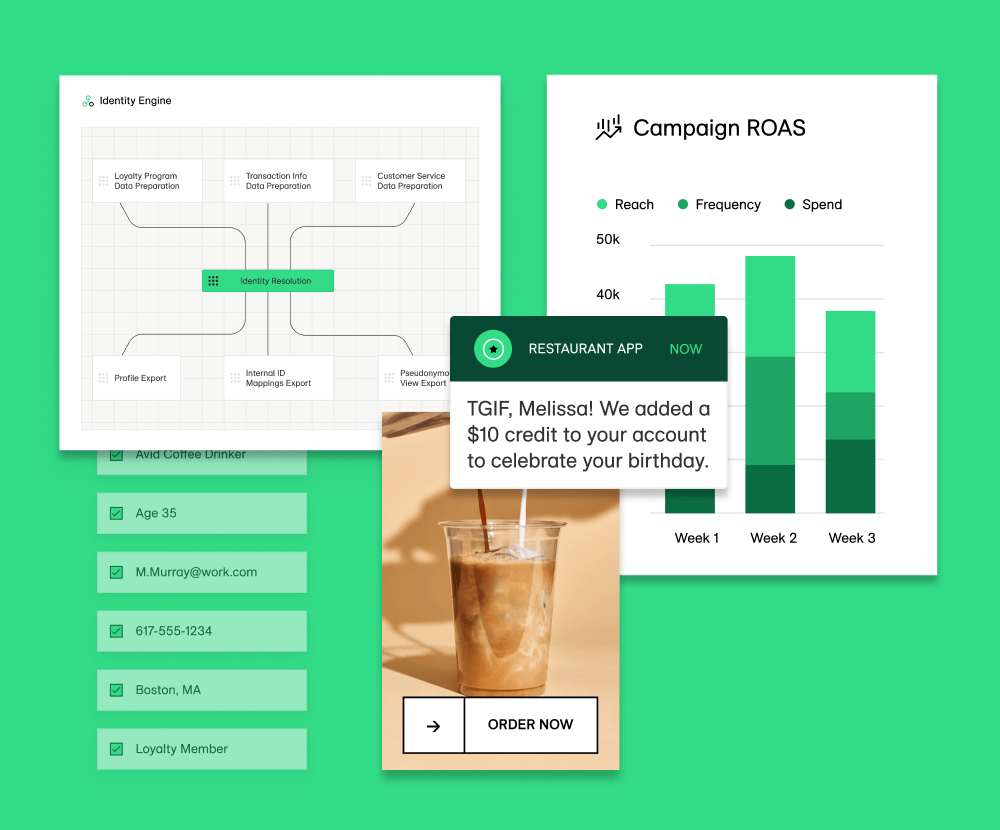
First-party data has always been a foundation for effective marketing – powering personalization, measurement, and customer experiences built on signals that come directly from your audience. In the AI era, that foundation becomes an even sharper competitive differentiator. As publicly available large language models are trained on the same data, the models themselves are being commoditized. The brands that pull ahead will be the ones with proprietary signals that no public model can replicate. That makes building an effective first-party data strategy more urgent than ever.
At RampUp 2026, LiveRamp CEO Scott Howe described the current landscape as a “war for signals” and was direct about the stakes: “In an AI world, data is power and those that control the data will win and those that do not will be captive to the model.” Brands need to mobilize their own unique first-party data – purchase behavior, customer interactions, loyalty signals – to create advantages that competitors cannot replicate.
Your first-party data is the foundation for every AI-powered decision your business will make – from campaign optimization and audience targeting to measurement, personalization, and media mix allocation. This blog walks through the why and how of a first-party data strategy: what it is, why it matters now more than ever, and how to build one step by step.
Key takeaways
- First-party data is your most durable competitive advantage in the AI era – it creates proprietary signal that commoditized public models cannot replicate.
- A unified first-party data strategy breaks down internal silos, threads a common identity through the full funnel, and fuels personalized experiences across every touchpoint.
- Verified transaction data is the most honest signal for training AI models – far more reliable than proxies, clicks, or modeled signals.
- Data collaboration with trusted partners enabled by clean rooms extends the value of your first-party data while maintaining control of it.
What is first-party data?
First-party data is information that customers share through your company’s owned channels, such as your website or app.
This can include browsing behavior and purchase history, in addition to personally identifiable information (PII) like name, email, and phone number. It also includes data stored in your CRM from customer interactions, such as sales inquiries or transcripts from customer service support tickets. Not all of this data carries equal weight.
In the Collaboration Advantage: Serving Consumers Better, Driving Results Faster at RampUp 2026, Mey Wong, Head of Emerging Technology at TurboTax, argued that the opportunity is not accumulating more data – it’s in identifying which deterministic signals are the right ones and making them work together.
Why is first-party data important?
The key to first-party data is its relevancy and trustworthiness. Because it comes straight from the source – your customers – it is highly accurate and yields rich insights into what your audience prefers and how they interact with your brand. This enables you to create more personalized marketing campaigns and customer experiences while protecting customer data.
In the AI era, that accuracy takes on new urgency.
Lauren Griewski, Head of Chase Media Solutions at JPMorganChase, framed it this way in the Collaboration Advantage: Serving Consumers Better, Driving Results Faster at RampUp: “AI is only as good as the signals that we feed it. And so for years in the industry, we’ve made decisions and optimized around proxies and clicks and modeled signals. And the most honest signal is the transaction, the verified transaction."
When AI models are trained on your verified first-party data rather than on proxies, they optimize against real business results and the advantage compounds over time.
Benefits of a first-party data strategy
A first-party data strategy is a plan for collecting, connecting, and resolving all available data about your customers and prospects into enterprise-wide profiles of individuals and entities such as households or small businesses.
For many organizations, this data is spread across siloed systems – your CRM, Customer Data Platform (CDP), point-of-sale (POS), email and SMS platforms, enterprise resource planning (ERP), and contact center data stores.
With a first-party data strategy in place, you can unify these data points, resolve them back to individual customer profiles, and make those profiles available to every line of business across your organization.
In the AI era, that unified profile is also the signal layer your models train on – making the quality of your first-party data strategy inseparable from the quality of your AI-powered decisions. This benefits your company in four ways:
- Deliver cohesive, consistent customer experience
- Access clearer customer insights
- Maximize marketing impact
- Preserve consumer trust
Deliver cohesive, consistent customer experiences
Achieving a unified customer view breaks down internal silos so you can collaborate seamlessly across the enterprise. Activating your data with a consistent identity framework that spans the broadest range of touchpoints is the key to understanding your customer clearly and getting more out of your technology investments.
Once your first-party data is connected internally with an enterprise identity, you can expand the reach of your marketing by activating audience data across the digital ecosystem, including CTV, media networks, social platforms, and new AI surfaces.
You can also create and activate new, high-value audience segments with third-party data partners – serving the right message at the right time across browsers, mobile devices, social platforms, and CTV.
Access clearer customer insights
When you centralize and organize disparate first-party data points, you uncover trends and patterns in customer behavior that would not be visible with incomplete profiles or third-party sources. Over 40% of data analysts say they spend more than half their time preparing data for use in campaigns. A unified first-party data strategy reduces that friction and frees teams to focus on the data-driven insights necessary to compete.
Maximize marketing impact
Your organization needs to keep consumer data current and actionable. Segmenting and activating audiences with first-party data reduces the signal loss built into cookie deprecation while improving accuracy across the entire journey from reach to conversion through to measurement.
Those measurement signals also become the training data for your AI models – the more accurately you measure, the smarter your optimization becomes over time.
Preserve consumer trust
Effective first-party data strategies operate within a framework of mutual value exchange. Customers need to understand your data-handling practices and the benefits they receive in return. Prioritize clear communication and consistently deliver high-quality experiences to foster first-party relationships and brand trust.
First-party data use cases
When properly activated, first-party data becomes the foundation for experiences that drive engagement, conversion, loyalty, and revenue growth across every customer touchpoint.
- Targeted advertising
- Tailored content
- Personalized customer service
- Improved website experiences
- Loyalty programs
- Reduced customer churn
- A/B testing
1. Targeted advertising:
Leverage purchase history, browsing behavior, and engagement patterns to create audience segments that outperform broad demographic targeting and deliver higher conversion rates and improved ROI. Applications include lookalike audience creation, cross-channel retargeting, dynamic product recommendations, and frequency optimization.
2. Tailored content:
Increase engagement and improve conversion performance with personalized homepage content, email messaging, and resource recommendations based on visitor profiles and customer journey stage.
3. Personalized customer service:
Equip service teams with comprehensive customer profiles to resolve issues faster and identify opportunities for deeper engagement through predictive support and proactive outreach.
4. Improved website experiences:
Drive higher conversion rates with dynamic homepage customization, smart search functionality, abandoned cart recovery, and progressive profiling.
5. Loyalty programs:
Transform basic points programs into data-driven engagement platforms with tiered reward structures, behavioral triggers, and personalized reward catalogs.
6. Reduced customer churn:
Use predictive analytics to identify at-risk customers and deploy personalized retention offers, win-back campaigns, and proactive customer success interventions.
7. A/B testing:
Move beyond simple split tests with multivariate testing across customer segments, personalization testing, and long-term impact measurement on customer lifetime value.
How to build a first-party data strategy
Here’s how to develop a comprehensive plan – from data activation across your owned channels to collaboration with trusted partners – that turns your proprietary data into competitive advantage.
- Define your goals
- Determine how to measure success
- Build customer trust
- Gather customer data from across your enterprise
- Ask customers to share data
- Create a customer journey map
- Fill first-party data gaps
- Invest in the right platform
1. Define your goals
A first-party data strategy can support a wide range of marketing and business outcomes. Start by identifying specific, measurable objectives – increasing cart size, improving customer service interactions, driving higher conversion rates – and prioritize key use cases to build on early success. A data strategy is a journey, not a destination, so be prepared to continually optimize.
2. Determine how to measure success
Customer identifiers built on first-party data outperform third-party cookies in advertising effectiveness. Omni Hotels & Resorts improved their advertising effectiveness by four times with signal-less solutions from Google’s Display & Video 360 and LiveRamp. Evaluate how you can show the impact of your first-party strategy on metrics like customer lifetime value, repeat purchase rate, and churn risk.
3. Build customer trust
Help customers feel comfortable sharing their data by establishing clear privacy standards, robust internal data governance, and transparent communication about the direct benefits they receive in return. This transparency builds trust, reinforces value exchange, and encourages more customers to opt in.
4. Gather customer data from across your enterprise
A successful first-party data strategy hinges on the ability to assemble complete and cohesive customer profiles. Identify data silos between lines of business and analyze data layouts to determine how you can unify information. Consider the needs of stakeholders outside of marketing and configure permissioning to set every team up for success – this unlocks additional use cases like product development and supply chain optimization.
5. Ask customers to share data
When you establish complete, cohesive customer profiles across your enterprise, data collection becomes a matter of confirming key PII rather than collecting every data point at every interaction. Opt for methods that integrate seamlessly with customer interactions and are perceived as non-intrusive – such as leveraging transactional interactions for preferences or feedback during the checkout process.
6. Create a customer journey map
Map how customers move from initial awareness to conversion and beyond. By understanding these paths, you can identify touchpoints for collecting data, segment your audience more accurately, and personalize marketing across the entire buying lifecycle.
7. Fill first-party data gaps
Companies implementing first-party data strategies quickly identify gaps in contact data or an over-reliance on one channel. A sound strategy enables you to get the highest ROI from data enrichment efforts such as contact append or attribute append. When your first-party house is in order, match rates with data providers improve and you only buy the data you need.
8. Invest in the right platform
A data collaboration platform is the best option to ensure your data is properly managed, integrated, and protected across departments and data systems. A data collaboration technology partner can help you collect and connect first-party data from across your enterprise, and assign consistent, persistent Enterprise Identifiers to fuel cohesive customer journeys.
Beyond collection: the power of data collaboration
Howe’s RampUp keynote described the current landscape as a “war for signals.” In that environment, your first-party data is the most valuable asset you have – but no single brand has a complete view of its customers on its own.
Data collaboration closes that gap.
By joining your first-party data with trusted partner data in a secure environment, you can unlock insights, audiences, and measurement capabilities that neither party could generate alone. The key is maintaining sovereign control throughout. Those who share data without protection risk being disintermediated. A clean room ensures that your data stays your data – even as it powers shared models and insights.
For brands with robust first-party data, collaboration multiplies its value. For those still building their data assets, the right partners can fill critical gaps in audience understanding and measurement.
Griewski reinforced this approach from Chase’s perspective at RampUp, arguing that verified transaction data should serve as a “transaction spine” for neutral, cross-channel measurement — moving the industry away from fragmented decisions driven by siloed platform data. “Walled gardens see fragments,” she said. “And then that fragmented data creates fragmented decisions. And fragmented decisions create inefficient spend.”
Results in practice
Citi transformed its media and measurement capabilities by threading a common identifier through the full funnel. Starting with basic customer suppression in acquisition campaigns, the team built toward cross-media measurement using clean rooms and custom attribution — achieving a 30% improvement in CPAs over three years.
At RampUp 2026, Kinjal Parikh, Head of Media Sciences at Citi, described the shift: “I think what I consider a big win… is getting to as full or complete a view of the customer as we can. We didn't have that before.” That view of the customer journey — what consumers are exposed to, how they engage across channels, and where they convert — now informs how Citi allocates budget and evaluates media performance for new product launches.
Haleon, CVS, and Reddit partnered to connect contextual community signals (health-related conversations on Reddit) with CVS’s first-party purchase data. Qualitative research revealed that GLP-1 users were already turning to Reddit to find solutions for digestive health side effects – making it a natural environment for Haleon brands like Tums and Advil. By reaching those consumers in an authentic setting and measuring the impact with CVS’s deterministic loyalty data through the LiveRamp Clean Room, the campaign delivered 600% higher unit sales growth than the category and a triple-digit lift in new-to-brand customers. Carolyne Klug, Shopper Engagement Team Lead at Haleon, put it simply: “As a marketer, how you grow – more people, more product. Getting more people to purchase our brands... that new-to-brand stat, that really got me excited.”
Both examples share a common thread: verified, first-party transaction data – activated through identity resolution and protected by clean room technology – produced measurable outcomes that proxies and modeled signals could not.
Develop a first-party data strategy with LiveRamp
In the AI era, your first-party data is not just a marketing input – it’s the proprietary signal layer that determines whether AI works for you or for your competitors. LiveRamp can help you develop a comprehensive consumer data strategy that pairs your first-party data with trusted partner data to unlock deeper customer insights, reach new audiences, and build enduring brand and business value. Talk to one of our experts to learn more.
FAQ
What is first-party data?
First-party data is information that customers give directly to your company through your website, app, or CRM. This includes browsing behavior, purchase history, email addresses, and other personally identifiable information that comes straight from your customer interactions.
What is a first-party data strategy?
A first-party data strategy is a plan for collecting, connecting, and activating all available data about your customers into unified, enterprise-wide profiles. It breaks down data silos, threads a common identity through targeting and measurement, and makes customer insights available to every division across your organization — fueling personalization, media optimization, and AI-powered decisioning. Increasingly, that strategy extends to data collaboration with trusted partners, protected by clean room technology.
What is data activation?
Data activation is the process of putting your first-party data to work across marketing channels — from audience targeting and personalization to measurement and optimization. An effective first-party data strategy ensures that the data you collect doesn’t sit idle in silos but flows into the platforms and partners where it can drive business outcomes.
Why is first-party data important in the AI era?
AI models are only as good as the signals they are trained on. Publicly available LLMs are being commoditized because they all learn from the same data. First-party data — especially verified transaction data — gives your models a proprietary signal layer that competitors cannot replicate, enabling you to optimize against real business outcomes rather than proxies or clicks.