

Beyond the Quick Fix: Why a Data Collaboration Platform Wins the Onboarding Long Game

Every marketing team is under the same pressure. Do more with what you have, move faster, and prove results sooner. In that context, a data activation tool – like a composable customer data platform (CDP) – that promises quick setup with a cheap price tag is hard to ignore.
Who wouldn’t want to believe that you could ship a campaign this week at a fraction of the market price?
Here’s the catch: fast and cheap infrastructure has a way of accruing tech debt and inefficient ad spend.
In data activation, that debt compounds: Identity resolution and accurate reach to intended audiences suffer. Connections across the wider ecosystem stay limited to the identifiers already in your warehouse. Data governance gaps widen. Campaign performance slips a few points at a time – until what you thought was the “cheaper” option ends up costing more in wasted media spend and leaving opportunity on the table. In this case, the old adage “you get what you pay for” couldn’t be more true.
This post unpacks what a sunk-cost approach to data onboarding actually costs over time, and what to look for in a deeper platform that’s built for the long game.
A CDP has some connections. But can it reach the right people?
Accurate reach is the difference that shows up again and again in your campaign performance. A warehouse-native activation tool can only work with the identifiers already sitting in your warehouse. If your CRM holds email addresses and a few hashed IDs, that’s the extent of your reach. There’s no identity graph resolving those signals into a single, interoperable view of each customer across channels, devices, and time.
Without durable identity resolution, the same person looks like three different people on mobile, desktop, and CTV. You pay to reach that one customer three times, and you still can’t tell it’s the same customer. Then, the campaign ends and you try to learn from it but you can’t accurately attribute what worked, so every optimization decision that follows is a little less informed than it should be.
A data collaboration platform with an identity graph built on deterministic signals – real, observed connections rather than probabilistic guesses – produces accurate matching and reach and drives confidence in your ability to target exactly the audience you intended to target. It resolves and refreshes those connections, so you find new, verified touchpoints to match and reach your intended audience.
It's worth being precise about what “resolution” means here, since this gets misrepresented often. LiveRamp doesn't map your first-party data into its graph and drop records that don’t match. Rather, we match every touchpoint in each record against the graph as a reference point and resolve those records to a RampID wherever possible. The more touchpoints you provide on a record, the more confident we can be in resolving a persistent, maintained RampID. However, even just providing an email address often leads to extremely high resolution rates.
If for some reason a particular touchpoint isn’t yet part of our graph, we create a persistent, derived RampID placeholder (rather than dropping the record), so it can still be matched to platforms with that same derived RampID. Contact enrichment can also help fill in missing data from a record. This results in higher reach and matching to additional touchpoints.
Reach only matters when it helps you connect with the right customers. A high match rate tied to the wrong individuals just amplifies waste. That’s why accuracy is the foundation. In an independent Comscore CustomIQ analysis of how LiveRamp resolves data against our identity graph, full PII matched at 99.5% with 97.8% accuracy. With hashed emails alone, LiveRamp was able to match 89.8%. No other identity provider has published third-party validation at this level of accuracy.
Data governance: When a low-cost option carries expensive risk
Consent configurations are a foundational component of customer data. Data governance can't be a manual review step bolted on at the end of activation. It needs to be built into the infrastructure where governance controls are supported throughout the workflow.
Composable CDPs generally aren't designed for that. Many pass data straight from the warehouse to each destination, leaving governance to whatever rules that destination applies. That leaves your team to track which fields went where, under what consent, and for what purpose. One misconfigured sync can send PII somewhere it was never permitted to go, and the savings on platform fees disappear next to the cost of a failed audit or a partner violation.
A data collaboration platform wraps every distribution path with configurable controls and an audit layer, so you stay in control of where your data goes and how it's used – whatever identifier a given destination accepts.
The stakes rise as AI agents take on more of that work. When autonomous agents make real decisions about how data is used, the same data governance practices need to function holistically within your agentic workflows.
What does the “cheaper” option actually cost at scale?
Consider the full picture: what a platform decision costs across a year of operation. That figure is your total value of ownership.
- Lost estimated campaign performance: As a rough estimate, a 10% to 15% drag from reaching people outside your intended audience or from inaccurate attribution against $5 million in annual media spend is $500,000 to $750,000 in avoidable waste.
- Compliance risk: A single governance incident – personal data flowing to a destination without consent configurations, the wrong data used for the wrong purpose, a failed audit, a partner violation – can dwarf whatever you saved on platform fees.
- Unprovable performance: If identity doesn’t persist from activation through measurement, you can’t tie results back to the destinations that matter for your campaign – and next quarter’s budget gets set on incomplete attribution.
None of these line items appears on the original quote. All of them are real, and they compound.
Pricing should be as flexible as your strategy demands. It’s why LiveRamp has designed our model around usage so that teams never pay beyond what they should.
{{liveramp-pricing}}
The data onboarding criteria that matter more than price
Upfront price is only one element in your evaluation. Here’s a better checklist for choosing a data onboarding approach:
- Target accuracy supported by deterministic identity: Does the platform maintain a continuously updated identity graph built on real, observed signals, or is it limited to the identifiers already in your warehouse?
- Comprehensive ecosystem reach: How many of your priority destination integrations – including emerging AI surfaces – come ready to use, and who keeps them working when a partner changes its API?
- Built-in data governance: Can you define and enforce data-use rules at the workflow level, for human operators and AI agents alike?
The right platform is the one where the cost of not having it – in accuracy, reach, and governance – is highest. That’s the number that belongs in your comparison.
The long game is what matters
The question was never whether your team can get started with a cheaper tool. Of course, it can. The question is what you’ll be managing 12 months in, when the integrations need maintenance, when campaign performance has drifted, when an audit asks where your customer data went, and when finance asks why the cheaper option ultimately cost more than projected.
Platforms built for the long game share a few traits: identity depth, ecosystem breadth, and governance built in from day one. These elements keep performance compounding in your favor instead of against you. Get the foundation right and every new channel, partner, and use case gets easier to reach from there.
If you’re earlier in your research, start with what LiveRamp is and how the LiveRamp Data Collaboration Platform could fit your stack.
Frequently asked questions
Is LiveRamp expensive?
LiveRamp’s pricing is determined by the volume of data you utilize and the specific actions performed with it. Starting at an accessible entry point, your investment scales as your usage grows, ensuring you only pay for the value you receive. The best way to evaluate LiveRamp, like any solution, is total value of ownership.
What are the hidden costs of a composable CDP?
The upfront price of a composable CDP rarely reflects the full cost of using one for data onboarding over a year. Common hidden costs include inaccurate match rates without an active identity graph, media waste from weak cross-channel resolution, and governance and compliance risk.
How do I calculate the ROI of a data onboarding approach?
Build the comparison in three parts. Establish your baseline: platform fees plus the internal hours spent keeping integrations alive. Model the delta – what a more accurate match rate recovers when applied to your annual media spend. Then, price the risk you’re carrying today, weighted by likelihood. Together those give you a total value of ownership figure, which is the only number that supports a real platform decision.
What’s the difference between a composable CDP and a data collaboration platform when it comes to data onboarding?
A composable CDP activates data straight from your warehouse and is limited to the identifiers already there. A data collaboration platform adds a robust identity layer – resolving, enriching, and refreshing customer connections across channels and devices – plus a maintained ecosystem of integrations and built-in governance controls. The first is a pipe. The second is an identity foundation that keeps improving.
Does LiveRamp drop records that don't match?
Virtually no records are dropped. LiveRamp resolves your first-party data against its identity graph as a reference point; it doesn’t absorb that data into the graph itself. When a touchpoint isn’t yet part of the graph, LiveRamp assigns a persistent, derived RampID so the record can still be activated and measured, then upgrades it to a maintained RampID as more evidence accumulates.
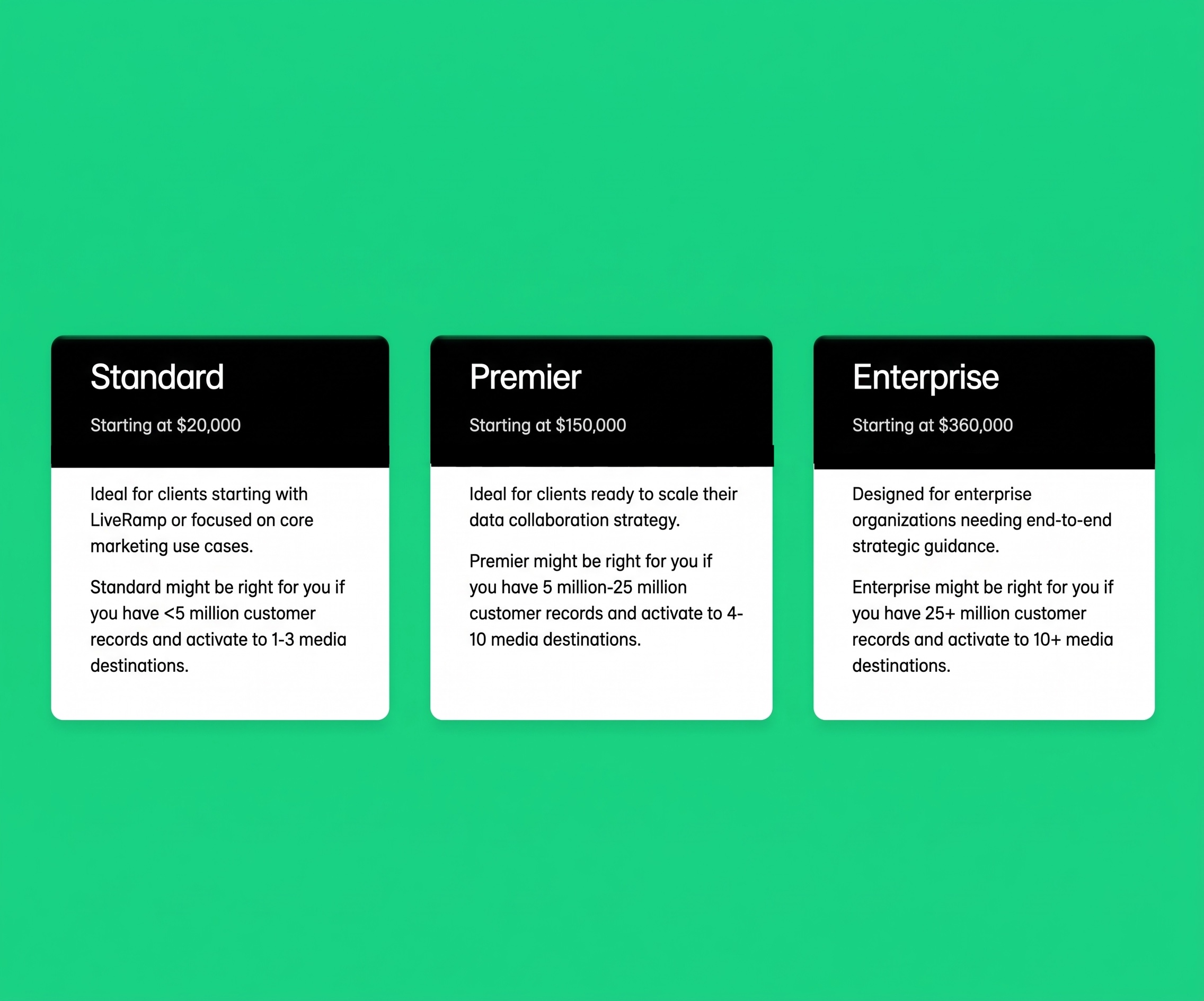
How LiveRamp Pricing Works
Our tiered, consumption-based models makes it easy for you to pay for value and scale on your terms.