

Fewer Pipelines, Fresher Data: Identity Resolution Inside Databricks
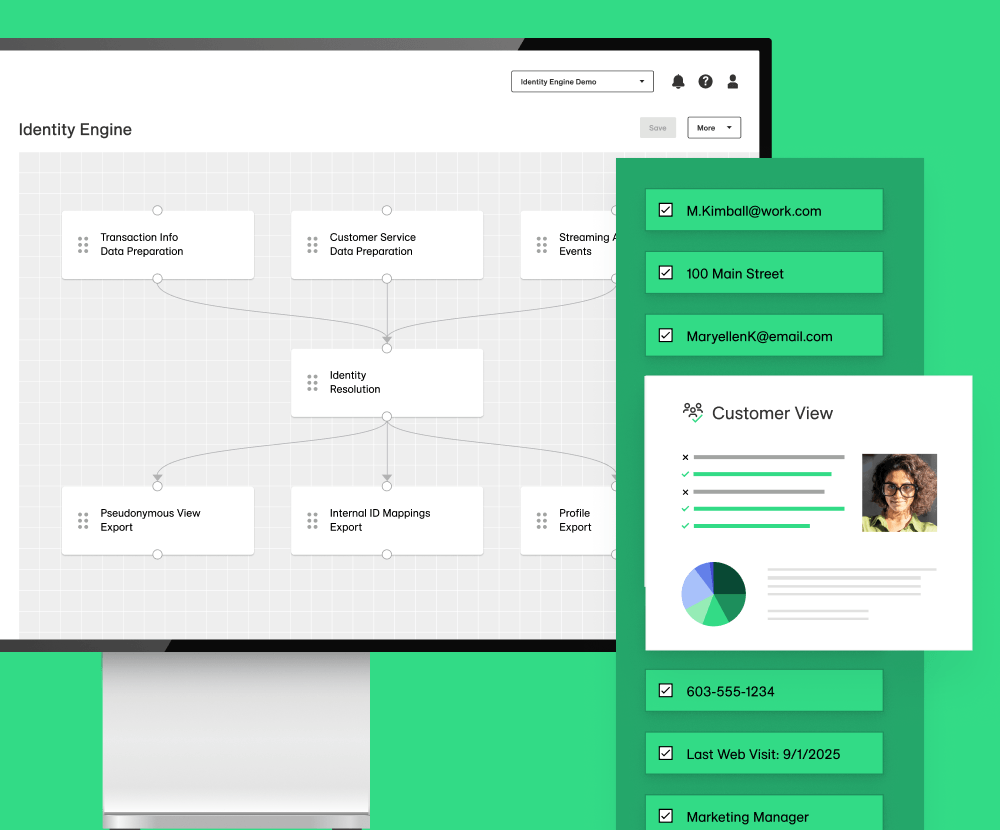
Many enterprise data environments are fractured.
Data teams are rapidly evolving their cloud infrastructure to manage vast and complex data pipelines – from purchase histories to predictive models to customer360. Marketing teams are also becoming increasingly sophisticated in how they leverage data – from building segments to executing media planning to optimizing campaign strategy and performance.
Yet, many marketing and data teams continue to struggle with data quality, accessibility, and actionability. One question sits underneath most of it: Which records belong to the same person?
A marketer asks it before targeting a segment. A data scientist asks it before training a model. A compliance officer verifies it before honoring a deletion request. The question is the same every time. Your architecture decides whether you get a confident answer in minutes or an unreliable one in days.
Customer data platforms (CDPs) solve an important part of the identity equation. They help organize and unify known customer data, and the category is evolving quickly. With Databricks’ recent launch, CustomerLake, they are bringing agentic capabilities to marketers and data teams already working from a governed data foundation.
Inside that shift, identity resolution, advertising connectivity, and measurement matter more than ever. A CDP customer ID works well inside your own walls. Once you need to collaborate with a partner or media platform, you need something that can connect that data without carrying personal information along. That’s where RampID comes in, as a layer on top of your CDP customer IDs. It travels outside your walls tokenized, and it extends the value of the foundation you’ve already built.
LiveRamp is committed to delivering identity capabilities that customers can deploy directly into their cloud data infrastructures. Embedded Identity Resolution allows marketers and data teams to resolve records and fragmented touchpoints to a person-based identifier faster while data remains isolated, governed, and fully in your control.
LiveRamp Embedded Identity comes to Databricks
Databricks and LiveRamp have partnered to help brand marketers, agencies, and data teams build an identity-powered, cloud Data + AI foundation that connects customer intelligence to real-world marketing execution. This joint offering and purpose-built solutions reduce operational complexity while maintaining data integrity and governance.
When LiveRamp Embedded Identity runs natively in Databricks where your data already lives, it becomes a natural extension of how we think identity should work: governed, in place, and immediately usable for downstream workflows.
LiveRamp Embedded Identity is deployed via Databricks Packaged Clean Rooms, with Unity Catalog providing the underlying data governance and access controls. Teams can run identity resolution against their existing records in Databricks and immediately receive matched RampIDs for downstream analytics, partner collaboration, and digital activation.
Here is how it works:
- The customer creates a Databricks Packaged Clean Room
- The customer records are shared using zero-copy access
- LiveRamp's identity graph and resolution capabilities are shared to the clean room through a notebook
- The customer runs the job from their Packaged Clean Room
- Once the job is completed, the resolved RampIDs are written directly back into the customer's Databricks workspace and are available for downstream use
Where teams feel the impact: Efficiency, security, and speed
To minimize data movement, the data stays where it is. Marketing and data teams get to work without waiting on transfers.
- Data operations: There are fewer pipelines to maintain. There is no identity-specific ETL to build or fix, and resolution runs within the Unity Catalog governance you already have.
- A smaller security footprint: Data stays inside your environment, minimizing movement and reducing data exposure.
- Fresher, faster data: Audience modeling, segment building, and measurement workstreams use current records rather than a snapshot from last week.
Once resolved, RampIDs are available immediately in your Databricks workspace. Teams can apply them to the work already underway, including building a more complete customer view, preparing audiences for activation with partners and media platforms, and supporting measurement across channels.
Together, Databricks and LiveRamp give marketers a data foundation for scalable accuracy and performance. Databricks provides a governed environment and intelligence platform where customer data is unified and analyzed. LiveRamp provides the identity layer that connects that data to the broader marketing ecosystem.
Why identity resolution belongs in your cloud now
The way identity has historically worked – exporting customer data to an external service, waiting for a match-back file, and re-importing it – was always a compromise. Today, that compromise is no longer acceptable. Four forces are converging to make native, cloud-based identity resolution urgent:
- AI needs clean, accurate and connected data. Models trained on stale or unlinked records provide unreliable results.
- Signals are shrinking. Cookies and device IDs are fading, and hashed emails are getting harder to defend, through both privacy scrutiny and match rate lens.
- Your data already lives in the cloud. Governance, analytics and AI all run in your cloud environment. Identity should not be the one piece still sitting outside of it.
- Master data depends on it. Teams building a governed view of their customers need a reliable way to decide which records belong together. Without a matching engine in your cloud, that work stalls.
Meanwhile, the legacy export/re-import cycle introduces compounding risk: brittle ETL pipelines, expanded attack surface, and downstream models running on days-old snapshots.
Data teams are building the foundation for AI, privacy governance and collaboration right now. Identity resolution belongs in that foundation. Embedding LiveRamp natively into your cloud infrastructure makes that a reality today.
Next steps
- For builders: Want to see how it works under the hood? Read the companion Databricks post on deploying LiveRamp Embedded Identity.
- For marketers and data leaders: Learn more about LiveRamp identity and how it can work in your cloud environment.