

The Marketer’s
First-Party Data Playbook

How to unlock the most value from your first-party data

Intro: Data is everywhere

Think about every website, platform, and app you visit on an average day. Do you start by reading email promos while drinking your morning coffee? You might click on a sales ad for bathing suits at Target, reminding you that you need to find a birthday gift for your niece’s pool party. So you pop onto Pinterest to search, “best birthday gifts for kids.” While you’re there, you also peruse healthy recipes for dinner. By now, you’ve clicked on at least four links, absorbed in a digital journey through varied interests and tasks — all while still in your pajamas.

The same is true for your customers. Average US households have 21 digital devices, from smartphones to tablets to smart TVs. And the ways we search for information are still evolving. Most of Gen Z, millennials, and Gen X primarily use mobile search, and more than 40% of adults use voice search daily with devices like Amazon Alexa and Google Home.
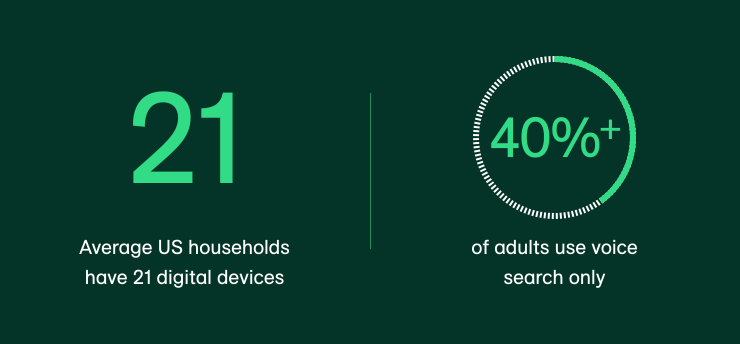
Average US households with 21 digital devices; over 40% adults use voice search functionality daily.

With customers active in so many places, navigating the digital world can feel complex. Not to mention marketers also face increasing privacy regulations, tighter budgets, and the challenges of cookie deprecation and signal loss. The encouraging news is that marketing technology has not only caught up to these challenges, but with the right partner, you can outperform what was ever possible with cookies. But how?

The key lies in reaching customers wherever they are with personalized content precisely when they need it — leveraging first-party data.

Unlock more value from your first-party data

As a marketer, you already know first-party data, or customer records, is critical to your brand’s success. But did you know your first-party data is key to unlocking true business value — from more accurate campaign reach to developing high-impact audiences and segmentation to driving more personalized experiences? You can harness your first-party data with greater efficiency and precision through data activation.

That’s what Eli Lilly achieved when they partnered with LiveRamp.

The pharmaceutical leader wanted to transform its customer experiences by serving patients across their entire health journeys. By connecting its rich, complex library of first-party data, Eli Lilly was able to get a deeper understanding of each patient’s preferences and needs while keeping privacy a top priority. Finding the perfect balance between personalization and privacy is what mattered most to Steve Rommeney, Eli Lilly’s Associate Global VP of Engineering, Platforms, and Capabilities.

“Are we seeing customers the way they want to be seen? If the customer is standing in front of me today, we want to make sure we can pass that test,” he said at RampUp 2024, LiveRamp’s premier marketing and advertising event.

What’s the first step toward making these goals a reality? Start by incorporating first-party data best practices into your advertising strategy.

Steve Rommeney
Associate Global VP of Engineering, Platforms, and Capabilities
Are we seeing customers the way they want to be seen? If the customer is standing in front of me today, we want to make sure we can pass that test.

How to transform your
first-party data strategy

Think about every website, platform, and app you visit on an average day. Do you start by reading email promos while drinking your morning coffee? You might click on a sales ad for bathing suits at Target, reminding you that you need to find a birthday gift for your niece’s pool party. So you pop onto Pinterest to search, “best birthday gifts for kids.” While you’re there, you also peruse healthy recipes for dinner. By now, you’ve clicked on at least four links, absorbed in a digital journey through varied interests and tasks — all while still in your pajamas.

Start by creating clear business goals

Today marketers are challenged to do more with less — average marketing budgets have fallen to a post-pandemic low of 7.7% of company revenue, according to a Gartner survey of CMOs and marketing leaders. Cameron Alverson, Senior Director of Media and Analytics at Living Spaces, knows that as a steward of his team’s marketing budget, he must have goals and partners that help him embrace efficiency.

“The biggest challenge for us when it comes to marketing in the future is figuring out how to be more efficient with the same or fewer dollars,” he said. “LiveRamp is critical for us to understand who is our audience, what is their behavior, and how we can best engage them. That makes us smarter.”

As you re-evaluate your marketing budget and strategies, ask yourself:

  • What are the major business goals you’re aligned to for the next 12, 18, and 24 months?
  • How can marketing drive a critical impact on the success of your organization?
  • What resources and tools does your team need to deliver on these goals?
  • How can you leverage what you know about your customers and prospects to achieve efficiencies with your marketing outreach?
  • How can you leverage this data in new ways?

With clear goals, you’ll have a better understanding of where and how to activate your first-party data, and ultimately, enhance the scale and efficiency of your audiences to avoid media waste.

Cameron Alverson
Senior Director of Media and Analytics
The biggest challenge for us when it comes to marketing in the future is figuring out how to be more efficient with the same or fewer dollars. LiveRamp is critical for us to understand who is our audience, what is their behavior, and how we can best engage them. That makes us smarter.

Connect your organization’s first-party data

No matter how much first-party data your organization has, it’s most valuable when it’s unified in a privacy-minded way. When you connect customer data from across your organization to a consistent identity framework with clear rules that protect consumer privacy, internal data collaboration becomes both accessible and empowering.

NBCUniversal was able to launch more than 3,000 new audiences by linking the organization’s fragmented first-party data to an enterprise identity. The team had deterministic data for 90 million households and 200 million adults, but they wanted to understand their customers on a deeper level, explained Kaitie Coghlan, SVP, Data Product & Partnerships at NBCUniversal. Since connecting the enterprise’s first-party data to an identity framework, the team has unlocked the most accurate, connected view of customers — from viewers of The Office to readers interested in cosmetics to users booking tee times via NBCU’s apps.

“We’re able to create a holistic view of who these households are and the individuals within those households and how they interact with our brand,” Coghlan said at RampUp. “In return, we can serve up customized, unique experiences that keep the consumer coming back, and, of course, drive revenue for our advertisers.”

With a unified first-party data strategy, you can begin to expand your advertising impact and reach by activating your audience data anywhere — from expansive partner networks to integrations, including CTV and top media networks.

What is data activation?

Data activation involves moving data from data warehouses and other siloed storage locations to operational tools that are easily accessible by users and teams across your organization. The goal is to make data not only centrally available but also actionable, empowering teams to make informed decisions in real-time. Learn more.

Kaitie Coghlan
SVP, Data Product & Partnerships
We’re able to create a holistic view of who these households are and the individuals within those households and how they interact with our brand. In return, we can serve up customized, unique experiences that keep the consumer coming back, and, of course, drive revenue for our advertisers.

Analyze your data for new customer trends and opportunities

Once your data is unified across your enterprise and media partners, you have a unique opportunity to uncover trends in customer behavior and preferences. Start by analyzing patterns, such as buying group tendencies, time-specific website engagement, and repeat product purchases. These trends will not only help you identify new audiences for targeting and suppression, but you can begin to strategize how to capture more authenticated customer data — all while building consumer loyalty and trust.

“It’s critical to understand your first-party data insights completely,” Puru Mehta, Global Product Marketing Manager at TikTok, pointed out at RampUp. “Some users may have shown interest, but have long stopped looking at your emails. Some users are just not a good product fit. But if you’re targeting these audiences, you’re spending money yet losing brand value,” he said.

Getting a clear picture of your customers through first-party data is the first step toward enabling targeting and personalization that maximizes ad spend and expanding your audience reach.

Smiling young man with dark hair wearing blue and green plaid button down shirt standing indoors.
Puru Mehta
Global Product Marketing Manager
It’s critical to understand your first-party data insights completely. Some users may have shown interest, but have long stopped looking at your emails. Some users are just not a good product fit. But if you’re targeting these audiences, you’re spending money yet losing brand value.

Expand your audience reach

By combining the power of your first-party data with second- and third-party data from trusted partners, such as LiveRamp’s Data Marketplace, you’ll be able to tap into prospective customers through demographic, behavioral, and transactional data in a privacy-enhanced way, and close the gaps in your customer journey.

Luxury retail brand Saks partnered with LiveRamp and Snowflake to expand campaign reach while keeping their first-party data secure. “Marketing is everything that happens before someone comes to the site,” said Robby Douglas, Director of Marketing Measurement and Acceleration at Saks. “If we’re looking at it just from our customer data, we’re only going to be thinking about it in one silo. As we’re expanding the journey beyond just one point in time, we need to have things easily funnel into our existing cloud and have our customer data in a way that we want it.”

Robby Douglas
Director of Marketing Measurement and Acceleration
Marketing is everything that happens before someone comes to the site. If we’re looking at it just from our customer data, we’re only going to be thinking about it in one silo. As we’re expanding the journey beyond just one point in time, we need to have things easily funnel into our existing cloud and have our customer data in a way that we want it.

Activate and optimize campaigns across all channels

On average, companies rely on 28 disparate data sources to measure campaign performance, making it a challenge for most marketing execs to assess marketing impact. With a first-party data strategy connected to a privacy-centric identity, you can continue to build and optimize campaigns with partners in a flexible, privacy-enhanced way. Erin Foxworthy, Industry Lead, Advertisers and Agencies at Snowflake, said her team works with partners like LiveRamp to help advertisers reconcile customer data across thousands of touchpoints — without ever moving the data outside the customer’s walls.

“We send copies of data to our partners, which is important from a security and governance perspective. Applications like LiveRamp can bring the work to the data, like resolution, segmentation, and measurement,” she said.

Plus, better data connectivity with partners can simplify campaign measurement and deepen ad personalization, serving the right message to customers at the right time. This level of measurement, personalization, and campaign optimization is only possible when silos between first-party data are eliminated, Foxworthy explained. “That’s when we get excited about what the possibilities are,” she said.

Smiling woman with short dark hair and dangling earrings wearing dark blouse, closeup portrait.
Erin Foxworthy
Industry Lead, Advertisers and Agencies
We send copies of data to our partners, which is important from a security and governance perspective. Applications like LiveRamp can bring the work to the data, like resolution, segmentation, and measurement. That’s when we get excited about what the possibilities are.

Evolve your strategy with a data collaboration partner

Your advertising will only deliver the best results if your consumer data strategy evolves. The best, and safest, way to evolve is with a flexible data collaboration partner that can connect your brand to customers — everywhere they are — in meaningful ways.

For example, when Delta Air Lines wanted to personalize flight experiences for almost 200 million travelers, the organization connected and activated its trove of first-party data in the /LiveRamp Data Collaboration Platform. By partnering with LiveRamp, Delta unlocked a clearer customer view and the ability to personalize each trip based on travelers’ preferences — from streaming services to in-app experiences tailored to their schedule, preferences, and journey. Plus, Delta gained a deeper understanding of customers without relying on third-party cookies and mobile identifiers.

Effective data collaboration starts with a trusted partner, said Sarah Honeyman, Managing Director, Engagement & Optimization, Inflight Entertainment and Connectivity at Delta Air Lines. With LiveRamp, Delta’s consumer data strategy grew beyond its first-party data. “As we considered making the journey part of the joy, starting with our first-party data, we asked how can we deliver a meaningful experience for the customer using the data we have on hand? And how do we start to ingest second-party data with our brand partners so we can make the experiences in our onboard products even more relevant?” Honeyman said.

In an industry that thrives on innovation, evolving your data strategies and partnerships isn’t only a must, it’s the most reliable path to long-term business success.

Sarah Honeyman
Managing Director, Engagement & Optimization, Inflight Entertainment and Connectivity
As we considered making the journey part of the joy, starting with our first-party data, we asked how can we deliver a meaningful experience for the customer using the data we have on hand? And how do we start to ingest second-party data with our brand partners so we can make the experiences in our onboard products even more relevant?

Conclusion

You know your company’s first-party data is invaluable. So how can you nurture its value into new, revenue-driving opportunities? By leveraging LiveRamp’s data collaboration platform, you can reach audiences everywhere they are in a privacy-centric way — across browsers, apps, and CTV — at scale across a global network of available platforms and partners. A first-party data strategy, built on privacy and trust, is the key to deeper relationships and more meaningful experiences throughout the customer journey.